


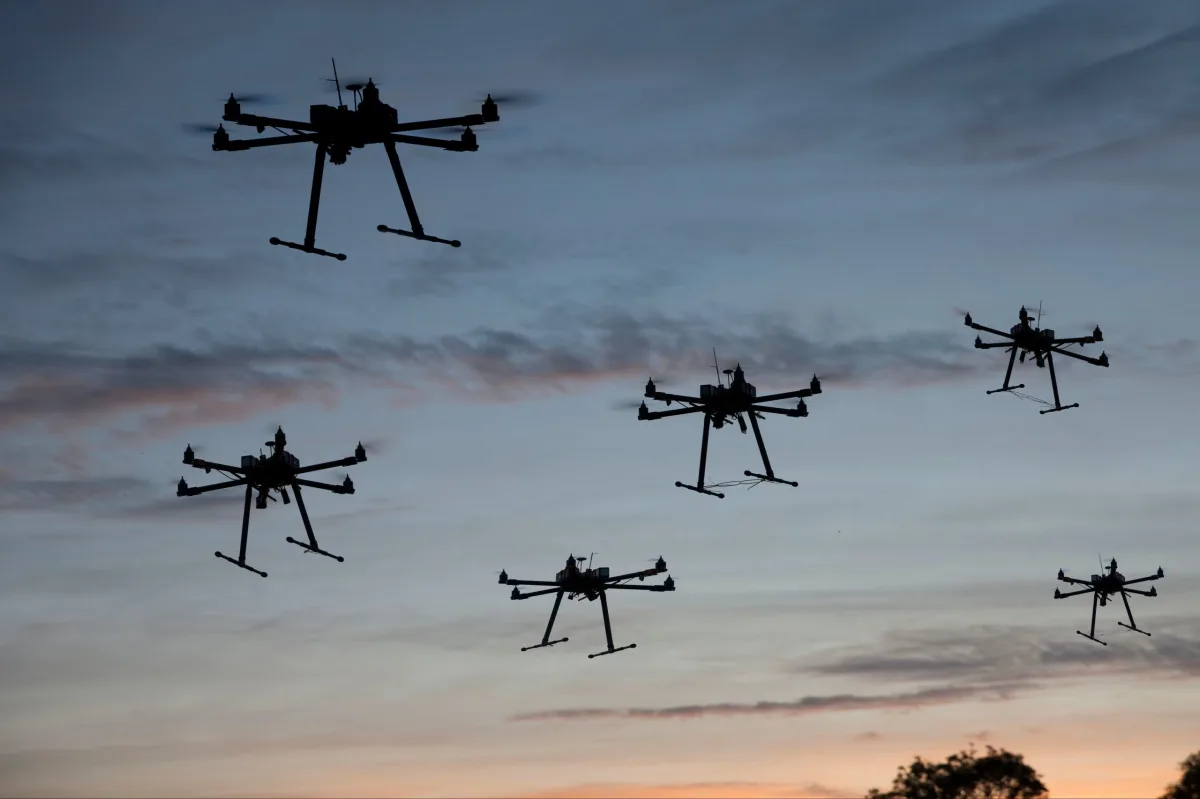

The myth of the absolute technological invulnerability of Western armed forces is wavering under the blows of an unprecedented geopolitical and technological transition. For decades, the Euro-Atlantic axis has based its hegemony and global deterrence capability on expensive, high-tech industrial platforms—stealth systems, fifth-generation fighters, aircraft carriers, and advanced satellite networks. However, the advent of low-cost drones and the commercial spread of Artificial Intelligence are leveling the playing field, allowing minor state adversaries and non-state actors to inflict devastating damage on first-order powers.
The recent conflicts in the Middle East and Ukraine represent the first, bitter taste of this new era of warfare. In the Gulf, the massive traditional air superiority of Western coalition forces did not prevent Tehran from responding with impressive effectiveness: in just 39 days of conflict, Iran saturated the area's defenses by launching more than 2,200 missiles and 4,400 drones. The result? Eight Western aircraft destroyed or severely damaged on the ground (including a $300 million E-3 Sentry radar plane and several refueling aircraft), ground radars knocked out, and the demonstration that bases positioned in the rear are no longer safe havens.
The New Economy of War and Cost Asymmetry
Drones have not only transformed the tactical dynamics on the field but have radically rewritten the economy of conflict. Today, extremely low-cost aerial and naval vectors can neutralize billion-dollar industrial and military assets. The Black Sea scenario is emblematic: Ukraine managed to decimate the Russian Black Sea Fleet using kamikaze drone boats costing just $300,000 each, sinking 13 warships and damaging dozens more.
The entire Western bloc is now on the wrong side of this economic equation. Shooting down a $7,000 Shahed drone with a $4 million Patriot missile represents a "Pyrrhic victory" that drains finances and quickly empties strategic stockpiles. The recent campaign in the Middle East literally drained Western supplies, consuming up to 80% of the advanced missile interceptors in stock in just a few weeks. For European countries like Italy, whose ammunition and air defense system stocks (such as the Samp-T) are historically limited, such an asymmetry of attrition would be fatal in a matter of days.
From Single Tool to "Intelligent Swarm"
The imminent danger to Europe's security lies in the evolutionary leap towards AI-driven autonomy. In Ukraine, drones capable of navigating the last hundred meters to the target in total autonomy if enemy electronic interference interrupts the signal with the pilot, or long-range vectors capable of flying 600 miles without GPS, relying on visual terrain recognition via preloaded satellite maps, are already being tested.
The convergence of these innovations will lead to the birth of "intelligent swarms": thousands of drones capable of autonomously coordinating in real-time to saturate Western air defenses. In this context, traditional European military doctrines based on centralized control become obsolete: robotic swarms will act at a speed and with a dynamism that no human mind or standard hierarchical structure will be able to replicate.
AI Parity and the Illusion of Sanctions
Even on the software front, the West is losing its historical competitive advantage. Although Silicon Valley giants lead the research on Large Language Models, AI is an inherently fluid commercial technology that proliferates rapidly. Today, the reality between the Western bloc and China is one of substantial technological parity.
Through the technique of "adversarial distillation", Chinese companies systematically extract capabilities from cutting-edge Western models by violating their terms of service, training their algorithms at a fraction of the original cost and nullifying the effectiveness of trade blocks on advanced microchips. In the military field, moreover, the difference is not dictated by who develops a tool first, but by which army manages to assimilate, adopt, and mass-produce it before others. And while Ukraine, driven by existential necessity, manages to produce four million drones a year, the entire NATO bloc struggles to purchase just a few tens of thousands a year due to rigid assembly lines and hyper-complex procurement requirements.

The Italian Case: Bureaucracy as a Threat to National Security
In this scenario of radical transformation, Italy represents the weak link and, at the same time, the country that most urgently needs to change course. The historical tendency of European democracies, and of Italy in particular, is to favor "exquisite" platforms: massive, exceptionally expensive, hyper-regulated weapon systems produced in very few units (consider the programs for new fighters or heavy tanks). This industrial philosophy is outdated: modern warfare requires expendable, economical weapons produced on an industrial scale.
The real obstacle for Italy is not the lack of technological excellence or engineering ingenuity, but a suffocating bureaucracy that paralyzes the adoption of innovations. The procurement processes of the Italian Ministry of Defense and public contract regulations take years—sometimes decades—to approve system requirements, allocate funds, conduct tenders, and reach production. In the era of Artificial Intelligence and commercial drones, where the life cycle and obsolescence of software are measured in months, Italian bureaucratic slowness equates to strategic suicide.
While the Pentagon has established monthly commissions to remove bureaucratic obstacles to digitization and impose the rapid sharing of military data, Italy is still trapped in silos, cross-ministerial vetoes, redundant formal checks, and a risk-averse culture that penalizes the adoption of civilian and flexible solutions. If an Italian engineer or startup develops a revolutionary defense algorithm, the process to see it integrated into our Armed Forces systems is so tortuous that these entities often fail or sell abroad.
A Cultural Shift No Longer Postponable
The West cannot stop the proliferation of AI and autonomous technologies. The only defense is speed. For Italy, cutting military and civilian bureaucracy is no longer a matter of administrative efficiency or economic savings, but a categorical imperative of national security.
The country must shift from a cautious and defensive approach in peacetime to a mindset based on agile experimentation, error tolerance in testing, and ultra-fast procurement channels dedicated to emerging technologies. It is necessary to forge a direct and unconstrained link between the Defense sector, universities, and the private tech sector.
History is unforgiving to rigid systems: when in 1588 the massive Spanish Invincible Armada faced the English fleet, Madrid was at the height of its global power, but its ships were conceived for outdated weapon logics (boarding and infantry on deck). The English, more agile and equipped with modern long-range cannons, annihilated it, marking the beginning of the inexorable decline of the Spanish Empire. If Italy and the West do not immediately dismantle their "bureaucratic monsters" to make room for the flexibility of drones and AI, they risk suffering the same fate, outclassed by poorer but infinitely quicker adversaries in adapting to the future.



Comments
No comments yet. Be the first!