



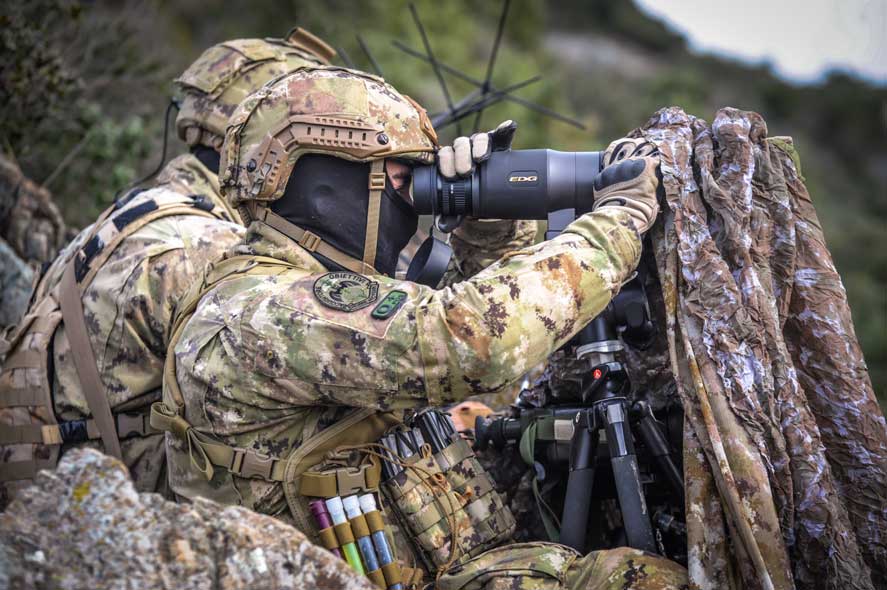
The 185th Paratroopers Reconnaissance and Target Acquisition Regiment "Folgore" (abbreviated as 185th RRAO) is a unit of the Italian Army, since 2018 part of the special forces, composed of specifically selected and trained personnel, particularly trained and equipped to conduct the full spectrum of typical "Special Operations" tasks, particularly specialized in conducting Special Reconnaissance and Terminal Guidance Operations.
The 185th RRAO regiment has a distinctly intelligence-oriented "vocation" and is specialized in direct actions involving the engagement of "stand-off" targets using the armament at its disposal and all terrestrial, aerial, and naval fire platforms. The "RRAO" typically operates by infiltrating operational detachments equipped and trained to operate "behind enemy lines," at great distances from friendly forces and in complete tactical isolation.
The operational component of the regiment consists of officers, non-commissioned officers, graduates, and volunteers in permanent service or fixed-term service, trained and selected through a training course lasting about two years, culminating in the awarding of the "Target Acquirer" brevet, with operational dependence on the Joint Command for Special Forces Operations (COMFOSE), and is stationed in Livorno.
It traces its origins to the 1st Paratroopers Infantry Regiment, part of the 1st Paratroopers Division “Folgore”, which at the end of July 1942, as part of a reorganization of units, ceded the III battalion which, together with the XI, constituted the 185th Paratroopers Infantry Regiment “Folgore”. When the division was airlifted to North Africa, the 185th regiment was retained in Italy as the initial nucleus to form the 184th Paratroopers Division "Nembo" in November.
In April 1943, the 185th regiment was detached from the “Nembo” division to be first sent to the Karst and in August to Sicily, to face the Allied landing on the island. Subsequently, it received orders to retreat to Calabria, where from September 3 it was engaged in combat against the British.
The "F" Squadron
The armistice of September 8, 1943 caused general disorientation which also affected the regiment and in particular the three battalions operating independently. A part of the III Battalion, led by Captain Sala, joined the German forces. Instead, Capt. Carlo Francesco Gay, commander of the 9th company of the III battalion and other paratroopers, decided to separate from the main body of the battalion to comply with the armistice clauses. While the main part of the XI Battalion formed the 185th Autonomous Paratroopers Assault Unit "Nembo", joining the Co-belligerent Army, the group of paratroopers led by Captain Gay became part of the XIII British Army Corps, forming the initial nucleus of the so-called 1st Autonomous Special Unit.
In January 1944, the unit under Capt. Gay's command transformed into the 1st Reconnaissance Squadron "Folgore", better known as “Squadron F” or “F Recce Squadron”. Squadron F was employed in vanguard roles, conducting patrol activities beyond enemy lines, with tasks of reconnaissance, observation, and information gathering as well as raids against sensitive targets, to facilitate the advance of Allied forces from south to north, for the liberation of Italy from German occupation. The first operational theater was the Abruzzo mountains of Majella, followed by deployments in central Italy and Tuscany.
On September 2, 1944, in a clash at Monte Pomponi (AR), Lieutenant Eldo Capanna and Sergeant Otello Boccherini heroically fell, both posthumously awarded the gold medal for military valor. In March 1945, Squadron F was called upon to undertake one last challenging task, which marked its passage into the history of Italian military parachuting: Operation Herring.
Squadron F, reinforced with about 100 selected volunteer paratroopers from the “Nembo” paratroopers regiment, on April 20, 1945, from Rosignano (LI) airport, 226 Italian paratroopers boarded American C47 Douglas aircraft. The airdrop, already highly risky, proved exceedingly arduous due to strong enemy anti-aircraft defenses. After the airdrop, the clashes were intense and fierce, with several casualties. The war drop represented the pinnacle and at the same time the conclusion of the Squadron's saga, which was disbanded a few months later.
Post-war Period
In the post-war period, the traditions of the regiment were maintained from 1957 by the Paratrooper Training Battalion of the Military Parachuting School, from 1975 named 3rd Paratrooper Battalion "Poggio Rusco", always framed until 1996 in the SMIPAR based in Pisa, from that date in Scandicci and then dissolved in 1998.
On April 3, 2000, as part of the reorganization of the Army units, the 185th Ground Artillery Regiment (Paratroopers Target Acquisition) "Folgore" was established from the reconfiguration of the 185th Paratrooper Artillery Regiment “Folgore”, of the Folgore Brigade (Livorno), also inheriting the legacy of the dissolved 13th Target Acquisition Group "Aquileia" (GRACO) of which it assumed the motto “Videre nec videri” (to see without being seen). In 2002 the regiment was included in the pool of forces for special operations (FOS) of the Army and in 2004 it assumed the name of 185th Paratrooper Reconnaissance Target Acquisition Regiment “Folgore” (RAO).
The Reconstitution

On June 21, 2013, as part of the paratrooper brigade enhancement program, the 185th Paratrooper Artillery Regiment "Folgore" was reconstituted, based in Bracciano (RM), taking back the war flag until then kept by the 185th RAO regiment.
At the same time, the 185th Paratrooper Reconnaissance Target Acquisition Regiment "Folgore" was assigned the War Flag once belonging to the 185th Paratrooper Infantry Regiment "Folgore".
With the restructuring of the Italian Armed Forces, in 2014 the 185th RRAO, as well as the 9th Paratrooper Assault Regiment "Col Moschin", left the Paratrooper Brigade "Folgore" to join the new COM.FO.S.E, a brigade-level command responsible for ensuring the necessary unity in training, preparation, procedural development, and acquisition of materials for the Army Special Forces sector.
On June 21, 2015 the Regiment received as a beret badge, the emblem of the Folgore Reconnaissance Squadron (Squadron F).
The inclusion in the Italian special forces was validated in October 2018 with the exercise "Notte scura 2018", with operational dependency from the Joint Special Operations Command.
The Regiment's Symbols
The Heraldic Emblem
One of the symbols of the regiment is the heraldic emblem. Inside the bifid golden list, fluttering, placed under the tip of the shield is the motto: “Come Folgore”.
The Badge
The headgear badge was assigned to the unit on June 19, 2015. The acquirers changed the metal beret badge that reproduces the one belonging, during the Second World War, to the Folgore reconnaissance squadron (Squadron F).
The Unit Insignia
The insignia, in burnished metal on a leather pendant, is oval-shaped with a raised edge bearing the unit's name. It represents a parachute canopy with a partially visible suspension line bundle (specialty symbol); loaded with a sword placed upright with the tip downwards on the bat with lowered flight (operational premise in a nocturnal environment); in turn loaded with a compass rose, on the globe resting on the branching, of the anchor flukes (use in any terrestrial region and operational scenario, including amphibious). At the tip of the oval, a fluttering bifid list with the inscription in capital letters VIDERE NEC VIDERI (to see without being seen).
The Insignia
The metal collar insignia of the infantry weapon with the sword, parachute, and wing of the airborne troops. The blue color recalls the paratrooper specialty.
The Herring Dagger
The historical dagger of the regiment, which personnel wear on major ceremonies, reproduces the dagger supplied to the paratroopers of Squadron F, by the British military during the Second World War. Considering the employment for which the squadron was intended, the personnel received specific training from the British commandos in parachuting, explosives use, and unconventional combat techniques. The paratroopers received equipment, materials, and armament, including the “commando dagger” (Fairbairn model), already in use by the British special units of the time.
The War Flag
The war flag of the 185th RRAO originally belonged to the 1st Parachute Infantry Regiment established in Tarquinia in 1941 and shortly after renumbered as the 185th Parachute Regiment. At the end of the Second World War, the regiment was disbanded and the flag was placed in the shrine of flags at the Vittoriano in Rome.
However, a few years later, precisely in 1963, when the Folgore Parachute Brigade was established, the 1st Parachute Regiment, heir to the regiment of the same name established in Tarquinia, was reconstituted and received the related war flag. Due to subsequent reorganizations of the Army units, the regiment was again disbanded in 1975, handing over the war flag to the 3rd Parachute Battalion "Poggio Rusco" framed within the then Military Parachute School (SMIPAR), based in Pisa. Transferred to Scandicci (FI) in 1996, the “Poggio Rusco” was then disbanded in 1998 and the war flag was again placed in the shrine of flags.
In 2013, the war flag of the 185th Parachute Infantry Regiment "Folgore" was assigned to the 185th Rgt. RAO, which handed over its own to the reconstituted 185th Parachute Artillery Regiment of the Folgore Brigade based in Bracciano (RM). In 2018, the Head of State awarded the decoration of Knight of the Military Order of Italy to the war flag of the 185th RRAO for the courage and professionalism demonstrated in over a decade of military operations abroad.
The Acquirer Badge
In February 2020, the SME authorized a new badge for RAO operators, Target Acquirer: the new badge contains the stylized symbols of the specialization: bat wings, which have always evoked the ability to see and operate at night, the letter F which recalls the emblem of the paratroopers of Squadron F, that of Operation Herring, inserted in the cardinal points. At the top, stylized gladius and wing parachute.
Structure
The organizational structure of the 185th Reconnaissance and Target Acquisition Regiment (RRAO) is composed of:
- Regiment Command
- Command and Logistic Support Company
- 3rd Acquirer Battalion “Poggio Rusco”
- Training and Operational Support Battalion (ASO)
Tasks
Special Reconnaissance (SR)
These are reconnaissance and surveillance activities conducted primarily (but not limited to) in hostile, denied, diplomatically and/or politically sensitive environments in order to gather or verify information of strategic or operational importance, using unconventional techniques and methods. For this type of missions, it is necessary to have the ability to infiltrate covertly into an area and exfiltrate from it by land, air, or amphibious means and static, remain in the operational area for up to 3-5 days without external supplies, survive, evade capture, escape and flee from a potentially hostile area. In these types of missions, the activity of the Target Acquirers takes place mainly in enemy-occupied territory, in small self-sufficient units that operate in isolation. Due to the peculiarity of the training, these soldiers are requested for particular intelligence operations in support of AISE.
Direct Action (DA)
Like all Special Forces units, the 185th RRAO is also trained and used for Direct Actions with a particular focus on Terminal Guidance Operations (TGO). These are operations conducted to locate, identify, and determine the precise position of high-value operational-strategic targets (HVT) and to enable non-organic stand-off platforms (air, naval, and land) to use their weapon systems to engage them effectively.
Military Assistance (MA)
In recent years, the men of the 185th RRAO have carried out and continue to carry out military assistance activities in favor of the Special Forces of various foreign countries. This is a wide range of activities that support and influence the critical resources and assets of friendly states through training, advising, training, or conducting combined operations.
Training
The Selection and Training Process for FS Operators
The selection and training process for FS Operators (known as “FS Process”) is the set of selection activities (physical and psycho-aptitude) and basic training of Army personnel, belonging to every category (Officers/NCOs/Enlisted/Reservists) who, following a written application, express the intention to serve in the operational component of the Army's FS units as “Incursore”, “Target Acquirer” or “Ranger”. The FS Process consists of the following phases:
- Selective and Common Basic Training Phase: it is conducted and coordinated by the Special Operations Training Center (Ce.Add.OS) and consists (in order) of:
- Physical Selection Tests: aimed at verifying the possession of the minimum athletic requirements for access to the FS Iter (1 week);
- Selection Internship: conducted to test the possession of the psycho-physical and attitudinal characteristics for access to the FS Iter (1 week);
- “Basic Operator for Special Operations” Course (OBOS Course): represents the fundamental moment for the common basic training of “FS Operators” (12 weeks).
- Specialized Basic Training Phase: A series of training and educational activities conducted under the responsibility of each FS unit for the personnel who, after successfully completing the “Selective and Common Basic Training Phase,” are sent to the relevant specialization and capacity completion courses at the FS units, in order to obtain the relevant Incursore/Target Acquirer/Ranger qualifications.
Specialization for Target Acquirer
This phase qualifies the candidates as Target Acquirers, and since 2011 it lasts 50 weeks. The specialization includes a series of courses each composed of various modules and organized as follows:
- Special Reconnaissance (SR) Course for Target Acquirers.
- Terminal Guidance Operations (TGO) Course for Target Acquirers.
- Amphibious Mobility Course for Target Acquirers.
- Intelligence Course, at CIFIGE and/or equivalent course
- Basic Skiing Course conducted at the Alpine Training Center
- Basic Mountaineering Course conducted at the Alpine Training Center
- Military Free Fall Course (CCALM) conducted at the parachuting training center (CAPAR) of the Folgore Paratroopers Brigade
Other courses after qualification
Depending on the rank, role within the unit, and the unit's staffing needs, the acquirer may attend additional courses to improve their professional skills.
- JTAC Course, conducted at the Aerocooperation School of the Italian Air Force in Guidonia.
- OSSALC Course (Security Service Operator qualified for hull work) is a two-month course conducted at the COMSUBIN of the Italian Navy, open to all members of the Armed Forces, at the end of which a certification for the use of the air breathing apparatus (ARA) up to 15 meters deep is obtained.
- ARO/ARA Course (Oxygen Breathing Apparatus/Air Breathing Apparatus) conducted at the COMSUBIN of the Italian Navy.
- Military Rescuer Course
- MCM Course (Military Combat Method)
- Basic course for handling and use of explosives for Special Forces.
- Various intelligence courses at CIFIGE and CeFIT.
- Language courses at the SLEE (Army Foreign Language School) in Perugia.
- Various types of courses held at the International Special Training Center. URL consulted on December 20, 2020 (archived from the original URL on November 25, 2020). in Pfullendorf (Germany), the NSOS. URL consulted on December 20, 2020 (archived from the original URL on June 12, 2021). (NATO Special Operations School) in Mons (Belgium), the NSO. (NATO School Oberammergau) in Germany.
Weapons and Equipment
- Beretta 92 FS (M9) Pistol
- Glock 19 4th generation semi-automatic pistol
- Heckler & Koch MP5 submachine gun and the new MP7
- Steyr Mannlicher AUG assault rifle
- Colt M4 assault rifle
- Heckler & Koch G36 assault rifle
- FN Minimi (M249) light machine gun
- MG 42/59 machine gun
- Accuracy International Arctic Warfare bolt-action sniper rifle
- Sako TRG bolt-action sniper rifle
- Heckler & Koch G3SG/1 semi-automatic sniper rifle, specific version of the Heckler & Koch G3 assault rifle
- Barrett M82 semi-automatic sniper rifle
- Benelli M4 Super 90 (M1014) semi-automatic shotgun
- M203 grenade launcher
- Heckler & Koch HK69 grenade launcher
- Mk19 Mod 3 automatic grenade launcher
- OD/82 hand grenade
- 60mm Hirtenberger Mod. M6C 210 mortar
- Dynamit Nobel Panzerfaust 3-T anti-tank rocket launcher
- MBDA MILAN medium-range anti-tank weapon system
- Various types of latest generation night vision devices
- T-10 C parachute (personnel and material drops)
- T-10 MIRPS parachute (personnel drops)
- MT1XX parachute for free-fall technique (TCL) airdrops, used for training (Full-Equipment) and insertions in enemy lines operations
- Instruments for observation and laser targeting
- RAO 185º knife (EXTREMA RATIO)
- HERRING knife (EXTREMA RATIO)
Vehicles
- Ford RANGER (off-road vehicle)
- Iveco VM 90 (multi-role off-road vehicle)
- Zodiac Commando inflatable boats
- RHIB for transport and operational insertions of an entire detachment (Full-Equipment)
- Iveco LMV/VTLM (light multi-role vehicle)
- Cagiva W12
- LTATV Special Operations Vehicle
Honors
Knight's Cross of the Military Order of Italy
Special operations forces unit employed for more than a decade, in multiple and risky operational theaters, exerted itself with the highest professionalism, undisputed courage, and total dedication to complete the assigned missions. With valor and disregard for danger, the personnel of the 185th, always faithful to their motto "Videre nec videri", repeatedly demonstrated bravery by conducting, in hostile territories, intelligence missions, patrol and engagement actions, achieving tactical successes that enabled the attainment of important strategic objectives. Proud and cohesive regiment, it contributed to enhancing the prestige of the Army and Italy in the international context.
Iraq, Afghanistan, Bosnia-Herzegovina, Kosovo, Lebanon, and Libya, 2002-2017
Comments
No comments yet. Be the first!