


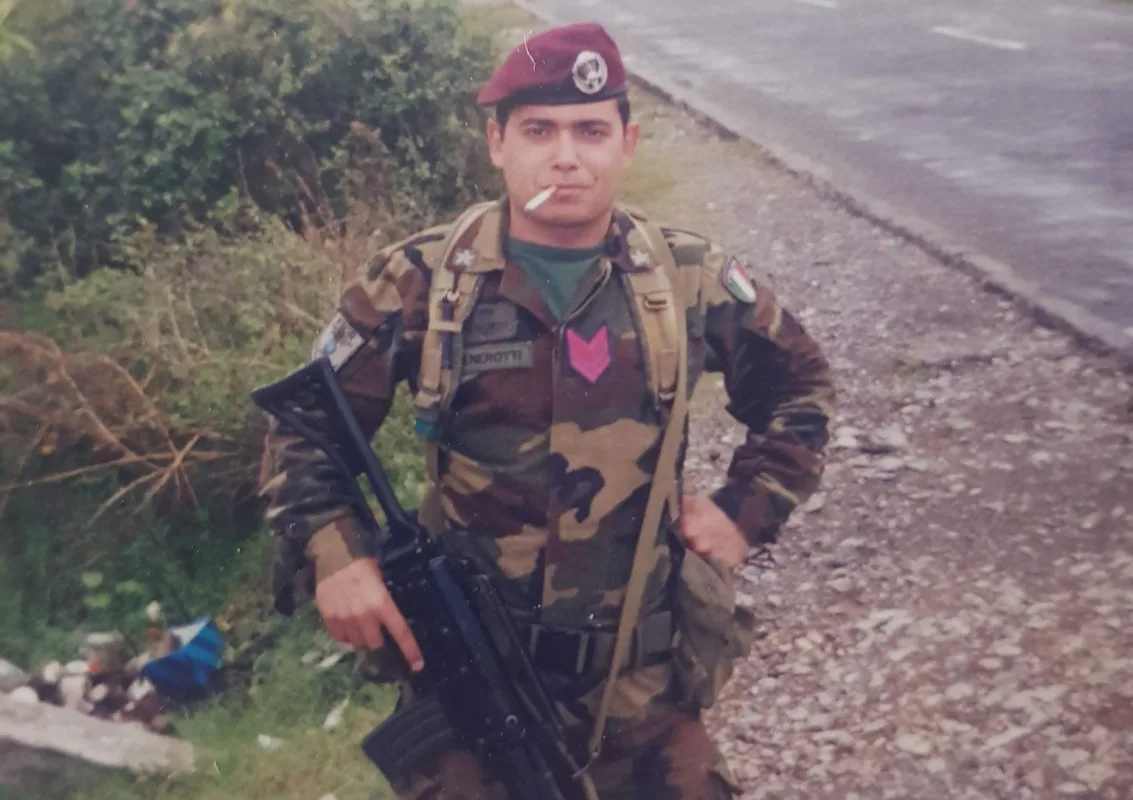

I was part of the Folgore Paratroopers Brigade from September 3, 1999, to March 23, 2002.
Before joining, having enlisted as a short-term volunteer (VFB), I completed a 3-month course at the 85th Volunteer Training Regiment "Verona" in Montorio Veronese (Verona), and a two-month specialization course as a rifleman at the Infantry School of Cesano (Rome). I encountered some obstacles in enlisting, but I overcame them.
In these three years, I experienced intense emotions, met many friends, some of whom I still keep in touch with, others unfortunately, are no longer with us.
I left for a professional choice, but also because, at a certain point, I was angry with the Institution, guilty, in my opinion at the time, of having abandoned us.
You will better understand my motivations by reading my military story.
I still keep in touch with my peers and my superiors today, and I have great respect for them.
I have included some photos, I did so meticulously, ensuring that the faces of personnel still in service were not visible, and I had to refrain from including others, even very beautiful ones. I also concealed the surnames of personnel still in service.
I hope not to bore you... let's begin:
"Hands off the Folgore!"
Mid 90s, I was 16 or 17 years old and leaving school, from the technical institute "Guglielmo Marconi" in Civitavecchia, heading home, that day on a wall, written with a spray can in a rough manner, I noticed: "Esprit de corps, Courage, Boldness, Loyalty: hands off the Folgore!".
These were the post-Somalia years, or rather, the Somalia-gate, the investigation artfully mounted by the weekly magazine Panorama to discredit the Folgore Paratroopers Brigade, later dismissed for total groundlessness (it was discovered that the paratrooper had invented stories for Panorama for personal economic gain).
That was my first contact with the Folgore. But it didn't end there.
In those same years, Lino Corsetti, a Marshal of the Italian Army now retired, and the father of my dear friend Francesco, told me about the deeds of the Paratroopers on July 2, 1993, in the battle of the pasta checkpoint: he was at the old port of Mogadishu that day, at the brigade command on a mission with the 11th Transmission Regiment "Leonessa" of Civitavecchia.
I couldn't believe it. Italy had a unit of highly trained fighters who had fought a bloody battle while I was riding around on my Aprilia 50.
I, who was obsessed with military films and magazines and thought those things were exclusive to the Americans, or at most the British.
I was swept up in a whirlwind of emotions and dreams. I asked, I inquired, I bombarded Lino and his son Francesco (also a soldier, specifically an Instructor Corporal at the RAV in Verona) with questions. I WANTED TO JOIN THE "FOLGORE".
The submission of the application to the military district
I had a bit of trouble enlisting as a VFB... in June 1994 I had a motorcycle accident, fracturing my tibia and fibula.
After the three-day visit (March 1995) the health profile of my lower limbs was three, an insufficient condition to enlist as a volunteer. A two was necessary.
I knew I was healed, but I had to prove it to the military doctors to have a correction on the health profile issued to me in La Spezia three years earlier. The military district of Rome, in September 1998, sent me to the Military Hospital of Rome for the necessary visits and the related correction.
The outcome, unfortunately, was negative. The military doctors took it lightly... perhaps they didn't even look at the X-rays... probably they didn't feel like taking such a responsibility. The news destroyed me morally. I wanted at all costs to enlist in the army, I wanted at all costs to become a PARATROOPER OF THE FOLGORE. But I didn't lose heart.
I called Lino, the friend Marshal, always him, and he told me there was another loophole: since the health profile had been issued by the Navy, I could request a military visit from them, but this time, to avoid definitive rejection, I had to bring X-rays of the limb and a declaration from a civilian orthopedic certifying my complete recovery and fitness for any sporting activity.
So I did, I presented myself with all the documentation, and they corrected the profile. It was a great victory.
Now I could enlist. I immediately brought the application to the Military District of Rome with the new health profile on the same day. They immediately told me I would leave at the end of March 1999.
Do You Want to Be an Officer in the Navy? No Thanks, I'm Volunteering in the Folgore
During that same period, September-October 1998, my uncle, an executive at a major company in the capital with contacts at the top of the Navy, came to my house for a family visit. He had learned of my choice from my father and told me he could "strongly" influence my potential application as a Reserve Officer in the Navy (we're in the late '90s, at the last AUC competitions). I politely declined the offer. No, thank you. The call of the glorious maroon beret was too strong. I didn't think about it for a moment.
The Volunteer Course at the 85th Regiment "Verona"
March 24, 1999. It's a date I will never forget. The train departure from Rome, the arrival at the Verona station. I remember every moment.
I traveled all night, arriving at the Regiment in the morning around 10:30. The impact was tough, but not shocking.
I remember the first maroon beret. A 1st Sgt. Maj. VSP instructor from the V Paratrooper Company "Bats", 2nd Btg. Tarquinia, 187th Par. Regiment Folgore, named Antonio D., whom I later met in person. He was on duty at the gate the day I arrived in Verona. You could recognize him from 2 km away compared to the other soldiers, not just because of the beret's color: he had a lean and athletic physique, and above all, a very tense, angry face: it was the unmistakable sign that he had spent a few years in one of those tough units.
We dressed the same day and then headed to the company: they immediately taught us military discipline, some suffered from this, I did not, I was proud to learn it. After all, I had wanted it. And it was what our Commanders always told us: "you are volunteers, no one told you to come here".
I also had difficult moments to overcome. For more than two months I didn't go home, but no one had ordered me to enlist. I remember initially feeling a slight back pain while standing at attention, it was nothing compared to the training I would experience in the Folgore Paratrooper Brigade.
By great fortune, I found a friend in Verona, the Corporal Major Instructor, Francesco Corsetti, we had known each other for years, we hung out with the same group in the same city, we were Great Friends. He was the son of Marshal Lino, the one from the 11th Rgt. Leonessa I mentioned at the beginning.
No favoritism, moreover he was not in my company, but an important psychological help. For the first time, I found myself away from my family without being able to rely on them. My psychological turning point was in a phrase of his in the early days, he looked me straight in the eyes and said: "When the going gets tough, the tough get going".
Today Francesco is no longer with us, a sea accident took him away forever, I would like to remember his way of joking and lightening up difficult moments. Without him, it would have been different.
I was assigned to the V Company "Cobra", a company mostly composed of Bersaglieri, Alpini, and infantrymen, no Paratroopers. My god... actually, listening to these men, the Paratroopers weren't worth much... just talkers. I had a Bersaglieri sergeant who felt like Rambo, criticized the paratroopers at every moment of his existence, but he didn't even know how to read a topographic map, went on patrol like a picnic, without weapons, without gear... given his military incompetence in the Folgore Brigade he would have cleaned toilets for life.
The only person who knew about military training was a Permanent Service Volunteer from the Alpini, a Sicilian guy who was the only one in my Company to have participated in missions abroad. And it was no coincidence that he was from the Alpini. Beyond the jokes and rivalries between Paratroopers and Alpini, mostly from the draft, the Alpini have always been a great corps. A corps where if you managed to "hold your own" you became, by necessity, a Great Soldier. So for him too, the concept of the tense and angry face applied.
The week following my arrival, the first episode I particularly remember highlights what has always been my character: never being afraid to speak up if you think you're right. I was on duty at the company bathrooms. Around 10 PM, the Company Commanding Captain and the Instructor Corporal arrived for an inspection. They headed to the bathrooms, I saluted militarily, the Captain returned the salute, approached, then turned and left. As he turned again, he saw some footprints on the floor: "Cadet, clean properly, someone has walked here, and you haven't cleaned it."
I had cleaned everything; it was simply that the Captain had stepped on that area of the floor when entering the bathroom. I stood at attention and asked to speak: "Captain, it's dirty because you stepped on it when you entered." I saw the instructor corporal turn pale. The Captain sighed, then politely asked me about my educational background. I replied about my diploma and my brief university experience. And he concluded with this phrase: "The Army needs people like you. Keep it up, you'll go far in the armed forces."
I had asserted myself, I understood how it worked. I had cleared my last doubt; the rest I had already figured out.
So, since I understood the mechanism, I adapted, waited for my moment. To the instructors, I only said "Yes, Sir." There's one in particular I remember today with a laugh. He was a corporal major at the RAV, acting just like Sergeant Hartman. Very tough on me. I met him again with my platoon in the Folgore 2 years later. Both in military uniform. He was a rank above me. I had a maroon beret on my head, a fierce look from a tough unit. Me. Certainly not him. He greeted me like a frightened puppy.
After about twenty days, They arrived, the Folgore selectors. You know when you imagine something, and then it happens exactly as you thought and, above all, as you dreamed it would be? That's exactly what happened.
Two Men presented themselves, an RS Lieutenant, with a past in the special forces of the Col Moschin, a drop covered with foreign badges and missions, and a Marshal of the same style. They had strong and decisive voices, athletic physiques, two real beasts, nothing like the potbellied Marshals I had seen until then. I don't remember their names, I remember they were from Pisa, looking at us volunteers with the gaze of men wanting to adopt children, and two bright eyes telling you that if you want to be the best, you have to go to Them. I also remember that everyone within the Regiment, for two days, stopped speaking ill of the Heroic Brigade, including the bersaglieri. They showed us a film in the Regiment's cinema about the Folgore Brigade, from the Battle of El Alamein to the nineties, focusing on the most significant events, Somalia first and foremost.
Well, that film reinforced my concept even more: They were the best. And I had to go to Them. I remember a speech by the assault Lieutenant: "You won't be asked to do Rambo things. Not for now. You will have gradual training until you reach the highest levels a soldier can achieve. Because, if the country demands it, you must be ready with maximum operational efficiency because the enemy gives no discounts. In the Paratrooper Brigade, you will be trained to be able to face any threat in combat."
Never heard a speech like that until then. Enemy? Combat? Threat? I had chills. It was my unit. I had to get there.
Before continuing, the Italian Army at that time needs to be better explained.
In those years, the Paratroopers of the Folgore were simply from another planet compared to any other specialty of the Army. For half a century, the Folgore was the only large unit of the Italian Army composed exclusively of volunteers. Even during conscription until the mid-1990s, one had to apply and pass physical tests to join. The Folgore has been selecting personnel since its inception, in 1941. It was the top of the top in every way.
Not that it isn't today, but with professionalism in the Army, other specialties have, fortunately, grown enormously. Brigades and specialties like the Sassari, the Bersaglieri, the Alpini, are today combat units extremely reliable on par with the Paratrooper Brigade.
As mentioned before, the FOS pool, the COMFOSE, etc., did not exist. It was the Paratrooper Brigade that handled special operations for the armed force. Within it, the 9th Rgt. Col Moschin, the spearhead whose raider companies were composed exclusively of professional soldiers, its three maneuver regiments, the 183rd, 186th and 187th and its powerful Artillery Rgt., the 185th.
186th and 187th then, framed the battalions 2nd Par. "Tarquinia" and 5th Par. "El Alamein" and given Italy's geographical position, during the Cold War they were trained within NATO as very strong first-line units in case of conflict with the Soviet Union.
It should also be remembered that until the early 2000s, only personnel belonging to the Paratrooper Brigade Folgore could access the selections of the 9th Rgt. Col Moschin, as sapper (as VFB) or as raider (as VSP). It was a single family. And the selection, even for future Raiders, as well as for Paratroopers, began there.
Joining the Folgore meant performing military service in the elite of the Italian armed forces. The Paratroopers at the time were truly intimidating. The name FOLGORE was intimidating. And honestly, I was a little intimidated too, but at the same time thrilled to know that by committing myself properly, I could be part of it.
Having framed the military scenario of the time, here we are at the physical selections: running, high jump, push-ups, pull-ups. I made a certain effort to pass them all, I won't deny it. But I cared so much about that appointment that in the previous days I had trained a lot.
The rest of my stay in Verona was filled with formal training, and a a.i.c. (individual combat training) for children. Ridiculous patrols, never read a topographic map. The aim was to "make numbers" in the Army, the VFB had just been born, conscription still existed, so the policy was: let's make them do children's things, so no one gets hurt and the General Staff is happy.
However, I remember a Captain, Commander of the II Company, a Paratrooper: he made his students wear webbing with terracotta bricks inside, individual weapons for everyone, instructors included (in my Company for these it was optional at their discretion).
And I remember the Regiment Commander who praised him in front of everyone at the flag-raising: "Bravo Bruno, Bravo, that's how soldiers are trained". About this man, icy blue eyes, silent even with his peers, always ready to respond to your salute in a military manner, incredible legends circulated about his past in Somalia.
However, the patrols I did in Verona were important to get used to the weight of the backpack... I remember the other students swearing left and right, while I remained in my silence and my suffering, knowing that the often unbearable weight on my shoulders was necessary to perform well in the ranks of the Brigade as a Rifleman. Because I chose to be a Rifleman. And I was satisfied.
On June 21, 1999, from VFB Cadet, I became VFB Corporal. Assignment Paratrooper Rifleman, destination Cesano (Rome), Infantry School for the related Course. It was a great satisfaction, but I still had to get rid of the black beret.
The Rifleman Course at the Infantry School of Cesano
I arrived in Cesano, but the situation wasn't much better. In fact, in some ways, even worse. However, there, by the will of our battalion's Commander, a Lieutenant Colonel nearing retirement who didn't want any problems. In return, though, I found instructors with the Maroon Beret who did what they could... however, I remember an extraordinary peacekeeping exercise conducted (of course) by a Paratrooper Lieutenant, marred by the serious injury to the eye of a student hit by his own blank shot fired from the bolt of his rifle.
The company was made up of Corporals to be trained and then end up in the various specialties of the Army, bersaglieri, infantrymen of the Sassari, Paratroopers, and others... In that company, however, I met some of those who would become my future Company comrades in the Folgore. Andrea R., Michele C., Carlo S., Cesare L., Luca Z., Emanuele T., Agostino P., Claudio S., Antonio T., Antonio M., Giuseppe M., Francesco C., Donato C., Giuseppe F., and Simone T. (I hope I haven't forgotten anyone!).
We formed a "group", one day we would sweat in the mud led by strong and charismatic Commanders of the Folgore, we felt, and indeed were, different.
Cesare L., Antonio M., and Claudio S. were conscript soldiers of the Folgore Brigade who had applied for VFB. They were the only ones who had the Maroon Beret, they were Certified, they knew what it meant to lift their feet off that damned C-130. To us, they were masters, Cesare in particular an older brother.
22 months of service solely and exclusively in the ranks of the Brigade, he had never worn a black beret, in Pisa he had been an A.I.P., instructing conscript soldiers to obtain the Paratrooper certificate at the Military Parachuting School (later became Ce.A.Par.). Physically, he was from another planet. We wanted to become like him. He came first in the Rifleman Course, Andrea R. second, and then me, and after all the others.
I was on the podium, but above all, the top three were all destined for the Paratrooper units. I still remember very capable soldiers who would later be assigned to the Sassari Brigade, one above all, very intelligent, skilled, cunning, strong: Stefano B.
The training at Cesano wasn't much... what can you learn from a Platoon Commander Second Lieutenant of Complement with 10 months of service??? Cesano served me to see my family more frequently, as I lived half an hour from the barracks. Every weekend at home, and I even had a spot in the barracks for my car. Plus, in the middle of summer, the company was closed around mid-August: I had a nice week of vacation in Sardinia with a friend...
And the day of assignments arrived here too: there was a legend that said we would all be assigned to the bersaglieri... because the garibaldi had personnel needs. I swore that if it happened, I would apply for discharge. And I really would have. Fortunately, though... it was just a legend.
Destination for us aspiring Paratroopers: ONE HUNDRED EIGHTY-SIXTH PARACHUTE REGIMENT FOLGORE.
In 1999, as mentioned, along with the 187th Rgt. the antechamber of the special forces. One of the toughest, most operational, angry, and highly decorated units of the Italian Army.
All of us in Siena, at the 186th, including the three guys already Paratroopers. The rest mixed between bersaglieri and Sassari Brigade.
It was September 2, 1999.
Arrival at the 186th Parachute Regiment "FOLGORE" in Siena
On September 3, 1999, I arrived with the others in Siena at the 186th Regiment, we took a train journey full of hopes, stories, and thoughts about what was supposed to be one of the most operational units of the entire Italian Army. Even the three who were with us, despite already being Paratroopers, had no idea what it meant to become part of such a Regiment. They had never had operational experiences, Cesare trained the students in the gym course, Antonio and Claudio had been Parachute packers.
On September 3, precisely. It wasn't the true impact with the Folgore. The Folgore, the one from the stories about Somalia a few years before from my friend Lino, the BATTALION where the Riflemen, the warriors, end up, was out in Bosnia. The real FOLGORE, the massive and angry one, I would see later. But it was only a matter of time...
We were "parked" in the Command and Services Company "Sorci Verdi", the Company was overcrowded, there were more than two hundred people, but everything seemed to be under control, something that elsewhere, in such cases, would have been impossible. All the guys returning from the mission were aggregated to the CCS. So there was no place for us... the BATTALION would return in two weeks.
We hit the jackpot: it was Friday, they sent us home for the weekend, and on Monday all to Pisa for the gym course to obtain the Paratrooper Certificate. It was a great disappointment for the older batch of our group, they would be certified after us!
September 6, 1999, PISA, the Gym Course
The Parachuting Training Center (formerly SMIPAR) in Pisa was a spectacle: it felt like being in a 5-star hotel, the food was amazing, we did physical activity all morning, theoretical and practical training on the use of the parachute in the afternoon. Cheerful atmosphere, but it was obvious, you were always in the FOLGORE: if you made a mistake, you were punished. Order and discipline came first.
And then I think I was lucky to find a great Commander, a true giant with unique charisma: Colonel Incursore Paracadutista Marco Bertolini.
A legend of the Italian special forces, Commander of the 9th Assault Battalion Col Moschin in Somalia, I had learned about his exploits from books and the Internet, he was the one who commanded the Italian Incursori in the Horn of Africa from day one and the raid on the Mogadishu embassy on December 16, 1992. Later he commanded the 9th Regiment Col Moschin, the Parachuting Training Center, and then the Folgore Paratrooper Brigade. During the ISAF mission years, he was Chief of Staff of the mission in Afghanistan. When he looked you in the eyes at the flag-raising, he made you feel proud to belong to the Specialty.

I have a particular memory of Colonel Bertolini, one that I will never forget in my life: it was the last physical test before the jump, the last test of the famous "gym course", a long run of several kilometers focused on endurance. The Colonel was at the finish line, arms crossed. In the final curve a few dozen meters from the finish, one of my shoes came untied and I lost it. I didn't care and ran like crazy to the finish, with only one shoe.
The Colonel started applauding me shouting "Very good!!!" then looking around, surrounded by dozens of Paratroopers, he continued pointing at me with a finger "This is the right spirit, the spirit of the Paratrooper".
I felt like I had won the World Cup, it's useless to explain... my Instructor, never a smile in a month, gave me a pat on the back and smiled as if he had won it too...
And then his speeches, at the flag-raising, were wonderful, his words were real thunderbolts that entered your body:
"Outside the barracks behave well, because as civilians, off duty or discharged, you will always be identified as Folgore Paratroopers. If they catch a former bersagliere urinating on the street, at most the newspaper will write "Ex-military caught urinating in a public place". If they catch one of you, it will instead be "Ex Folgore Paratrooper caught urinating in a public place". You are and will be Paratroopers forever. That maroon beret will be yours for life, you will take it to the grave."
For the first time since I enlisted, and especially in my life, I found myself in front of a Man for whom, if he had asked me, I would have thrown myself into the fire without hesitation and without asking questions. I had the fortune to speak with General Bertolini over 20 years after my discharge and I told him this in person. It was a very strong and emotionally engaging moment. I am convinced I was lucky in life to have met a Man of such caliber. I don't know if I can convey the idea: it's something very personal, perhaps difficult to explain and to convey to those who have not lived in such military environments.
However, in Pisa there was a difficult atmosphere that strongly penalized Paratrooper traditions: a month earlier, in August 1999, a Paratrooper Trainee had died under unclear circumstances, so any act of hazing, including "push-ups", which the infantry call push-ups, was strictly forbidden.
Well, my thought is that push-ups are not an act of hazing, but a tradition, something you cannot erase, something with bold and ancient roots, and it was, among other things, an "easy" way to strengthen the physique of the Paratroopers.
Do 20-30 push-ups a day off schedule and then we'll talk again...
So I followed the Gym Course like a model student... and so did my friends. It was a continuous selection, the turret, the cloth, the run, the pull-ups, the push-ups (push-ups...), the high jump...
The Company was made up of soldiers from different Units of the Brigade. We from the 186th all graduated, except for two. Both made the same mistake in the false fuselage the day before the first jump. A very serious mistake, perhaps the most serious, namely letting the static line pass on the opposite side of the hand holding it. Jumping in that way risks traumatic amputation of the head, severing it cleanly.
Failed, out, there were no appeals, our instructors cared a lot about our safety. Rightly so.
Moreover, returning to Siena without a Certificate was not really a good calling card... later only Francesco C. managed to repeat it and get certified, while the other not only was rejected again, but he was discharged because the Brigade was not for him... better that way.
Halfway through the course, we learned from our escort which Company of the 186th we had been assigned to: the XIII Paratrooper Company CONDOR, the Relentless Raptors. A glorious company, one of the few existing deployed in the battle of El Alamein.
The rifle companies were three in Siena: the XIV Indomitable Panthers, where we could not end up, was an experiment of the Brigade Command, composed only of Permanent Service Volunteers, experienced Paratroopers with years of military experience, then there was the XV Black Devils, the Company that paid the highest blood tribute in Somalia, having fought on the front line on July 2, 1993 in the Battle of Check Point Pasta. On one hand, we felt more at ease, thinking "damn, the XIII will be calmer...". It was a big mistake in judgment, a really big one.
October 4, 1999, the first jump
The first jump is like the first sexual encounter, or the first kiss, or anything else you do for the first time knowing you are writing the history of your life. You understand nothing. You do everything automatically, and you do it well. The Zic-1, the Commanders telling us to get ready, the C-130 maneuvering, its noise enters you like the voices of a woman whispering she wants to make love with you. Climbing the ramp, the smell of Kerosene, it's like being in a movie. And you look for the reassuring gaze of some companion. Unforgettable moments.
And again... 5 minutes to jump... get ready.... 1 minute to jump... approaching the door... 5 seconds to jump... at the door: GO!!!!
The leap, 1000-1, 1000-2, 1000-3... you reach 1000-4... canopy check... a few spins... and you've gone from the roar of a flying plane with the door open to the most complete calm. It's you, alone, with your Irving 80 floating you in the sky.
An enormous satisfaction, an unforgettable moment. The drop zone was the legendary one of Altopascio. The landing wasn't bad, even though you realize that the somersault learned in the gym in Pisa simulating the landing, you will never be able to do it...
The second and third jumps followed within a month, the second always in Altopascio, the third on the Tassignano drop zone among... chickens and hens.
The return to the 186th Paratrooper Regiment "FOLGORE"
November 5, 1999. And here we are.
No offense to anyone, but the hard contact with the FOLGORE, the heir of the HEROES who fought in Africa in 1942, you have it when you enter a BATTALION. In Siena, there was, and is, THE FIFTH. The 5th PARATROOPER BATTALION "EL ALAMEIN". Together with the 2nd Battalion "Tarquinia" (framed in the 187th Rgt. of Livorno), the Fifth was (and still is) the only existing maneuver paratrooper battalion deployed in the battle of El Alamein. A glorious and daring history behind it, the clearest and most important, from a military point of view, in Italy. The Fifth Battalion, under the command of Lieutenant Colonel Giuseppe Izzo, in the epic battle inflicted severe losses on the British with acts of pure and legendary heroism.
That heavy legacy was among us. And it demanded respect.
In 1999 it was made up of the three rifle companies XIII, XIV, and XV, maintaining the same numbering assigned in 1942, at the time of the foundation and deployment in North Africa, plus a Heavy Mortar company, the Mo.Pe.. My first contact with the XIII on a psychological level was traumatic.
Do you remember when I said we made a big mistake in thinking the XIII Company was "calm"???

Here we are, let's say that the word "calm" or "relax" were concepts very far from that reality... at least as an initial shock.
You are the last arrival, the lights are dimmed by the webs of old parachutes hanging from the ceilings, legendary drawings on the walls, maximum formality and discipline even among sergeants and lieutenants... add to that you are a rookie... I WANT TO CLARIFY THAT NO ONE EVER DARED TO ABUSE ME, everything imposed on us was part of the MILITARY DISCIPLINE REGULATION.
In short, the regulation was applied to the letter.
Shock, but also a highly electrifying situation. I had fought to get to that point. I was already a skilled IT systems engineer and hadn't enlisted due to a lack of professional opportunities. In fact, I had left university, majoring in computer engineering against my parents' wishes, just to be part of that group of people who were a bit crazy and a bit poetic...
I was literally struck by that extraordinary adventure that was entering my life.
However, I didn't think that gray and gloomy environment would become my second home over time, those tough and inflexible Commanders, my Fathers, and my seniors my Older Brothers.
It was Friday, no weekend at home, we arrived in the late afternoon and there wasn't enough time for any leave. The duty Sergeant made sure to equip us as a Paratrooper should be equipped: American "alice" backpack with iron frame, kevlar helmet, and especially American webbing... away with that garbage provided by the General Staff. The Folgore has always acted independently, adopting U.S.-sourced material since the mid-'80s. Unlike other units of the Italian Army, it spent its funds to best equip its soldiers.
My Commanders, first contact
Monday November 8. I met Them. My Commanders. I will limit myself to talking about those who were my direct Commanders, but all the others were exceptional men too.
The Company Commander was Francesco M., Captain, he seemed to joke when he spoke, but he was deadly serious, an incredibly intelligent Academy Officer, loved or hated by the troops. However, I still can't understand why. There was no Company Commander, when we became "adults", who granted his men as much leave as he did. He made us work hard… but also, and rightly so, rest. He demanded strong physical training for the entire Company, especially running. He was also a computer science graduate and soon we would find ourselves...

He also paid great attention to the technical part, both theoretical with classroom lessons, and practical with patrols and offensive/defensive tactical actions. He didn't improvise, he planned our training (and our leaves) in the best possible way.
His deputy, a young but Great Officer, Antonio C., serious and rational, we later discovered he was very approachable, and often made cheerful jokes. His joke "ciacalas or ciculus?" is a pleasant memory of a serious and cheerful Commander just right. It often happened to meet him in the Pubs of Siena, and, always with the right formality, we exchanged a few words and a beer. I think he will have a great future in the Army, obviously among the Paratroopers.
And then the Platoon Commanders. Emiliano P, Commander of my Platoon, the 3rd, only a year older than me, immediately became a mentor, and later a great friend, but didn't hesitate to pull my ears (metaphorically) when I messed up. The Platoon Commander is the lowest in the Regiment-Battalion-Company-Platoon hierarchy, so he knew his men best. He was extremely formal, demanded attention in every circumstance, but also expressed excessive Romanity, cheerful and playful outside of work, he was still top-notch militarily.
He was, and still is, one of the greatest marksmen in the Italian Army, awarded the Sniper Instructor badge. He was a mix of cheerfulness-seriousness. A die-hard Roma fan like me, he made me pay dearly for this pseudo-football friendship... He believed in me a lot, and I think I repaid him as I should. In the years following my discharge, he joined a special operations unit.
Then came him... the Legend, the Company Sergeant Major, Giuseppe P.. Great Abilities, Ideologically I could define him as "the Folgore Man", a gaze as hard as stone, passionate and knowledgeable like few about military art and history, we were all afraid of Him, but over time we understood he had a huge heart, or at least I understood this.
If you messed up before taking you to the Company Commander, he would give you a talk, trying to hit you inside, trying to make you understand, with words, that the Folgore had to be respected, that it couldn't afford to have indifferent and fake Paratroopers in its ranks. I understood this from Him. He also had his flaws, never a cheerful joke, sometimes he exaggerated, but 99% of the time he was terribly right.

We had to understand it before saying among ourselves "he's crazy". He was also an excellent Fighter, one of the most prepared in the Regiment. He had exceptional knowledge and handling of weapons, also due to the fact that he was the only one in my Company who had previously managed to pass the very tough "80b" course at the 9th Col Moschin Regiment (the equivalent of today's OBOS course), in addition to having "done" Somalia.
So, in the mud or in a forest, he knew how to survive, and he tried to teach us this. He personally taught me a lot, as a Paratrooper and as a Man.
And again, the Squad Commander, Maurizio Gallitto, I dare to mention his Last Name because he is no longer in service in the Army. A Volunteer in Permanent Service, he was one of those who came from the Paratrooper draft, always an Amaranth Beret, he had a huge heart, and an inhuman strength. He wasn't big, just over one seventy tall, but with a past as a professional boxer, the words "pain" or "suffering" were terms that were not part of his vocabulary. On patrol, he didn't take off his backpack even when we stopped to rest. He was a great athlete and often gave us physical education lessons. He came from the XIV Indomitable Panthers, the paratroopers par excellence at that time.
In my company, I also fondly remember the sergeants Giovanni C., the only one, in XIII, together with Giuseppe P., who had "done" Somalia, Andrea N. and Maurizio D.G.. The latter had an incredible career: from a conscript paratrooper in Condor batch 94, today he is even a senior officer, still in the Folgore.
The first speech was given to us by him, the Company Marshal, Giuseppe P.: "Forget Cesano, here you are neither in Cesano nor in Pisa, here you must learn to be Paratrooper Riflemen".
Pian del lago, Montagnola Senese, Pian di Spille... a whole month of tough and uninterrupted training.
On November 21, the MANGUSTA awaited us.
Before moving on to the Mangusta, however, I would like to remember the other superiors of the Regiment who were not part of my Company, but of whom I have an excellent memory. At the 186th Regiment, there were very well-prepared men, some former Raiders, including Marshal R.B., a former operator of the Col Moschin, over 10 years in special forces on the front line between Somalia, Rwanda, Yemen, and Bosnia.
He told me about his July 2, 1993, some hectic phases of the battle and the friendship that bound him to Stefano Paolicchi, Sergeant Major of the 9th fallen in combat that day in Mogadishu, and other anecdotes during his stay at the Col Moschin. I still keep in touch with R.B. today, he is a person of a level, not only military but especially human, like few others.
And again, among the former operators of the special forces of the Col Moschin, I fondly remember Marshal S.C.. He was part of the assault commando that in 1986 was supposed to intervene on the Achille Lauro.

"They" were recognized by the "flea" on the beret, they had the traditional badge but inside, neither the Battalion number, 5, nor the regiment number, 186, but they had the 9. 9th Assault Regiment Col Moschin indeed. Their enormous experience was put at the service of us conventional Paratroopers.
And again, the XV Company had as Commander a Great fighter by nature, Lieutenant Carbonetti, decorated with a silver medal for military valor for the feats of July 2, 1993. I was lucky enough to exchange a few words with him. Like him, and for the same reason, Marshal Giovanni Bozzini was decorated with the same honor, a great person, at that time he was part of the Battalion Command, and he remained there until my discharge. I mention their Last Names because they were made public in the fantastic book by General Paolo Riccò Black Devils: the true story of the battle of Mogadishu. I had an excellent relationship with Bozzini in particular.
And then many others, many of whom I don't remember the names, but strong and valiant, as the Paratrooper Tradition demands.
I also began to know the beauties of Siena and its people. Unlike Livorno, where there is a historical rivalry between the Paratroopers and the citizens, the relationship with the Sienese was excellent. There was mutual respect, except for a few isolated episodes. In Siena, the Paratrooper was, and still is, perfectly integrated into the social fabric. Sienese and Paratroopers participate together in commemorations, celebrations, and... sufferings.
Then for a young person, Siena was (and still is...) a real godsend. The Tuscan town is an important university center both nationally and internationally, and consequently, beautiful young women were certainly not lacking... I remember the evenings at Barone Rosso, Caffè del Corso, and the Irish Pub, reference points for us Paratroopers. Rivers of beer and conversations in all languages...
If you were young and pretty and passed through those parts in those years, you would have had at least one contact with a Paratrooper... you couldn't escape us, you would have been our prey.
November 20, 1999, my Mangusta
For those who have been in the Folgore, the Mangusta needs no introduction. The Mangusta is an exercise where 2 or more units, or companies, or tactical groups compete. One acts as interdiction, the other as counter-interdiction.
November 20, 1999. It was terribly cold in the Tuscan hinterland.
Given the unavailability of the other Regiments of the Brigade (the 187 was in East Timor, the Nembo I don't remember where, but it was away), the following deployment occurred: XIV Indomitable Panthers vs Rest of the Regiment.
That is, one company against three. We had to control the objectives without getting too close, we moved with vehicles, left the backpacks, and patrolled on foot, both day and night. In 10 days I must have slept no more than 20 hours...
They, on the other hand, were infiltrated by airdrop into an area unknown to us. The "Panthers" had to move with backpacks, weapons, and everything else, they slept during the day, and walked at night to escape the enemy (us).
Well, I thought, we'll tear them to pieces, 3 against 1, they'll have difficulty moving. Instead, they massacred us.
They achieved all the objectives, captured some of ours, we never managed to stop them, we only found some traces during the various patrols.
Too strong, too experienced and prepared. Personally, however, together with Maurizio Gallitto and Giuseppe M., we managed to locate one of their patrols. We took up position in a farmhouse towards sunset, and took turns observing the movements with the night vision device. Well... we discovered that in that case, they had moved using a civilian van. After all, in war, anything is allowed, right?
Of course, and that was supposed to be a war simulation. Moreover, we were dealing with the best of the conventional forces of the Entire Army.
The XIV Panthers had, and still have, the best soldiers of the Italian Army, both in the ranks and in the troops, which at the time was made up only of Volunteers in Permanent Service. People who could easily perform well in special forces. Authentic war machines, I particularly remember 3-4 elements... I greet them, if they remember me, They know I'm talking about them, their surnames P., S., C..
In the ISAF mission in Afghanistan these Paratroopers (exactly the surnames I mentioned) were part of the escort of General Rosario Castellano, Commander of the Folgore Brigade. A job previously carried out by the Col Moschin Raiders. This to give an idea of who we had on the other side...
Ours was a young Company, the troops were "green". Our ranks were very prepared, but they had to deal with totally inexperienced troop personnel, except for the VSP who were about ten. So the debacle was total. But we learned a lot from that experience. We learned to share food like real soldiers do, we learned to move in the woods, the techniques not to lose the tracks of who you are chasing, we learned to... not underestimate the enemy.
There was still a lot to learn, but it was a great experience.
December 1999, the group's baptism of fire, platoon assault at Pian di Spille
The "bread" of the Paratrooper rifleman is undoubtedly the assault. The assault can be of Squad, Platoon, Company (minor complex), or Battalion (tactical group).
After the Mangusta, the Platoon assault awaited us. We tried numerous times at pian del lago, a place near Siena. Then we went to Pian di Spille. The first day we fired a large amount of ammunition, both with the individual weapon (SCP), and with those of the unit (Minimi and Mg) and hand grenades. The next day, the assault.
The Platoon assault is more complicated than the squad assault because all 3 squads must synchronize in fire-movement. I put in maximum effort, also because any mistakes can be at the expense of safety, you go to fire with war weapons, you risk killing your comrades. We did very well, except for some problems with a unit weapon that jammed. However, Marshal Emiliano P. complimented us. I was beginning to get some satisfaction.
January 2000, the jumps with the riflemen Company, a whole different music
There was a rumor that said: in Pisa, even a sack of potatoes is thrown, just throw it down.
Surely an exaggeration, a saying from the times of the draft to strengthen the warrior spirit of the riflemen in maneuver regiments or battalions.
However, when I jumped with my Company, the XIII, everything was very different: real war jumps were carried out, with a backpack, individual or unit weapon, possibly by squad or platoon. The backpack, by regulation (and safety) cannot weigh less than 16kg. If it does not have adequate weight, the friction rope risks not unrolling and landing with the alice backpack attached to the legs is not a great thing... you risk breaking them, because in addition to the weight and bulk it prevents adequate movements during the landing phase.
I made 2 jumps in one day, one in the morning, the other in the afternoon. We embarked in Grosseto in the morning, at an airport where military jets were zooming by just a few meters from us. The usual smell of kerosene, the usual reassuring looks among us guys. After about twenty minutes of "travel" on the G-222, we jumped and re-embarked on the same G which had meanwhile landed in Ampugnano. Another jump and patrol Ampugnano-Siena. It was January 17, 2000, and I had completed my fourth and fifth jump. Now I was a full-fledged military Paratrooper. I adorned my drop with the badge with the star in the center.
Another important milestone in my military life had been reached.
In the meantime, Captain Francesco M. discovered my computer skills, and "redirected" me to the orderly room. Together we developed an important personnel control program that was later adopted by all the companies. But to be honest, inside me beat the heart of a Paratrooper rifleman. He understood it, and I tried to alternate between the orderly room and patrols. To tell the truth, in those years I participated in all the rifleman activities and at the same time became, according to my comrades and superiors, the heart of the XIII Condor Company orderly room. I was often seen in the orderly room still with camouflage and dirty uniform from training or I would stay up late organizing services and various papers. It was a pride for me to take care of it. I had a blast and was proud of it.
The month of February passed with numerous shooting ranges, in March we had an important appointment: the minor complex, the Company assault.
March 2000, among the snow of Carpegna, the XIII goes on the assault
If the platoon assault is a difficult offensive tactical act to prepare and execute, the Company one is even more so, especially if you have to operate in prohibitive conditions, but according to some of our Commanders, if we did well in adverse conditions, with good weather we would do even better.
We spent about a week in Carpegna, between shooting ranges, squad and platoon assaults for those who hadn't done them yet. The 1st Platoon commanded by Lieutenant Luca D. even did the assault in one day, and the Complex the next day.
Commanded by our Great Company Commander Francesco M., the minor complex we carried out was spectacular, whether due to the weather conditions or because we were a very cohesive company. To support us "frogs" were the senior VFBs returned from 8 (!) months in Bosnia awaiting VSP appointment and, unfortunately, transfer. The MG's song was extraordinary, the final target was also taken down by an anti-tank rocket launched by the great Giuseppe Sagliocco, Corporal Major with four years of experience only and always in the Brigade (former conscript paratrooper), now retired.
That day he ran and jumped for hundreds and hundreds of meters with the Panzerfaust on his right shoulder (go see how much a Panzerfaust rocket launcher weighs...) on the hills of Carpegna.
Everything, or almost everything, worked perfectly, and, importantly when 100 people are firing simultaneously, no one got a scratch. As always, after all. A sign that the Commanders' teaching had been perfectly received by the troops.
Spring 2000, preparation and departure for Albania
At the end of March, we were informed that we would spend the summer of 2000 in Albania and began to prepare.

Although the mission seemed "easy", nothing, as the Paratrooper tradition demands, was left to chance. Shooting ranges, weapon zeroing, peacekeeping exercises, and staggered departure from mid-June. It was our first mission, and we new guys felt it a lot. We all did an excellent job.
The entire Regiment, from the CCS to the Battalion, made a great impression, and I will never forget the compliments from the Brigade Commander Comm-Zone West, General Casalotto.
He was an Alpino, but he praised the 186th for the high efficiency demonstrated during the four months, he was literally "in love" in a military sense, with us. All the Generals, even foreigners, who came to visit us at the Ure base, near Durres, complimented us.
Operationally, we mostly conducted reconnaissance of routes with return on the same day, surveillance of bases, and surveillance of the military hospital in Durres where Albanian civilians, especially children, were also hospitalized.
The Regiment also had the task of training the Albanian Army soldiers.
They sent our best VSPs to teach them infantry combat techniques. And again, we conducted a spectacular assault exercise on a lake with inflatable boats.
General Casalotto, Commander of the Brigade operating in Albania, applauded us. He was so impressed by the Paratroopers' preparation that at the end of the mission he sent home the Carabinieri and Infantrymen who were escorting him, asking our Commander for a dozen Paratroopers to protect him.
Our Company provided Emanuele M., Volunteer in Permanent Service, obviously one of the best of the XIII. For him, in addition to the four-month mission with us, there would be another six months as the General's escort.

From an operational point of view, the mission offered long-range reconnaissance patrols, previously exclusive to special forces before our arrival.
I participated in one, called operation "Midsummer Night", which lasted 4 days. We started on July 11. We went to recon a part of the border between Montenegro and Albania. Places that didn't even exist on maps. At night we stayed in open and hidden spaces, during the day we walked, took photographs, and video recordings. The mission's task was also to locate Albanian Army barracks, secretly photograph, as much as possible, vehicles and men. This data would be used by NATO to see how the reconstruction of the Albanian Army, which had fallen apart after the civil war, was progressing. On the second day, we conducted a heli-resupply.
Having found the LZ (landing zone for the helicopter), we established the coordinates and communicated them to the helicopter. The LZ was a quadrilateral the size of a soccer field in a flat expanse at the foot of a hill in a remote area.
Two Paratroopers per side ensured security. The helicopter landed and unloaded food supplies and crates of water, then immediately flew away. Since there was a lot of food, our Commanders decided to distribute a good portion of the supplies to the Albanian civilian population living in less than optimal conditions. We distributed sweets, pasta, flour, and bread to women and children. A noble act, as always, born from the Paratrooper initiative.
At the end of August, our Company moved from the Ure base to the Puke base, towards the border with Kosovo. We would spend the last month of the mission there. The environment was more relaxing, we were more autonomous, but no less vigilant. There was a service, that of monitoring suspicious personnel at the border between Albania and Kosovo, which once completed allowed those who performed it to cross the border and be hosted by German soldiers in Kosovo for a night. I performed that service a couple of times and stayed a couple of nights with the Germans. Despite the German Army being significantly downsized after World War II, today it is a fine Army.
In terms of quality, the best I have seen. Their base was an absolute model of beauty, efficiency, cleanliness, and more. MG positions on all four sides, patrols of soldiers in motion, highly advanced automatic weapons, top-quality combat suits, ultra-modern radios, a canteen operating 24 hours a day, living modules from another planet compared to ours... complete with individual satellite TV including those for guests... I remember a joke from an Italian paratrooper: "not even my house in Italy is like this".
At the end of September, we returned to Ure and a few days later we returned to Italy.
The experience of that first mission made everyone more responsible, for the first time we found ourselves custodians of weapons with magazines and when we went out those weapons were loaded (of course, without a round in the chamber) in our hands.
We returned at the beginning of October and took a long and well-deserved leave of 20-30 days, but some members of the Company were recalled to help the Tuscan population in the disastrous flood that hit the Lucca area. As always, their contribution was so appreciated that the mayor of a rescued city thanked the Folgore with a plaque.
December 2000, an Unprecedented Minor Complex.
In the meantime, the Battalion Command had changed, Lieutenant Colonel Massimo M. had arrived, very attached to the XIII, having commanded it in Somalia. He was an excellent Commander, very prepared, a great military strategist, intelligence expert, and excellent communicator.
And again, at the 186th there was an Officer, Aldo Zizzo, whom I will talk about later. During this period, Major Aldo Zizzo, if I remember correctly, was part of the Brigade Command at the OAI office (operations, training, information). Additionally, the best Regiment Commander at the 186th, Colonel Maurizio Fioravanti (later Brigadier General Commander of the Folgore and as Division General Commander of the Joint Command for Special Forces Operations) arrived. I mention their names because today both are retired.
The mix of these three officers led us to a Company assault, an unprecedented minor complex.
The chosen theater of operations was Capo Teulada, an impressive military range (dozens of hectares of hills and flat expanses overlooking the sea) in southern Sardinia. The platoons forming the Company were three. The 1st and 2nd arrived in Sardinia by ferry, one would infiltrate by sea with inflatable boats, the other by land with the VM, while the 3rd would board a C-130 in Pisa and parachute near the target. The three platoons were given very distant infiltration points. And all three would have to undertake a long topographic patrol to reunite and reform the Company, which would then go on the assault.
I, being part of the second, infiltrated by land with the rest of my companions. We skirted the Teulada campsite along the state road, approached the infiltration area, disembarked from the vehicles, and entered the exercise field by cutting the fence with pliers. All this in utmost silence. We were in full combat gear. Israeli webbing, overloaded backpacks, unit weapons adapted for individual use, SAS-style clothing in the Iraqi desert. We walked at night for two days, resting during the day hidden in the bushes. During the night, we received harassment actions with flash bangs and blank shots from a hypothetical enemy, but no one managed to find us.
On December 22, the three platoons met on the top of a hill, with binoculars the Squad Commanders observed the target to be attacked the next day, reporting the details to their respective Squads. In the evening, while we were bivouacking, I listened to the Lazio-Roma derby with my cell phone, spending 40,000 lire on the phone... together with my inseparable friend Fulvio R.. Paolo Negro's own goal made us and our Platoon Commander jump, only we destroyed the bivouac carefully made during the daylight hours. We had to redo it in the cold and without light... but faith is faith and Roma was heading towards winning its third championship.
On the 23rd morning we set off in tactical and stealthy formation towards the target. No blank trial, none of us knew it, only our Commanders had observed it with binoculars. Even they, including the Company Commander, had only and exclusively the geographical coordinates.
The action was extraordinary. Smoke bombs were launched as a disturbance action, we did not know the area and were under stress having eaten and slept very little in two days. With these components, the simulation was as close to reality as possible. Only the enemy was missing.
Everyone was amazed at the success of the exercise, during the debriefing after the mission, besides the Battalion and Regiment Commander, an officer from the Brigade Command, Captain R., told us verbatim that no infantry unit, for obvious safety reasons, had carried out such a simulation, none, except for special forces, had sent 100 men to assault with live ammunition and grenades without conducting a blank trial, and under high conditions of stress and physical fatigue.
According to the officers, that was the real training a Paratrooper unit should undertake. Infiltrating behind enemy lines and conducting offensive and sabotage actions under physical and mental stress. How could they be wrong?
All Paratroopers in the world were created for this.
2001 first part, night squad, launches and the G-8 in Genoa
In the first part of the year 2001 we carried out many ranges, really many, particularly we were trained to shoot at night. In April we conducted the night squad and platoon assault. If a daytime offensive tactical act presents difficulties in terms of safety, imagine the nighttime one.
But as always, given the preparation of our Staff who trained us properly, we did things in the best possible way.
In May we began to prepare for the event of the year: the Folgore would be employed at the G-8 in Genoa to guard the airport of the Ligurian town, and in particular, the planes of the Heads of State. It was something new for us, the atmosphere was electrifying, we prepared ourselves in the best way, alternating shooting lessons at the range and riot training with shields, batons, and helmets. The airport was considered a red zone.
Officers and Non-Commissioned Officers of the Carabinieri came to give us theoretical lessons on the extra-parliamentary political movements considered violent and the situation we would encounter. For our Commanders, it was an important opportunity to demonstrate to the Institutions our skill even on national territory.
We all cared. And as always, respecting our Name, we trained greatly for two consecutive months.
In early July, before leaving for Genoa, I made 4 jumps in two weeks, all in Combat gear, and with topographic patrol Ampugnano-Siena following.
However, the G-8 operation sparked within me an aversion towards the Institutions and those who managed, from a chair at the General Staff, the Army soldiers, and in particular Us Paratroopers.
We arrived in Genoa around mid-July, I think it was the 14th or 15th, at night to avoid political protests.
The anti-globalization activists were obviously against the presence of the Folgore. But our ship, where we were supposed to stay for security reasons, had not yet arrived. They decided to temporarily take us to a ship where the Tuscania Paratrooper Carabinieri were staying. In the afternoon, we entered Genoa heavily escorted by Carabinieri, a car behind, one in front, a motorcycle on the right, and one on the left, sirens blaring, not even stopping at red lights. The bus that took us had the words BRIGATA PARACADUTISTI FOLGORE prominently displayed on its sides. And the anti-globalization friends really didn't love us, we had to travel 6-7 km through Genoa, from the Ilva steelworks pier to the opposite side of the port. Doing it without an escort would have been a huge risk.
Immediately, we were "parked" on a beautiful Egyptian cruise ship. We had two days of vacation, ate like kings, really enjoyed ourselves, a Parà from the XIV even clashed with a Paratrooper Carabiniere from Tuscania, a tough and big Lieutenant... our Parà (great friend... a "DOC" Panther, code name 7 D... hello, hope you're well) was a beast and was about to end badly, well, it tells you everything, it seems that 7D had drunk a little too much and was with the other "historic" Panthers watching a show of dancers in the ship's disco, started throwing peanuts at the people in front of him and hit a Tuscania Lieutenant on the head, who didn't show his rank but made a hand gesture "I'll cut your throat".
Well, maybe the Carabiniere should have told him "I'll take you to your Company Commander and you'll get seven days", but evidently, he didn't know he was dealing with a Panther... who indeed reacted like a Panther... fortunately, the companions of the two calmed things down and it all ended with a collective toast... two who have the Maroon Beret cannot go to war with each other.
We were saying it was nice on this ship. And yes, dancers, excellent cuisine, game rooms, two days of absolute freedom. It was so nice that they took away two days of leave, I would dare say, rightly. No one complained. As you understood, however, it was a temporary arrangement. Meanwhile, a rumor spread: our ship has some engine problems, it seems it was towed by tugs, it will arrive soon.
Indeed, the ship arrived. Some engine problems???? The ship had been rented for a week by the General Staff for 3 billion lire that ended up in the pockets of a Greek shipowner, the owner indeed.
This was reported to us by an officer of the Brigade Command, whose Rank, Last Name, and First Name I still remember today.
The ship had no engine problems, but it was a sea wreck, stationary for 15-20 years. Rusty water came out of the bathroom pipes, the air conditioning system lacked filters, so if you turned it on, you breathed the foul and unhealthy air emitted by the Ilva steelworks chimneys. The deck and corridor were in a state of total abandonment, the bridge windows broken, garbage everywhere.
This was the place that the Italian Army General Staff had assigned to the Paratroopers of the 186th Regiment for the service to be performed at the G-8. Evidently, something was not working in the hierarchical chain of the Army's high ranks. Our Commanders could do nothing, they adapted like us, among other things, they also had to sleep and eat in that dump, so they were not to blame.
As true Paratroopers, we rolled up our sleeves and started our work.
During those days, each of us had the special status of Public Security Agent inside the airport. We could, and had to, check anyone moving inside it. We could, if deemed appropriate, stop any person without the regular transit permit or with irregular or suspicious documents. We did a great job together with the guys from the 183rd, 185th, and 187th. Personally, I had the professional satisfaction of guarding for two hours, on the 20th, together with a companion, the Air Force One, the plane of the American President George W. Bush.
And right under Air Force One, a grotesque incident occurred: despite the recommendations of our Platoon Commander, something went wrong. I still can't explain how such carelessness is possible during such a service. A Parà from my Company was guarding Air Force One with a small FM radio to listen to music... the radio fell and got stuck in the wheel of the American President's plane. Now, it doesn't take an explosives expert to know that a radio-controlled bomb can be operated on a frequency modulation (FM)... and that's exactly what the US security personnel thought when they noticed this frequency coming from under their President's plane with the radar, and right on the first day of a delicate meeting like the G-8.

They blocked the airport, the American special forces were called, the Navy Seals and the Comsubin appeared out of nowhere (the Genoa airport is located by the sea) the Col Moschin raiders deployed on the Sheraton skyscraper with 12.7 carbines loaded their weapons. No one was to enter or leave the airport. They called the EOD (Explosive Ordnance Disposal). There's a bomb under George Bush's plane. Can you imagine it? No, it wasn't a movie, but it was the sad and grotesque reality. Fortunately, the Paratrooper spoke and everything returned to normal, but the screams of our Platoon Commander still echo in the skies of Genoa...
Apart from this incredible event, everything went smoothly. President Silvio Berlusconi even made an unscheduled stop, halted his car heading to the airport, got out, and shook hands with a dozen Paratroopers.
I think this is enough to understand the modus operandi we carried out in Genoa.
The deployment of Paratroopers at the airport had the desired effect: to instill fear in the violent protesters so they wouldn't approach. In a TV interview, an anti-globalization protester clearly stated that they had no intention of approaching the airport precisely because "the Folgore is there, and if they get angry, they'll shoot us."
Indeed, we had rather unwelcoming rules of engagement for anyone wanting to cross the airport's red line: if someone jumps the fence, fire.
2001 second part, "The Commander" arrives, Major Aldo Zizzo, and we head to Kosovo under his Command.
After the G-8, back to work immediately. At the beginning of October, we head to Kosovo. But first, there was the event that made my existence as a Paratrooper even more fulfilling: in August, the Fifth Battalion "El Almein" was commanded by what I define as The Commander par excellence, Major Aldo Zizzo, now retired.

You either loved him or hated him. I loved him, some of my friends loved him, others hated him. With him, there was no playing around in uniform.
In the morning, THE ENTIRE BATTALION ran, everyone, absolutely everyone, including clerks, armorers, sentries, and He led the way.
On his first day, upon arrival, he gave a long speech to the Battalion. For those who experienced the Folgore in the nineties, it was a speech like General Celentano's. He ordered a minute of silence for the entire Battalion in memory of those who had fallen fighting for the Homeland.
Then he rudely dismissed a Regimental Command Sergeant who told him "move, commander, we need to report" and he replied: "CAN'T YOU SEE I'M SPEAKING IN FRONT OF 400 PARATROOPERS?"
He reintroduced the shout "FIFTH!" at the flag-raising, and the entire Battalion responded: "FOLGORE!!!"
The Major was a well-prepared person in every aspect, a true war machine in the truest sense of the word. He left nothing to chance, especially in training.
He used a somewhat American style, high physical preparation, running both in athletic gear (tracksuit) and in boots and camouflage, knowledge of weapons and equipment, order, discipline. But when he wanted, he also had a quick wit. Sicilian by birth, his jokes were powerful. He made you feel like an excellent Paratrooper.
I met him a few years after I was discharged in a restaurant near my home, my first question was "Commander, what will happen now without you? Will the Battalion slacken?" And he replied "one must not be afraid of receiving anonymous letters". Yes, the anonymous letters. A spectacle.
When I was in service, the Commander received at least a couple... in the Regiment there were fake-soldiers (some without parachuting certification) awaiting transfer, who didn't care about training as Paratroopers.
Being men without guts, they wrote anonymous letters to the General Staff with content that was far from reality. And he, with his always strong and bold demeanor, read them to us.
I discovered his further greatness as a Commander and military strategist, as we will see later, in Kosovo.
In 2009 he was Colonel Commander of the 186th Paratrooper Regiment Folgore and commanded the Italian contingent Italfor XX in Afghanistan.
The Major arrived in early August, we prepared for Kosovo throughout the month and also in September. But precisely in September of that year, 2001, the event that changed the world and also our mission in Kosovo happened: the attack on the twin towers in New York on the 11th.

On October 4th we left for Kosovo. The 186th was the "Task Force Falcon", the base was located in the city of Djakovica, a predominantly Muslim town in the southwest of Kosovo about seventy kilometers from Pristina, the capital where the American Command was stationed.
Kosovo, like all other countries in the world where chaos prevails, given the political instability (or non-existence), was (and I think it still is) a hideout nation for various bandits, and among them, Islamic extremist cells could not be missing. We operated accordingly, with the alert profile at the highest levels, precisely as a consequence of the September 11th attack. In short, it was not "the usual" mission in the Balkans. The international scenario, precisely in those days, was beginning to complicate.
We always left the base with helmets and bulletproof vests, each of us was equipped with our own SCP and 7 magazines of 30 rounds each.
Upon arriving in Kosovo, since I was to be discharged immediately after the end of the mission, I expressed a wish to my Company Commander: to completely leave the administration and dedicate myself 24/7 to the operational cause. I was granted my wish.
I won't describe all the operations, we did many, two or three a week of various entities, sweeps, searches, weapon confiscations, patrols with helicopter infiltrations, foot patrols inside the city. Everything was very exciting, maximum operability, we often worked together with UMNIK, the multinational police constituted by NATO.
Only the guard duty at the base was boring, but someone always had to do it... for the rest, it was the most a Paratrooper could ask for. Even night patrols in combat gear in the Kosovar woods, both on foot and with vehicles. Everything was carried out with the utmost skill, the fields were full of anti-personnel mines.
We also took care of the surveillance of the Serbian minorities in the city and sensitive religious sites (Orthodox Churches and Cemeteries). We escorted the elderly Serbs when they had to shop, we watched over their homes 24 hours a day. They repaid us by offering us hot coffee and grappa at all hours, including nighttime.
We operated in hostile weather conditions: on December 20th there were -18 degrees and 1 meter of snow.
Our presence restored order and supported the UMNIK police forces.
In January 2002, the boys of the Battalion made a great catch: a patrol composed of Paratrooper riflemen captured the two masterminds of the attack against the American ship in Yemen in 1999. The two terrorists had been wanted by the Americans for 3 years and were captured by the boys of the Battalion in the Kosovar hinterland in a secret operation conducted, as always, masterfully.

We slept very little, from 3 to 5 hours a day. But I didn't care much. I was to be discharged and wanted to be an absolute protagonist. Despite the time spent performing services, we often engaged in physical activity, most of the time with Major Aldo Z. leading, and when there was a lot of snow, we went running with boots and camouflage. A soldier trained to certain levels cannot afford to "stop".
Major Aldo Z. constantly sent us this message, and those who cared, I cared, had to listen to him.
Apart from the usual meticulous care to keep his men always up to the mark, he was a lover of traditions. In the square where the Battalion Companies were located, he had a brazier with fire placed. He called it "The Fifth's Fire". There was a sentry 24 hours a day tasked with keeping it from going out until the end of the mission. The brazier had a lid on top to withstand snow and rain.
The patrols that went out for reconnaissance took care of bringing the firewood. The Commander also "established" a new tactical service: foot patrols in inhabited centers. For the Task Force, previously constituted by other Regiments, an absolute novelty. You could see it from the faces of the Kosovars when they saw us passing in tactical formation along the streets.
The purpose was to identify any illegal activities. We went out in groups of 10-12, individual weapons, Minimi machine gun at the front and back, connections with the base via radio.
In the very little free time, everyone watched football matches (only Roma...) or Italian TV in my room, especially the guys from the 3rd Platoon (Marshal Commander leading!). I had brought a satellite decoder with a "full football-cinema" subscription, and I had bought a gigantic satellite dish from a Kosovar for 70 marks (35 euros). To some guys in my company, I had brought the antenna cable into their room, but they were forced to watch what I was watching... on Sundays definitely the Roma match!
However, even on this occasion, as in the G8, I got as mad as a hornet. Disarming technical-bureaucratic things were happening. There are many stories to tell, but I'll focus on two events: in the first months of December, the generator that supplied power to the base broke down due to an overload. The entire base had a power consumption of 450kw, the generator could only support 400. It had cost the military administration 800 million lire. With 50 more, they could have bought one of 500kw, which would have been better for everyone. Well, to err is human, to persist is diabolical. No one from Italy bothered to send us a new generator.
Initially, with small groups, we managed to handle emergencies, first and foremost the base's lighting, and later, with enormous efforts by our Commanders, we managed to recover some small generators from other Italian bases in Kosovo, but this was not enough to guarantee us the necessary power for the electric heaters.

Moral of the story: we spent two months in hell, housed in iron corimecs surrounded by snow and ice without heating! Once again, the institutions had abandoned us.
I also think that no soldier in the world would have operated with our efficiency in those situations.
However, we are the sons of soldiers who during World War II fought against enormously superior forces in adverse conditions.
And we could not be intimidated by the lack of heating.
Despite the difficulties and adversities, we managed to carry out the assigned tasks with high professionalism and competence.
And again: the base's night lighting consisted of a powerful lighting system contracted to an Italian private company: over time, half of the lamps burned out, and the base was almost completely dark at night. No one could intervene since it was not a military responsibility, thus jeopardizing the security of the entire base. I remember that even the part of the ammunition depot facing the east side of the base in front of a civilian housing building was left without lighting. Our Commanders solved this problem by having us guard with night vision goggles.
As always, the Paratrooper's initiative spirit compensated for the Institutional shortcomings.
But I also have cheerful extra-military memories of Kosovo, one in particular: a cheerful memory for Paratroopers only...
December 25, 2001, Christmas dinner at the Regiment in the base canteen. I was free from any service and could participate (those on duty that day would attend the New Year's dinner). The menu offered delicious fish dishes and good Italian wine. High representations of the Multinational Brigade were invited, including the Commander, a Bersaglieri General, and other officers, non-commissioned officers, and troops from other non-Paratrooper units. The Fifth Battalion was represented by some tables, and very close to me, at the same table, were two VERY HIGH OFFICERS of the Fifth Battalion, who, disconcerted by the presence of black berets in the canteen, including the General, looked each other in the eyes and sang the famous refrain... DOWN IN THE VALLEY... THERE'S A BLADE OF GRASS... and the whole regiment responded: INFANTRYMAN OF... INFANTRYMAN OF..., the infantrymen were bewildered... these are things that only a Paratrooper can understand and appreciate.
Towards the end of January, we prepared to return.
The Regiment was organized as follows: the vehicles would be shipped in Thessaloniki, then a military convoy to Greece with the vehicles driven by those with the relevant military license and alongside a higher-ranking machine chief as required by Military Regulations. For all others, return by plane directly from Djakovica.
I had the license and had to drive, along with the others, first to Macedonia for 500km, then to Greece.
Upon arriving in Macedonia, we made a two-day stop, and in the bar, a gigantic brawl was about to break out between Roman-Paratroopers and Neapolitan-Infantrymen. There was only one TV with a satellite decoder, and both Rome and Naples were playing at the same time. The intervention of Marshal Emiliano P., my Platoon Commander and the highest-ranking representative of the Para-Romans, prevented the worst.
And again, Corporal Major Renzo M., a great friend, Paratrooper of the XIII, almost beat up the Macedonian bartender of the base who accused him of not paying for the pizzas he had ordered, saying: "Italian don't be smart, you pay." Renzo's reaction was first calm and diplomatic, he had paid for the pizzas and was explaining it to the guy, but since the Macedonian insisted and started raising his voice, good Renzo made him understand in his own way that it wasn't the case, putting diplomacy aside for a moment.

The Macedonian understood and apologized. Sometimes you have to use harsh methods to convey even the seemingly easiest concepts.
After those two days in Macedonia, on the night of February 3, 2002, we set off again. 300km in one go to Thessaloniki. Upon arriving in Thessaloniki, a few kilometers from the port, our destination, I began to hallucinate, I was exhausted, we had never stopped. Just a brief pause at the Macedonia-Greece border. We arrived at the port of Thessaloniki at 4 in the morning on February 4. The bulk was done. But as always... when dealing with the high logistical ranks of the Italian Army, surprises are just around the corner.
Once the vehicles were loaded onto the ship, it was time to return to Italy. After 4 months and 4 days, our mission was about to conclude.
We were picked up, with a 2-hour delay, by a civilian bus with a Greek driver who was supposed to take us to the airport. The bus broke down, another one came after another hour, in the meantime, they gave us horrible sandwiches to eat, the worst I've ever eaten in my life, hard bread with unidentified fillings inside. But it wasn't a problem, we were Paratroopers. And history said we had to adapt.
Finally at the airport. Where is our plane?
Our plane isn't there. No one knows where it is. It was 2 PM on February 4, 2002, we were at Thessaloniki airport, far from the terminal, but housed in a hangar, near a runway, managed by Italian logistical soldiers. We were worn out, stressed, tired, hungry. Our Commanders authorized us to go to the airport terminal, which wasn't allowed, we were armed in a regularly governed country, but they understood the situation, we organized rotating guards to watch over individual weapons and equipment and went to drink and eat some local junk food, paying, of course, with our personal money.
We drank dozens of bottles of beer, in fact, to be honest, we drank all the beers available in the small bar.
At 6 PM, a flash, a miracle, after hours of waiting, our plane arrived. A stroke of luck, a Boeing from a well-known Italian airline, a commercial flight.
I had already taken long flights (Italy-Kosovo) with military planes, both G-222 and C-130. I don't recommend them to anyone, in that situation it would have been another blow. But like everything, we said, from the G-8 ship to the rest, the service is incomplete. We had to load the backpacks and all the material into the plane's hold with our own arms.
So I ask, does the Army sign contracts with civilian airlines that are incomplete? And again, the plane was a pigsty, the Commander apologized, said that unfortunately, there hadn't been time to clean it. I think that in the Airline-Army contract both the cleaning of the aircraft and the loading of luggage are included. As always, we were the ones who paid the price.
At that time, I didn't pay attention, I had already decided to discharge, but I want to remind everyone that the money the Army spends is our taxpayers' money.
And personally, I demand that my money, which is taken from me through taxes, is well spent, not given away.
But evidently, something wasn't working in the high military ranks. This, if you understood well, was the reason that led me to discharge and separate from the beloved Folgore Brigade. It was like leaving a woman you love. It was painful, but from my point of view, inevitable. I didn't want to be fooled by the State Major's Commissariat officers, who, sitting on a leather chair with a belly touching the desk, deal with, for example, a soldier's equipment when they've never been soldiers. The Italian Army until 2002 had a supply of cabaret-style webbing. And many, many, many other things. A mountain of money is spent on Defense, but in the wrong way. Rickety ships, civilian flights with incomplete services, unsuitable generators, carnival-like equipment.
Today, according to my friends who are still in service, many things have changed (for the better). I hope things improve further in the future.
February 4, 2002, the arrival in Siena and the last month as a soldier
Arriving in Siena around 10 PM on February 4, 2002, we returned weapons and magazines. The mission was truly over.
A mission ends when the last weapon returns to the armory.
We cleaned our weapons, recounted one by one the 210 rounds of our ammunition, and returned everything.
In Siena, we found a surprise, actually two: female soldiers and radiators!
Both a novelty. Women had just been authorized in the Army, four in our company, but the most striking novelty was the radiators.

And yes, you understood correctly, the troops in Siena lived and lodged in freezing environments for decades.
Unfortunately, I had to be discharged, no women, and, above all, no radiators.
On February 5, I went out for the last time with a girl from Siena, also bidding farewell to the lovely local beauties...
I went on leave on February 6, 40 days. Since I had to leave, I had to use all the remaining days and recovery hours I had accumulated. However, I returned after a week for half a day; I had to pick up "my" VM at the port of Livorno and bring it to the Bandini Barracks, home of the 186th Regiment. I could have easily refused, but I wanted to contribute to the Paratrooper cause until the end.
A few days before my return to the Barracks, news broke the heart of the entire Regiment, and the XIII in particular: Simone Trudu, 22 years old, Corporal Major of my batch, same course in Cesano and Pisa, 5 brevet numbers after me, blood and sweat companion of the XIII Paratroopers Condor, lost his life in a road accident near his home in Sardinia, near Oristano. I was very close to Simone, we often went out together in our free time, in the early period he always came to my house on weekends, as it was impossible for him to easily go home living in Sardinia. I want to remember him as a Valiant Soldier, Proud Paratrooper, and Great Friend.
I returned on March 15, then on the 23rd I said goodbye to the guys and the Commanders, handed over the equipment to the Company warehouse and the military ID to the majority.
I had returned, after three years, a civilian.
I felt as light as a feather, but over time I discovered that the values encountered within the walls of that Barracks did not exist outside. They simply didn't exist. They were exclusive to the Paratrooper family. I found myself overwhelmed by what I had lost: an adventurous life, the jumps, the patrols, the assemblies, the missions, the morning run, the speeches of our Commanders, the outings to Siena at the Red Baron and the Irish Pub, the girls of Siena. Suddenly, none of this anymore. It was a tremendous shock that I have only recently recognized.
For a few years, I continued to keep in touch with the entire Company, then I drifted apart due to work commitments, today the power of the internet and social networks in particular have allowed me to reconnect and find everyone and sometimes even see each other.
Despite the years passing, the memories remain indelible and the memory of those years lived with a pounding heart and emotion every morning when I shouted together with another 600 Paratroopers "FOLGORE!!!!", will remain forever inside me.
With Esteem and Gratitude, proud and honored to have served Italy in Arms in Your Ranks
Alessandro Generotti, Retired Paratrooper Corporal Major 186-V-XIII
Comments (4)