


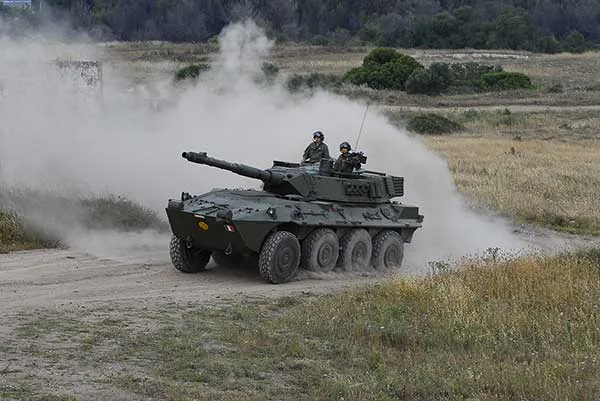

The "Savoia Cavalleria" Regiment (3rd) is one of the oldest and most glorious units of the Cavalry Corps of the Italian Army.
Since 2013, the regiment has been part of the Paratroopers Brigade "Folgore", serving as its reconnaissance unit. It is stationed in Grosseto.
It has participated in numerous military campaigns over the centuries, serving the Duchy of Savoy, the Kingdom of Sardinia, the Kingdom of Italy, and the current Italian Republic.
Within the 1st Squadron Group there is the 1st Paratrooper Reconnaissance Squadron, a Special Operations Support Unit (COS) with HALO/HAHO insertion capabilities, which the Joint Special Operations Command (COFS) can utilize in the planning of special forces missions, as a reconnaissance unit.
History
By decree on July 23, 1692, in the Duchy of Savoy, two different regiments were formed from the disbanded Brigade of Gens d'Armes of Piedmont, one of which was initially named Mombrison and then None, after the names of the commanders.
In the same year, it was named "Savoia Cavalleria", after the region where the cavalrymen were recruited, consisting of nine companies. In the years 1692 – 1693, it fought against the French in Piedmont and the Dauphiné. It was disbanded in 1699, but quickly reconstituted in 1701.
The regiment took part in all the independence wars of the Risorgimento. During the first war of independence (1848-1849), it participated in the Battle of Pastrengo (April 30, 1848), protecting the right flank of the Sardinian formation, and in the subsequent Battle of Goito (May 30, 1848), where it contributed, particularly with the Aosta Cavalry, to repelling the Austrian attempt to outflank the Sardinian forces. It participated, after the resumption of hostilities, in the unfortunate Battle of Novara (March 23, 1849) which, in fact, ended the war.

In 1859, it participated in the second war of independence mainly with reserve and flank protection duties for the army. On October 19, 1859, it received the name "Corazzieri di Savoia". It changed its name again to: "Savoia Cavalleria" Regiment on June 6, 1860.
During the First World War (1915-1918), the regiment initially employed only its machine gun sections (the 1497th machine gun company) dismounted on the Isonzo front. In August 1916, it received orders, along with the entire III Cavalry Division, to advance on the Aidussina basin as part of the operations for the conquest of Gorizia. In the period October - November 1917, after the tragic days of Caporetto, it protected the retreat of infantry units and significantly contributed to delaying the advance of German and Austro-Hungarian troops.
A year later, on October 30, 1918, during the final phases of the Battle of Vittorio Veneto, the regiment pursued the retreating enemy troops: it crossed the Piave, Livenza, and Tagliamento rivers, advancing towards San Martino di Campagna and Sedrano and capturing entire Austro-Hungarian units engaged in fierce rear-guard battles.
On November 3, 1918, a patrol of the Savoia Cavalleria, led by Lieutenant Carlo Baragiola, entered Udine, while the next day, the day of the armistice that ended the Great War for Italy, a regiment unit reached Caporetto.

It became the "Savoia Cavalleria" Regiment (3rd) on April 20, 1920. Since 1920, "Savoia Cavalleria" has been the custodian of the traditions of the disbanded "Lancieri di Vercelli" Regiment. In 1933, it adopted the distinctive red tie in place of the red edging on the black collar of the jacket.
During the Second World War, the regiment fought with great courage and skill.
On the Russian front, the Savoia Cavalleria distinguished itself in the famous Charge of Izbušenskij, which took place on August 24, 1942.
The regiment was heavily decimated during the retreat of Italian units from the Soviet Union, and only a small group managed to return to Italy. Among the horses in the Savoia Cavalleria during the Russian campaign was Albino, the horse that became famous after the war and is still preserved stuffed in the regiment's relic room.
After the war, the "Savoia Cavalleria" was involved in various peacekeeping missions and international operations.
The "Savoia Cavalleria" plays a key role within the "Folgore" Brigade, providing cavalry support and playing an important role in combat operations. The brigade as a whole is trained to be highly mobile and rapidly deployable, crucial characteristics for a paratrooper unit.
Current Organization

With the reorganization of the "projection forces" in 2013, it was integrated into the "Folgore" Paratroopers Brigade, of which it is the reconnaissance unit, with airborne capability.
From that moment, as evidence of the organic transformation of the unit (which now retains a residual armored capability), the regiment's personnel were ordered to use the maroon beret typical of airborne troops instead of the black one, historically assigned to armored units.
Following this measure, the regiment still retains armored capability.
Throughout its history, the regiment was awarded, in addition to the gold medal for the charge of Isbuscenskij, two other military valor awards, a bronze medal for the liberation of Udine at the end of the First World War in November 1918 and another bronze medal for operations conducted during the Russian campaign from August 1941 to May 1942.
The regiment's celebration day falls on August 24, the anniversary of the charge of Jsbuschenskij (1942).
Current Structure:
- Regiment Command
- Command Squadron
- Squadron Group composed of:
- 1st Reconnaissance Squadron "Abba" LRSU (Long Reconnaissance Surveillance Unit)
- 2nd Reconnaissance Squadron "Marchio"
- 3rd Reconnaissance Squadron "De Leone"
- 4th Heavy Armored Squadron "Manusardi"
Denominations
- 17th Century - 23.07.1692: Brigade of Gens d'Armes of Piedmont
- 23.07.1692 - 00.00.1692: Cavalry Regiment "Mombrison"
- 00.00.1692 - 00.00.1692: Cavalry Regiment "None"
- 00.00.1692 - 00.00.1699: Regiment "Savoia Cavalleria"
- 00.00.1701 - 09.12.1798: Regiment "Savoia Cavalleria"
- 09.12.1798 - 00.01.1799: 6th Cavalry Regiment
- 01.01.1815 - 03.01.1832: Regiment "Cavalleggeri di Savoia"
- 03.01.1832 - 19.10.1859: Regiment "Savoia Cavalleria"
- 19.10.1859 - 06.06.1860: Regiment "Corazzieri di Savoia"
- 06.06.1860 - 10.09.1871: Regiment "Savoia Cavalleria"
- 10.09.1871 - 05.11.1876: 3rd Cavalry Regiment (Savoia)
- 05.11.1876 - 20.04.1920: Cavalry Regiment "Savoia" (3rd)
- 20.04.1920 - 00.06.1946: Regiment "Savoia Cavalleria" (3rd)
- 10.09.1946 - 00.00.1948: 3rd Cavalry Reconnaissance Group
- 00.00.1948 - 15.04.1950: 3rd Armored Cavalry Group "Gorizia Cavalleria"
- 15.04.1950 - 04.11.1958: 3rd Armored Cavalry Regiment "Gorizia Cavalleria"
- 04.11.1958 - 11.10.1975: Regiment "Savoia Cavalleria (3rd)
- 11.10.1975 - 23.05.1992: 3rd Armored Squadron Group "Savoia Cavalleria"
- 23.05.1992 - present: Regiment "Savoia Cavalleria" (3rd)
Honors to the Standard
Bronze Medal for Military Valor
In the battle of resurgence (October-November 1918), while the bulk of the army was fighting on the Tagliamento, units of the regiment boldly entered Udine, still occupied by enemy forces, bringing it the first announcement of liberation.
Udine - Val Natisone, 1-4 November 1918
Bronze Medal for Military Valor
During a long cycle of war operations, even in the harshest and most uncertain situations due to environmental insidiousness and logistical and climatic adversities, with the pride of its ancient name, it made its old standard fly victoriously, imposing its aggressiveness and courage on the enemy everywhere. After pursuing strong enemy rearguards for two hundred and fifty kilometers, it gave new proof of its skill and impetuosity in occupying an important mining capital strongly defended by the adversaries.
Russian front: Dnipro, Stalino, Kriwojtorez, Pantelejmonowka, Orlowka - August 1941 - May 1942
Gold Medal for Military Valor
Hardened to every daring and sacrifice, during offensive operations for the conquest of an important industrial and mining region, he carried out with unwavering dedication and unchanged courage the burdensome, complex, and delicate missions, flanking large units engaged in pursuing significant and well-equipped enemy rearguards. When the battle suddenly flared up against the enemy, who, with the power of numbers and means, burst eagerly onto the southern bank of the Don, he swooped with lightning dexterity on the enemy columns, repeatedly subduing their stubbornness, thwarting their traps, and contributing, with rare skill and manly boldness, to the effective development of the stopping maneuver. Suddenly confronted by two enemy battalions during risky and deep reconnaissance, he contained their impact with the valor of the dismounted units and, venturing on horseback on the flank of the aggressors, annihilated their brutal resistance, restoring to the fight, with the dazzling impetus of victorious charges, the charm of the chivalric era and illustrating his name on par with the glories of the Risorgimento and its centuries-old traditions.
Russian front: Krasnj-Lutsch mining basin, July 1942; Simowskij, elevation 200.1, elevation 236.7, elevation 209.9 of Val Krisaja, Ciglione di Jbuschensij, Bachmutin, elevation 226.7 of Jagodnij, 21-30 August 1942
Bronze Cross of Army Merit
Cavalry regiment employed in Lebanon as a tactical maneuver group named "ITALBATT 2", distinguished itself during almost eight months of stay in the theater for commendable self-sacrifice, extraordinary spirit of sacrifice, superhuman commitment, and courage. Responsible for the control and security of one of the most sensitive sections of the demarcation line between Lebanon and Israel, it operated with admirable tenacity and indisputable professionalism, always ensuring a widespread and effective presence, even in a context with rapidly and progressively deteriorating political and institutional profiles. Men and women of the "Savoia", aware of the important task to be fulfilled, of the dangers and difficulties of the mission, conducted every assigned activity with the highest determination. Eager to emerge on par with their reputation, they demonstrated conscious courage, high military virtues, and contributed decisively to the success of operations, enhancing Italy's presence in the international context.
Al Mansouri/Zibquin - Lebanon, 2 October 2007 - 24 May 2008
Comments (1)