



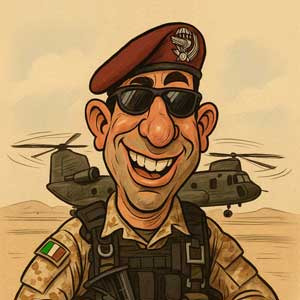
There are moments during an operation when two units may face the same problem and tackle it as if they live in different universes. Not because one is braver or more skilled than the other, nor because it has superior equipment, but because their mindset has been shaped by profoundly different missions and responsibilities.
The conceptual distance that separates a conventional unit from a special forces unit has nothing to do with cinematic rhetoric or the idea of “super soldiers.” It is instead the direct consequence of the operational function for which those units were created. As recently reminded by the Chief of Defense Staff, General Luciano Portolano, Special Forces are not “elite infantry” to be sent to the front line, but surgical tools, designed to achieve strategic effects with small numbers and high precision. Mass and continuity, on the other hand, belong to the conventional world, which provides the stable base on which the entire maneuver rests.
Two Complementary Ecosystems
Conventional units operate within a system aimed at large-scale maneuver, territory control, and time management along an articulated chain of command. In this context, discipline, consistency, and the ability to ensure continuous presence requiring significant numbers and stable procedures are necessary.
Special forces, on the other hand, live in an opposite ecosystem. They move on the edges of the political framework, in sensitive scenarios where margins for error are minimal and time is compressed. They almost always operate in small numbers, with high decision-making autonomy and a level of individual responsibility that would be unsustainable in larger structures.
This difference does not express a value judgment, but is the natural consequence of the operational functions for which these units were conceived.

Time: Distributed Resource or Cutting Blade
To truly understand the difference between these two worlds, one must observe how each relates to time.
In the conventional world, time flows along the chain of command. Information is gathered, analyzed, rises to higher levels, is integrated into a broader picture, and then comes back down in the form of coordinated orders. It is a slower process, but it allows thousands of people to move without colliding, maintaining consistency and control.
For Special Forces, time has another form: not a resource to be distributed, but a thin blade that forces decisions while observing. The OODA loop is not a theoretical concept: it is a continuous spiral where observation, orientation, decision, and action overlap. It is not about acting quickly, but about reasoning with a mental speed that allows the plan to be modified while it is underway.

Individual Responsibility
Another crucial difference is responsibility. In conventional units, it descends and ascends along the hierarchical levels in an orderly manner. The most delicate decisions are made higher up, based on an overall picture, and the distribution of tasks allows for stability and control.
In special forces, however, the distance between those who decide and those who execute is drastically reduced. The operator makes critical decisions independently and bears the immediate weight, both operational and moral. Where the structure cannot reach, intuition, experience, and the ability to anticipate developments intervene. It is a burden, not a privilege, that requires clarity even in the most absolute chaos.

Chaos: Threat or Natural Environment
On the ground, almost nothing happens exactly as planned. Every plan, even the best, cracks at the first contact with reality.
For conventional units, this means initiating a realignment process: communications, reordering, new orders. It is an approach that preserves effectiveness on a large scale.
For special forces, chaos is not an anomaly: it is an integral part of their operational environment. Training does not teach to avoid it, but to live with it, to recognize it as an inevitable interlocutor. A sudden change does not mark the end of the plan, but the beginning of another.
This is what allows a small group to generate effects disproportionate to its size.

Method: Execute or Build
Then there is the question of method. Conventional units, out of necessity of scale, work by following a defined solution, to maintain order among numerous and interconnected units.
Special forces proceed in the opposite way: they start from the desired result and work backward to create the conditions to achieve it. The question is not just “how do we do it?”, but “why do we do it, what risks do we take, what alternatives do we have?”. It is a method designed to adapt not only to unknown or hostile territories but also to political and cultural spaces where the rules are never clear and often change while moving.

Action is Only the Last Frame
The public sees only the action because it is the most spectacular part. But action is the last frame of a much longer, slower, and quieter process.
Beforehand, there is study, analysis, observation, invisible infiltration, continuous interpretation. If the intervention seems quick, it is because all the necessary slowness has already been spent beforehand, when no one was watching.
The true essence of Special Forces is not in the raid, but in the preparation that makes it possible.

Two Operational Languages, One Army
There are not two armies, but two operational languages that respond to complementary needs.
It is not a question of value, but of language: true strength arises from the ability to make different voices dialogue, not to standardize them. It is complementarity that makes an army truly resilient and effective.
It is wrong to employ Special Forces as mere elite infantry, just as it is wrong to expect conventional units to operate like Special Forces. Conventional units have doctrine, tasks, and capabilities built to bear the weight of maneuver, terrain control, and operational mass; Special Forces, on the other hand, are the result of a rare combination of individual predisposition, mental attitude, emotional resilience, and highly specialized technical skills.
Like in a racing team, a competition car wins only if the driver, engineers, and mechanics work in harmony: no one replaces the other, but without each, the car does not hit the track. Similarly, it is in the distinction and integration of roles that the true strength of Defense lies.




Comments
No comments yet. Be the first!