


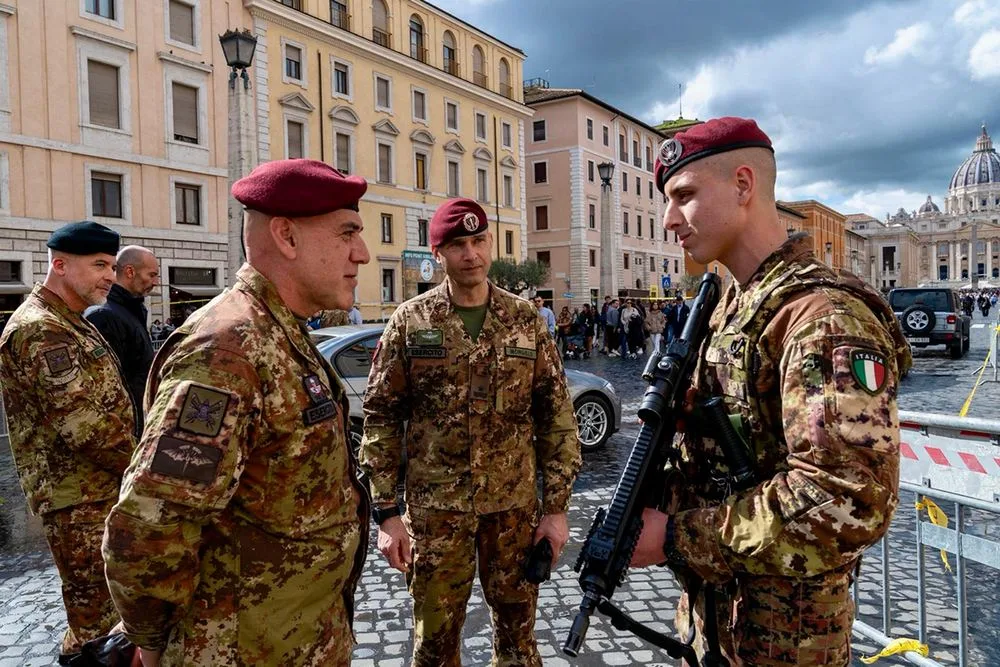

Until today, everyone was silent. From 2008 to today, all previous Chiefs of SME have remained silent. But not him. We expected it. We expected it because, from the first day of his appointment as Chief of Staff of the Army, we trusted in his stature as a Commander and Soldier. And finally, he declared it clearly: Operation Strade Sicure is a problem for the Italian Army. Words from General C.A. Paratrooper Carmine Masiello. The number one of the Army recently outlined in a parliamentary commission the conditions and challenges related to the "Strade Sicure" operation, emphasizing how it diverts important resources from the Armed Forces.
Despite the contribution to urban security, Masiello expressed concern about the sustainability of the operation. He highlighted that deploying such a large force for a prolonged period diverts essential resources from combat training, reducing the Army's operational readiness. This situation is exacerbated by the need for the psychological and physical recovery of soldiers after six-month deployment cycles, further compromising their preparation for institutional missions and high-intensity operations.
Launched on August 4, 2008, this operation has seen the deployment of Armed Forces units in conjunction with the Police Forces for specific crime prevention and control needs. Initially planned for a maximum of 6 months with a contingent of 3,000 units, the 2024 budget law now authorizes the deployment of 6,800 units until December 31 of this year.
The Chief of Staff of the Army reported how “the deployment of the Armed Forces in the Strade Sicure operation constantly diverts the equivalent of 12-14 maneuver regiments from combat training. Equally, forces in preparation focus their training on tasks for operations on national territory – he continues – This constant and prolonged deployment has a direct and cumulative effect on the level of preparation of the Armed Forces concerning the fulfillment of institutional missions. A situation is aggravated by the psychological and physical recovery and reconditioning of units at the end of the six-month deployment cycles. In fact, although personnel receive a comprehensive allowance and compensation for overtime work, averaging 55 hours per month at the end of the 6-month deployment, they accumulate an average of about 55 days of recovery, of which 40 for having served during holidays and non-working days and 15 for overtime work that exceeds the paid quota. This does not allow for meeting the need to train the Army and prepare the forces for deployment in increasingly competitive, high-intensity, and inherently lethal operational contexts as dictated by the aforementioned change in security paradigms.”
BrigataFolgore.net has also suggested in the past that the possible reintroduction of compulsory military service would allow, in addition to solving a series of problems within the Armed Forces, to reallocate resources for the Strade Sicure Operation, which does not necessarily require the participation of professional soldiers and could be entrusted precisely to conscripted soldiers.
We therefore hope that the national political apparatus will seriously perceive the words of the Chief of SME and stop using professional soldiers for tasks that have nothing to do with their real duties, we add. The Soldier must be a Soldier. The Soldier is part of an Armed Force. Public order should be the responsibility, in a civilized country, of the Police Forces. In recent years, the Armed Forces and the Police Forces in Italy have been improperly overlapped in their functions: not to mention the limitations that soldiers deployed in the Strade Sicure operations have, as they do not have judicial police functions. It is always up to the police forces present on site to proceed with arrests.
Perhaps it is time to address this situation and return to the Armed Forces all their already numerically deficient resources.


Comments
No comments yet. Be the first!