


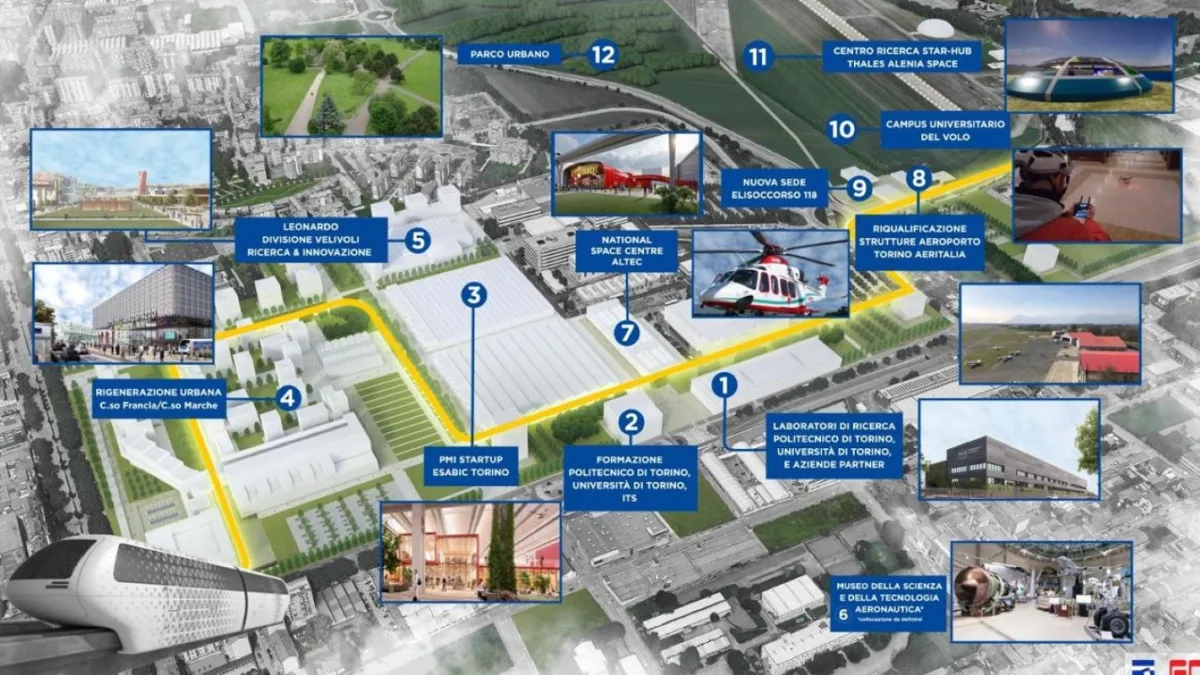

The agreement between the Piedmont Region and the Polytechnic University of Turin that initiates the expansion of the Corso Marche area is not just a construction project awaited for years: it is a step that consolidates Turin as a national platform for the space economy and, above all, opens an operational window for an actor already living in the city and its transformation: the Officers of the Italian Army attending the School of Application.
With Building 37 (10,000 sqm for research funded by the PNRR, with completion expected by 2026) and the future House of SMEs in Building 27 (estimated 30–35 million, public-private model to be defined), the “City of Aerospace” evolves from a label to a real infrastructure: laboratories, enterprises, dual-use technologies, demonstrators, and skills that directly impact contemporary ways of conducting operations, including land maneuvers.

Why this is a specific opportunity for the Army
In the Italian public debate, “space” is often treated as something the Army can simply receive (SATCOM, images, PNT/GNSS, alerts). But this approach is increasingly risky: today space is an operational multiplier, target, source of vulnerability, and a “terrain” of competition, with immediate effects on land battles (sensor-to-shooter, C2 resilience, force protection, navigation, and synchronization). This is the central thesis of the analysis “Space is not someone else's,” which focuses on a simple point: without organic “land-centric” competence on space effects, the land component ends up depending on others in terms of timing, priorities, and even operational language.
Translated for Turin: the City of Aerospace can become the living classroom where to build (or accelerate) that culture, transforming an industrial district into a multidomain gym for the Officers of the School of Application.

The US lesson: “in-house” competence without duplicating missions
A useful reference comes from the United States. In a February 6, 2026 interview with Breaking Defense, Col. Felix Torres (SMDC Center of Excellence) explains that the new US Army space-related career (about 1,000 positions, MOS “40D Tactical Space Operations Specialist”) is not born to “invade” the Space Force's field, but because each Armed Force has specific needs: the Army mainly oversees the tactical realm and effects on land maneuvers, while the Space Force remains focused on orbital operations and satellite control. The key concept is that overlap does not mean duplication: it is possible to coexist in the same domain with different, integrated missions.
This logic is perfectly consistent with the Turin objective: using Corso Marche not to “make space” instead of others, but to make the land component competent and autonomous in the tactical-operational use of space effects.

In Italy, space is already an operational domain: now educational consequences are needed
Italy is not starting from scratch. The Space Operations Command (COS) was established on June 8, 2020 with the mission to enhance national capability in the space domain, protect/defend assets, and integrate space services into operations.
And training is already including realistic scenarios: in the Annual Space Exercises where the COS integrated space into planning and conduct processes, including cases like SATCOM jamming, risk management, and the use of satellite services to support land campaigns.
The issue, then, is not “if” space matters for the Land, but who governs it when needed: at the brigade/battalion/task force level, in the operational minute, within degraded and contested environments.

City of Aerospace + School of Application: a natural bridge
That's why the expansion of Corso Marche can become a great opportunity for the School of Application: Turin is concentrating in the same place universities, large enterprises, SMEs, and laboratories on technologies that directly impact the decisive functions of land operations:
- Resilient C2 and beyond-line-of-sight communications (tactical SATCOM, jamming mitigation);
- PNT and defense against spoofing/jamming (synchronization, fire, logistics, C2 networks);
- ISR/targeting and reduction of sensor-to-shooter times;
- Force protection and situational awareness in multidomain contexts.
Moreover, the Turin axis is also strengthening on the “new space” industrial side: the IRIDE program, an Italian Government initiative coordinated by ESA with ASI support and funded with PNRR resources, aims to provide satellite data and services to support Public Administration and territory monitoring; it is a concrete piece of the national supply chain that also lives in the Turin area.
The proposal: transform Corso Marche into an “operational campus” for Officers
To make the opportunity measurable (and not just narrative), the City of Aerospace could host a stable path dedicated to the Officers of the School of Application, with three pillars:
- Operational literacy on the space domain (lexicon, value chain, limits, and vulnerabilities) with real cases of “degraded space environment.”
- Space–Cyber–EW integration for Land maneuver, with tabletop exercises and scenarios where PNT/SATCOM/ISR are degraded and TTPs need to be adapted.
- Connection with SMEs and laboratories (House of SMEs + Building 37) to understand how rapid solutions are born: prototypes, sensors, data fusion, adaptive training, predictive maintenance—with immediate impacts on readiness and sustainability.


Comments
No comments yet. Be the first!