


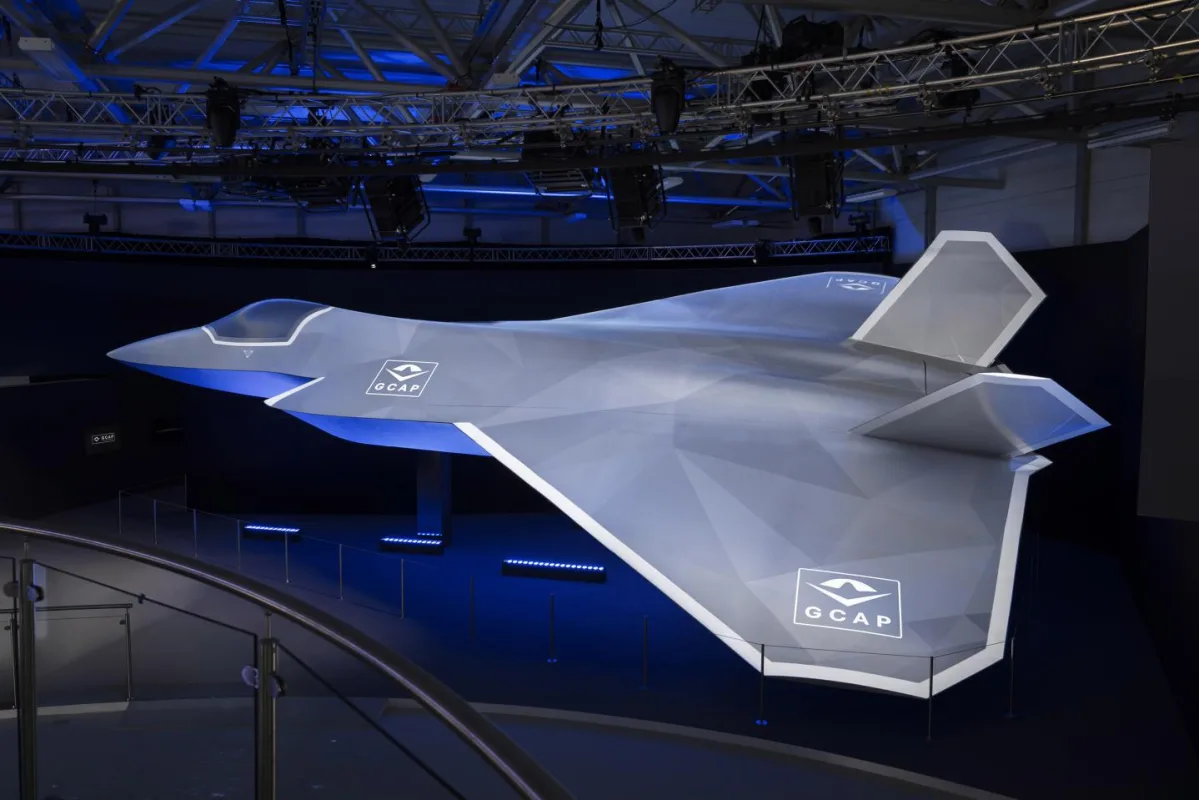

While London hesitates on funds and costs triple, the structural limit of a consortium lacking the German economic engine emerges. For the Italian Defense budget, the project risks turning into a leap into the void.
The Global Combat Air Programme (GCAP) has officially entered a zone of strong geopolitical and economic turbulence. The multinational project born to create the sixth-generation fighter Tempest is now facing the strategic doubts of its own promoters. But if the main uncertainty at this moment comes from the United Kingdom, it is by looking at the overall European picture and the stifled coffers of the Italian Defense that the ambitious program takes on the contours of a high-risk gamble.
The UK Factor and the Alarm of Tripled Costs
The core of the entire operation lies across the Channel, and it is precisely from there that the most worrying signals come. The rumors reported by the Telegraph about the postponement of the release of British funds to 2035 – the year the fighter was supposed to enter service – risk derailing the entire planning.
The deadline of June 30 for the approval of allocations by London is a dramatic step: without certainties, thousands of specialized engineers (including within Leonardo) will inevitably be reallocated to other competing programs. Behind the UK's hesitations is the explosion of costs for the development phase alone, which have skyrocketed in just a few years from 6 to a staggering 18.6 billion euros. An inflationary spiral that has led the British government agency Nista to define the project's success as "unachievable" in the current state.
The Strategic Mistake: Can We Do Without Germany?
The current architecture of the GCAP exposes a deep political and industrial limit. A program of such magnitude – which aims to redefine global technological standards between artificial intelligence, autonomous swarm flight, and directed energy weapons – cannot realistically do without Germany's presence.
The history of the European defense industry teaches that major successful programs (like the Eurofighter) have always required a critical economic and political mass that only the axis between the main continental powers can guarantee. Berlin, with its solid industrial base and undeniable financial capacity, has always represented the indispensable engine to cushion the risks of projects with very high technological density. Leaving Italy to bear the weight of such a challenge alongside a United Kingdom distracted by its internal crises and a Japan geographically and strategically distant, deprives the project of the necessary European economic center of gravity.
For Italy, It's Too Big a Gamble
In this scenario, Italy's position appears the most vulnerable. The situation of funds allocated to national Defense is notoriously far from flourishing. The Italian defense budget is structurally rigid, constantly squeezed between the need to maintain daily operations and the scarce resources allocated to investment chapters.
Betting billions on a long-term program like the GCAP, whose financial estimates continue to swell, represents an economic gamble that the country cannot afford. The concrete risk is to "cannibalize" the entire Multi-Year Programmatic Document (DPP), draining vital resources for the immediate needs of the military instrument.
While chasing the dream of a sixth-generation fighter, the Italian Armed Forces find themselves having to face much more pressing and concrete operational priorities:
- The Drone and C-UAS Revolution: Today's conflicts demonstrate that the absolute priority is the dominance of unmanned systems (UAV/UAS), the development of resilient mesh networks, and the acquisition of counter-drone systems. Sectors where tactical effectiveness is achieved with rapid and targeted investments, not with twenty-year programs.
- The Tactical Transport Crisis: The tactical transport fleet urgently needs upgrades to ensure the rapid projection of our units in the hottest operational theaters (such as the wider Mediterranean and Africa), a sector that risks running out of funds if resources are absorbed by the Tempest.
- Exercise and Training: Compromising funds for the efficiency of current means, fuel, and flight hours to pay for the GCAP development share would mean having, in the future, a futuristic prototype in industrial salons, but operational units incapable of expressing real readiness for deployment.
Conclusions
If for the United Kingdom the GCAP is a political game on its post-Brexit role, for Italy it risks being a dead end. Deprived of the financial lung that Germany's inclusion could have guaranteed, and faced with a hesitant Great Britain, Italy would do well to coldly assess its budgetary limits.
Continuing to invest blindly in a project whose costs have already tripled is no longer a farsighted industrial choice: it's too big a gamble that risks mortgaging the security of the present in the name of a financially unsustainable future.



Comments
No comments yet. Be the first!