


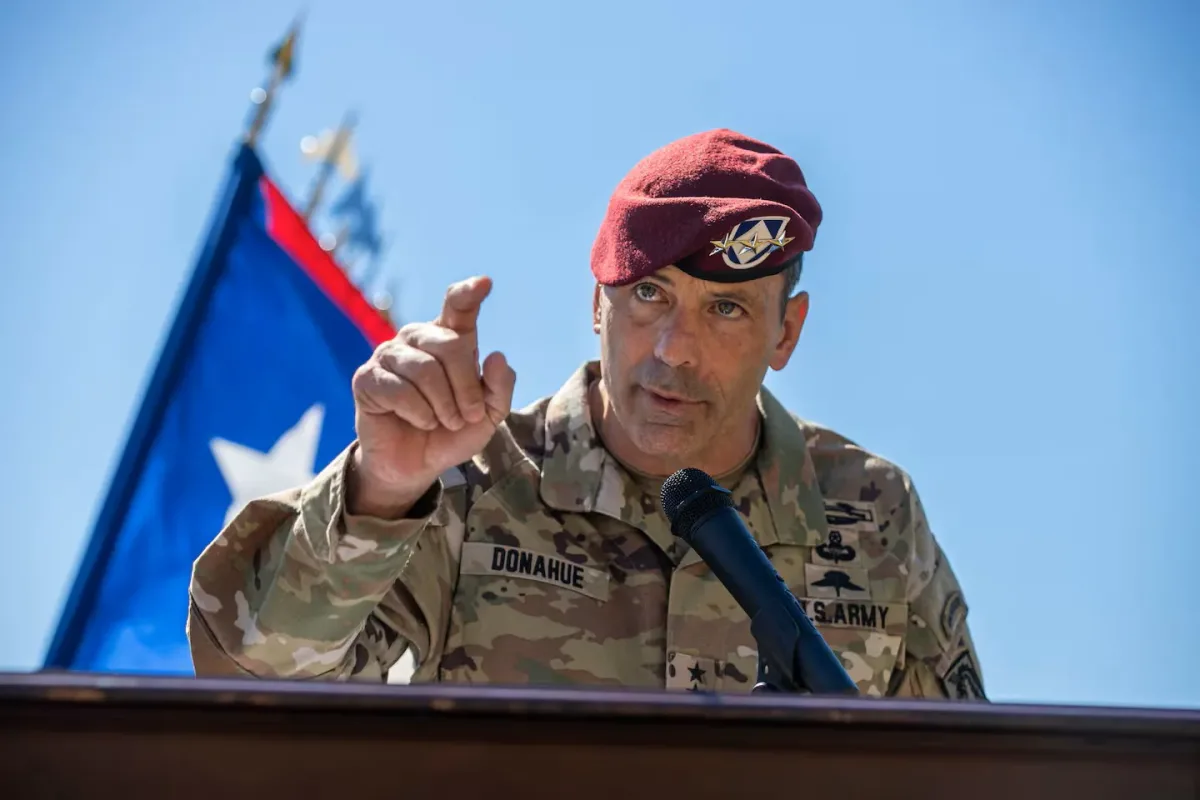

The Pentagon is undergoing its most radical transformation since the post-World War II era, but behind the rhetoric of "merit" and the fight against "woke" culture lies a much deeper reality: an irreparable rift between the political class in command and the military leadership. The dismissal of General Chris Donahue — the latest in a long series of 25 senior officers removed by Secretary of Defense Pete Hegseth in just eighteen months — is not just a routine turnover. It is a signal of a defense system breaking under the pressure of political leadership that seems to confuse the art of war with a self-referential power logic.
The code of honor versus blind loyalty
American generals raised among the dusty outposts of Iraq, the valleys of Afghanistan, and the delicate chessboard of NATO's eastern flank share an unwritten code: loyalty to allies, precision in procedures, and a deep understanding of the geopolitical consequences of every single order. It is a culture based on operational meritocracy and a solid respect for the institutional chain of command.
In contrast, the current Pentagon leadership seems to operate according to diametrically opposed criteria. The rhetoric justifying the removal of officers — accused of being "promoted for woke reasons" — deliberately ignores the field experience of men like Donahue, a Delta Force veteran and a man who has personally experienced the complexities of real war theaters. Replacing established experience with uncritical loyalty to the Trumpian political project is not just a change of guard; it is a weakening of America's decision-making capability.
The approach of technocrats lacking field experience
The real risk, perceived by analysts and military leaders themselves, is that military strategy becomes subordinate to an approach alien to the war culture. Recent history, marked by diplomatic tensions and missteps, shows that politics risks losing touch with operational reality.
When Secretary Hegseth announces a "deep review" of the American deployment in Europe without even notifying NATO commands, he is not just "simplifying bureaucracy." He is risking isolating the United States, treating historical alliances as negligible variables in an internal power game. The Gulf episode is just the tip of the iceberg: a demonstration of how, without the restraint and competence of military cadres, decisions made hastily in a Washington room can translate into serious tactical misunderstandings.
Towards a centralized (and risky) command
Hegseth's goal, in line with the directives of Project 2025, is total centralization. By eliminating critics, the "troublesome" generals who dare to raise strategic or ethical objections to operations like the attack on Iran, the Pentagon is becoming an organ of pure political execution.
The military culture, understood as a balance between pragmatism and strategy, is being dismantled in the name of an ideological vision. But a democracy cannot afford to transform its military hierarchy into an office of political undersecretaries. When direct experience is sacrificed on the altar of partisan loyalty, the consequences fall not only on a general's career but on the global security of an entire Alliance.
As military hierarchies look with increasing alarm at the corridors of the Pentagon, a spontaneous question arises: how long can the operational effectiveness of a complex machine like the American military endure when those who lead it have stopped listening to those who have fought the real wars?




Comments
No comments yet. Be the first!