


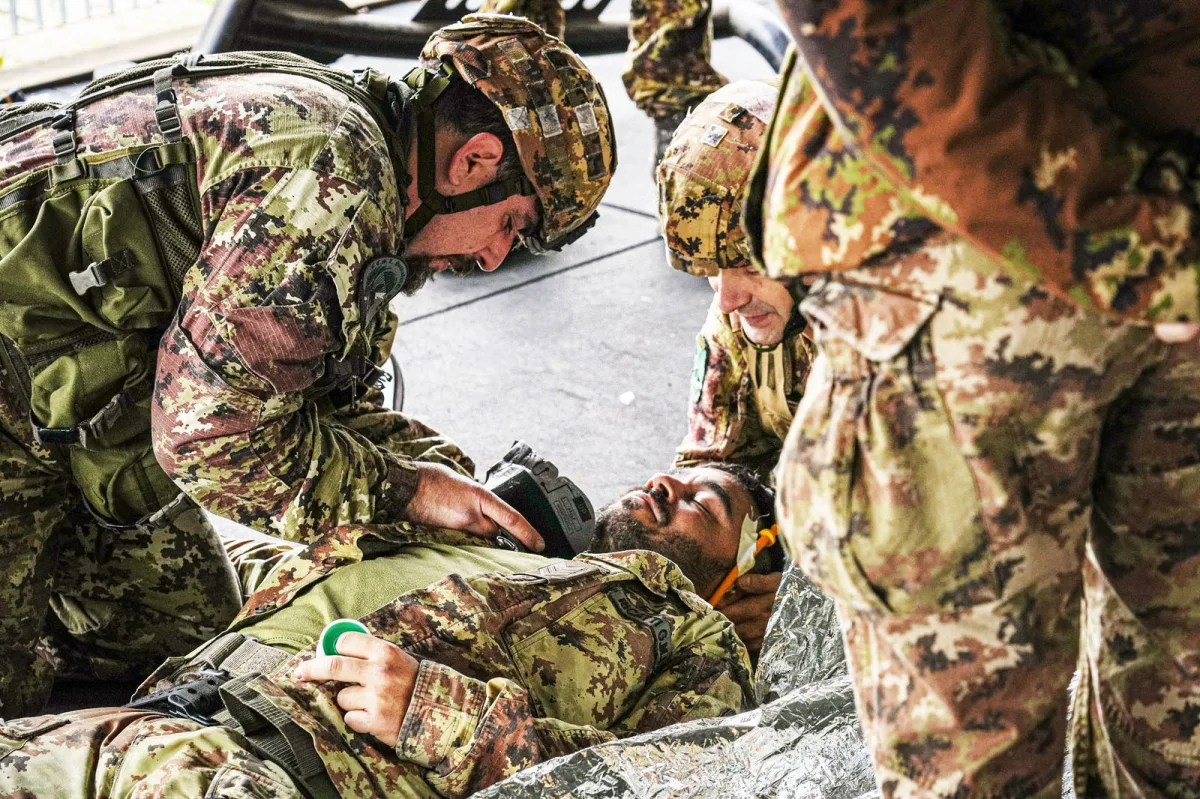

Recently concluded at the Multifunctional Training Complex of the Folgore Paratroopers Brigade in Livorno, a TCCC training course and two update seminars for Military Rescuers (So.Mi.). These programs, organized by the "Folgore" Brigade in collaboration with the Army's Military Health and Veterinary School, involved over 60 participants from the Folgore, the Army Special Forces Command, the Carabinieri of the 13th Carabinieri Regiment "Friuli Venezia Giulia" and the 132nd Armored Regiment.

The importance of training and updating
The courses were developed through cycles of theoretical lessons and practical activities, following the guidelines of the Tactical Combat Casualty Care (TCCC) protocol. This approach, recognized by the United States Special Operations Command (USSOCOM), aims to enable military personnel not belonging to the Medical Corps to perform life-saving maneuvers on combat casualties with timeliness and effectiveness.
The acronym TCCC stands for Tactical Combat Casualty Care, or tactical combat medicine, a protocol developed in the 1990s by the American special forces. Initially applied in the conflicts in Iraq and Afghanistan, TCCC has shown remarkable effectiveness in reducing complications from battlefield injuries, improving intervention techniques and evacuation procedures from the operational theater. Thanks to these innovations, the mortality rate of wounded soldiers has significantly decreased.

The TCCC approach in casualty management
TCCC systematically manages the treatment of combat casualties through three phases:
- Care Under Fire – The initial management of the casualty in the combat zone, during enemy fire. The casualty must, if possible, continue to fight and seek cover. The rescuer must ensure that their actions are compatible with the situation and provide transport to a safe area, trying to control any massive hemorrhages with the use of a tourniquet.
- Tactical Field Care – Once a secure perimeter is established, the rescuer performs triage of the casualties and intervenes with specific maneuvers:
- Control of hemorrhages with advanced techniques and dressings.
- Airway support and management of potential tension pneumothorax.
- Monitoring circulation with vascular access and administration of essential drugs (e.g., Tranexamic acid in case of hemorrhagic shock).
- Prevention of hypothermia and management of potential burns and eye injuries.
- Immobilization of fractures and evaluation of the peripheral pulse.
- Communication with the casualty to reassure them and with the tactical evacuation system (TACEVAC).
- Completion of the TCCC Casualty Card, documenting all procedures performed.
- Tactical Evacuation Care – In this phase, the casualty is handed over to the evacuation teams. Essential information, such as hemodynamic stability, treatments performed, and clinical conditions, are transmitted to the evacuation medical personnel. Security is maintained throughout the process.
The importance of the Tourniquet
A fundamental device in the management of massive hemorrhages is the tourniquet, which allows stopping blood flow in case of severe arterial injuries or amputations. This device, usable autonomously by the wounded soldier, ensures effective hemostasis in critical situations. However, it should not be maintained for more than two hours to avoid irreversible tissue damage.

The role of Military Rescuers in the "Folgore" Brigade
Within the "Folgore" Paratroopers Brigade, the military rescuer paratroopers represent a strategic resource, being present in every team or section to ensure immediate first aid in case of a comrade's injury. Their role is crucial in the first ten minutes following the incident, a critical period for the casualty's survival, until the arrival of specialized medical personnel or their evacuation to a hospital facility. This operational capability is particularly significant in contexts where immediate medical assistance is not available.
A constant commitment to operational safety
The continuous training of Military Rescuers is part of a broader framework of updating and specialization of the armed forces, aimed at improving operational readiness and the safety of personnel employed in high-risk scenarios. The adoption of TCCC procedures ensures high standards in the management of military emergencies, contributing to saving lives and making the entire rescue system more efficient in the most complex operational contexts.


Comments
No comments yet. Be the first!