


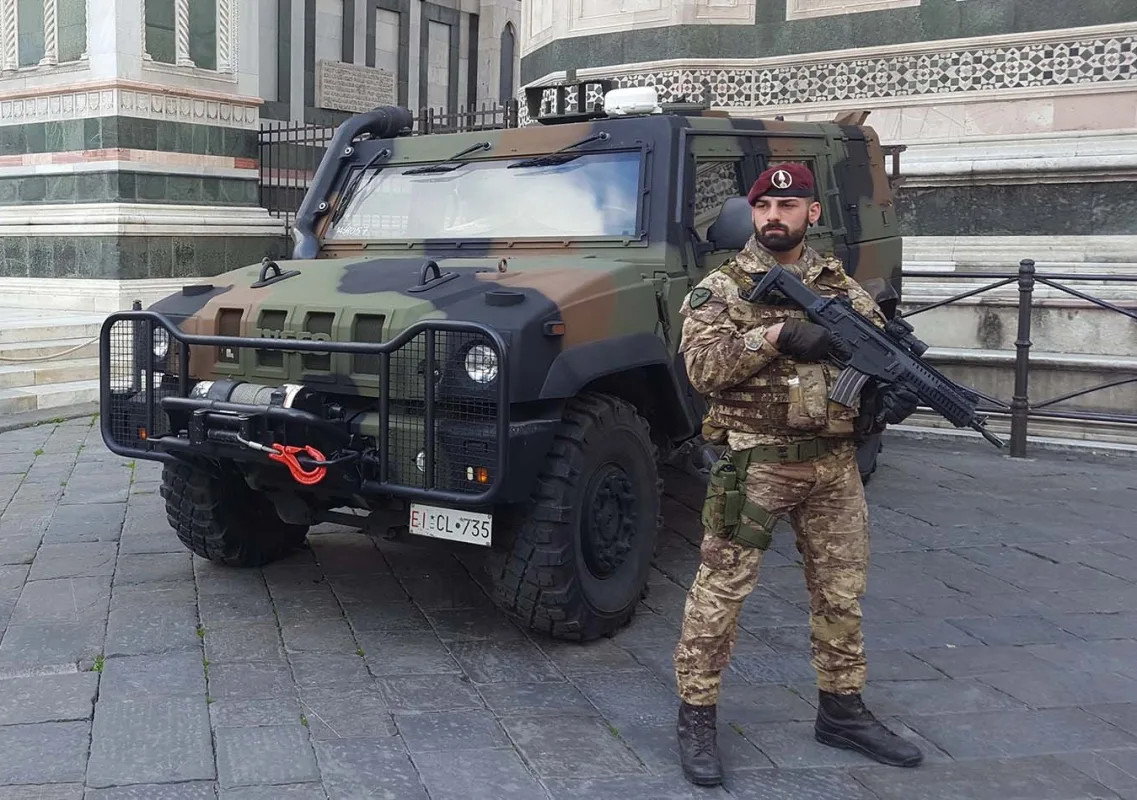

Rome, March 30, 2025 – Over fifteen years since its inception, the “Strade Sicure” operation might be on the verge of a substantial evolution. This is what emerges from the hearing of the Chief of Defense Staff, General Luciano Portolano, before the parliamentary committees convened to discuss Italian military missions for 2025.

The Strade Sicure operation born in extraordinary times
At the center of the debate is the role of the Armed Forces in the protection of the national territory and the need to rethink their operational methods, in light of changes in the internal and international context. The use of the military in support of internal security has distant origins, rooted in the dramatic mafia massacres of 1992, when Italy, struck at its heart by “Cosa Nostra”, launched the “Vespri Siciliani” operation.
In that vein, the “Strade Sicure” operation was developed in 2008, designed to support law enforcement in the surveillance of sensitive targets and in the prevention of terrorist and criminal threats. Initially conceived as a temporary intervention, it has been gradually extended and expanded, involving over 7,500 units.
To date, the operation represents the largest commitment of the Army on national territory: 6,000 soldiers employed in “Strade Sicure” and 800 in the parallel “Stazioni Sicure”, extended until 2027 by the 2025 Budget Law.

The issue of effectiveness: more quality, less quantity
During the hearing, General Portolano raised a crucial question: “Strade Sicure was born in a moment of emergency. Now we must ask if the emergency continues.” A point that invites reflection on the structural nature assumed by an operation born to face a critical phase and which today risks becoming a permanent measure, with a constant and burdensome use of military resources.
The Chief of Defense Staff indicated the need for a restyling: fewer numbers but more effectiveness, also through more dynamic operational methods. Among the proposals, the transition from fixed surveillance of individual targets to dynamic surveillance of entire urban areas, potentially able to cover more sensitive sites with mobile patrols, on the indication of the prefects. The issue of the use of the military on the territory intertwines with the broader question of the sustainability of the Defense model.
Minister Guido Crosetto emphasized that “the personnel blanket is short” and announced the need for a comprehensive rethink: new investments, increased personnel, and adequate training. “Today the numbers are calibrated for another historical era – he explained – but the world has changed, and continues to change rapidly.”

A presence to be reconsidered in the new global scenario
The reflection on the future of “Strade Sicure” comes at a time when Italy is involved in 41 military missions, 39 abroad and 2 on national territory. A complex commitment, in a global context marked by tensions in Ukraine, the Middle East, the Western Balkans, and beyond. In this scenario, the presence of the Armed Forces in Italian streets remains a reassuring element for many citizens.
However, its very longevity raises doubts about its nature: is it still an extraordinary operation, or has it now become an integral part of ordinary security? The debate is open, and General Portolano seems to indicate a middle way between abandoning the operation and simply extending it: transforming it, modernizing it, making it more streamlined and effective.
A “restyling”, indeed, that allows the Armed Forces to continue contributing to national security, but with more flexible tools, better calibrated to current needs. With the Jubilee approaching and international tensions increasing, the military presence on Italian territory is destined to remain a fundamental resource. But even resources, sooner or later, need to be reconsidered.


Comments
No comments yet. Be the first!