


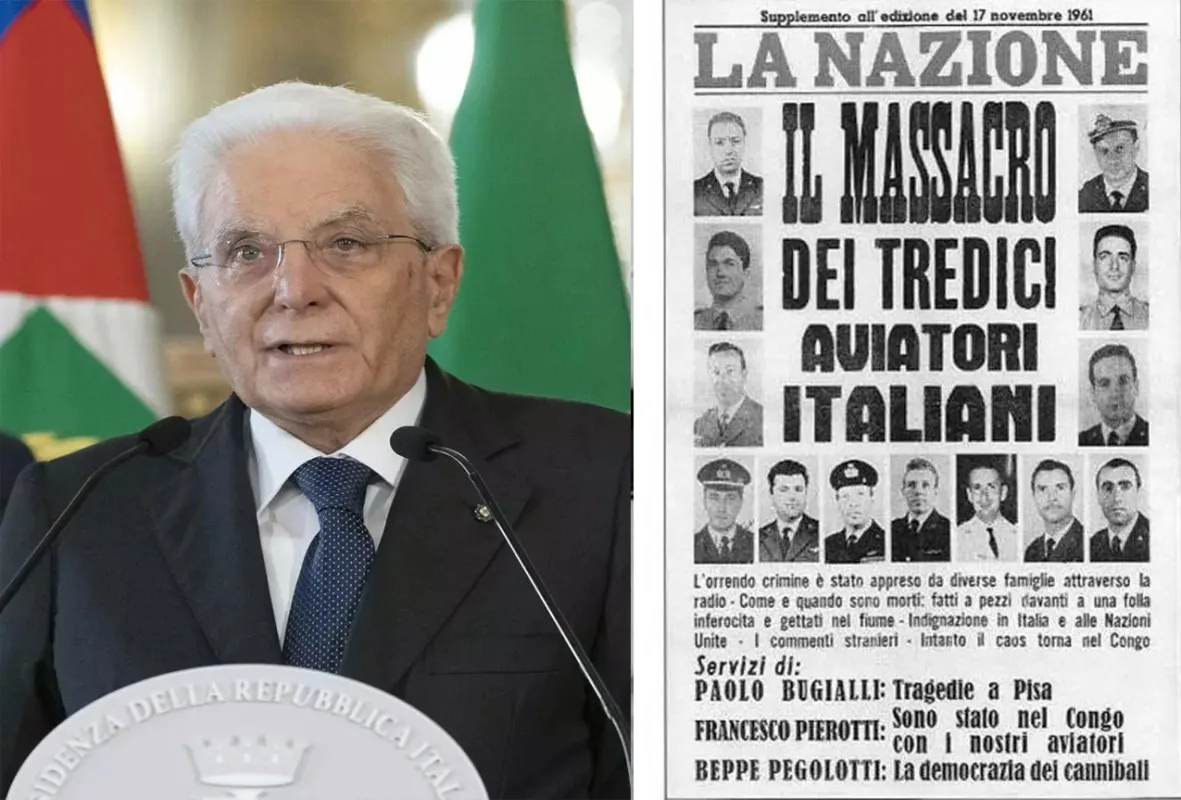

In the traditional end-of-year speech 2025, the President of the Republic Sergio Mattarella solemnly remembered the tragedy of the Kindu massacre, a painful episode in which thirteen Italian aviators from the 46th Aerobrigata of Pisa were killed in Congo during a United Nations peace mission on November 11, 1961.
Mattarella emphasized that this page, after over sixty years, remains an open wound in our national memory and represents a profound warning about the value and cost of peace.
In his message to the Italian citizens, the Head of State linked the sacrifice of those soldiers to Italy's broader commitment to international stability and the shared values of civil coexistence.
This reflection reinforced the central theme of the speech: peace is not an abstract ideal but a daily commitment, often accompanied by painful sacrifices.
The Context: Congo Between Chaos and International Interests
Congo gained independence from Belgium in 1960, inheriting an institutional void and deep tribal fractures, fueled by colonial and geopolitical interests.
Complicating the picture, international powers and interests moved to influence the country's fate, attracted by its immense mineral and strategic resources. In this context, the secession of Katanga took shape, the richest and most industrialized region, supported by substantial foreign capital and the use of European mercenaries.
The young Congolese state thus found itself divided among three centers of power:
- the central government of President Joseph Kasa-Vubu, with the forces of Colonel Joseph-Désiré Mobutu in the western sector;
- the supporters of Patrice Lumumba, led by Antoine Gizenga and General Lundula, with Soviet support in the eastern regions;
- the secessionist Katanga of Moïse Ciombe (Tshombe), supported by mercenaries and European economic influences.
The crisis quickly degenerated. In July 1960, just a month after independence, Katanga declared its autonomy, sparking a civil war. Shortly after, Patrice Lumumba, the first Congolese prime minister and symbol of the attempt to emancipate from external control, was assassinated.
The murder — perpetrated by Katangese forces with the complicity of the central power — opened an even more dramatic phase. Mobutu, then head of the army, would consolidate an authoritarian regime lasting nearly forty years in the following years.
In this explosive climate, amid internal rivalries and international pressures, the United Nations decided to intervene: in August 1960, with the mission ONUC, the blue helmets were deployed in an attempt to stabilize the country and prevent a large-scale regional conflict.

The Italian Crews and the Last Mission
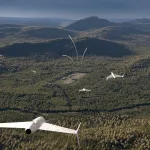
The two Italian aircraft — C-119 “Lyra 5” and “Lupo 33” — had been operating in African skies for over a year. On November 21, they were to return home.
On November 11, they took off from Leopoldville to deliver supplies to the Malaysian UN garrison in the Kindu area, on the edge of the Congolese forest.
The region had been shaken by weeks of violence and tension: armed bands, propaganda, suspicion towards anyone foreign. There was an unfounded fear of a Belgian mercenary airdrop supporting Katanga's secession. The Italian planes were to stop in Kindu only long enough to unload and, for the crews, to eat something.

The Massacre
The appearance of the two Italian C-119s, mistaken for Katangese aircraft loaded with paratroopers, triggered panic among the soldiers in Kindu. Hundreds of militiamen reached the airport by truck: the thirteen aviators, led by Major Amedeo Parmeggiani, were eating at the UN mess, a villa about a kilometer from the runway, along with about ten Malaysian officers.
Around 16:15, a first group of about 80 Congolese soldiers stormed the building: Italians and Malaysians, almost all unarmed, were overwhelmed and beaten; medical lieutenant Francesco Paolo Remotti, attempting to escape through a window, was caught and killed.
At 16:30, another 300 militiamen led by the local commander, Colonel Pakassa, arrived. Malaysian Major Maud tried in vain to explain that the aviators were UN personnel. At 16:50, the twelve survivors, forced to carry Remotti's body, were loaded onto trucks, taken to the city, and locked in the small prison. Meanwhile, arriving from Leopoldville, General Lundula and ONUC officials attempted to negotiate, but to no avail: the Congolese command seemed unable to control its men.
During the night, Congolese soldiers stormed the cells and shot the twelve Italians. The bodies, initially left on site, were soon after taken by the prison guard who, fearing desecration, transported them to the forest and buried them in a mass grave. Meanwhile, the militiamen spread the rumor that the Italians were supplying the secessionists and had been lured to Kindu by a supposed control tower trick; a few days later, Alberto Ronchey from La Stampa found that the tower had been out of service for months, debunking those versions.
The Return Home and a Nation's Mourning
For days, silence fell. No news came of the fate of the thirteen aviators, and even the UN command avoided rash moves to prevent chain reactions, unaware that the Italian soldiers had already been killed. Only weeks later, the prison guard found the courage to contact the Arcidiacono brothers, Italians who had been in Kindu for years: thanks to their information, it was possible to piece together the facts and activate the United Nations for the recovery of the remains.
In February 1962, a convoy of the Austrian Red Cross, escorted by Ethiopian blue helmets and accompanied by two officers of the 46th Aerobrigata (Lieutenant Colonel Picone and Major Poggi), located the mass grave in the Tokolote cemetery, a village on the banks of the Lualaba. The bodies, protected by a thick layer of clay, were in such condition as to allow immediate identification.
Transferred to the Kindu airport, they were loaded onto an Italian C-119 for Leopoldville and then returned to Italy aboard a US C-130.
The Thirteen Fallen of Kindu
- Maj. pilot Amedeo Parmeggiani
- Capt. pilot Giorgio Gonelli
- Lt. medical officer Francesco Paolo Remotti
- 2nd Lt. pilot Onorio De Luca
- 2nd Lt. pilot Giulio Garbati
- W.O. engine mechanic Filippo Di Giovanni
- W.O. engine mechanic Nazzareno Quadrumani
- Sgt. Maj. flight electrician Armando Fabi
- Sgt. Maj. radio operator Antonio Mamone
- Sgt. Maj. assembler Silvestro Possenti
- Sgt. Maj. assembler Nicola Stigliani
- Sgt. flight electrician Martano Marcacci
- Sgt. radio operator Francesco Paga
The Memory and the Value of Sacrifice
For decades, the event remained steeped in pain, confused accounts, and international indignation. Only in 1994 were the Fallen awarded the Gold Medal for Military Valor. In 2007, a compensation law for the families was approved.
Today, monuments and memorials preserve their memory: from Pisa to Fiumicino, from Milan to many Italian towns that have named streets and squares after the Fallen of Kindu.
Sixty-four years after that November 11, 1961, Italy remembers its aviators with respect and gratitude.
In a world that still knows conflicts, instability, and complex international missions, the sacrifice of the Fallen of Kindu reminds us of the value of silent service, of military commitment alongside democratic institutions and people in need.


Comments
No comments yet. Be the first!