


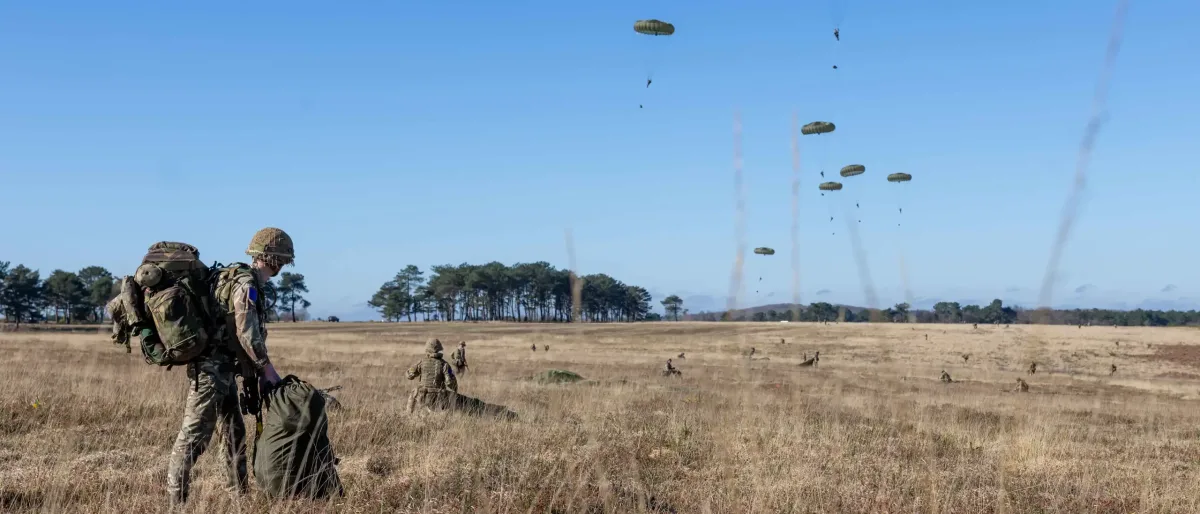

There is a pride that does not arise solely from the flag sewn on the sleeve, but also from the shared hardship. It is the pride of the “Airborne Family”: a cross-sectional community of paratroopers who, although coming from different units and countries, immediately recognize themselves in a common language made of discipline, simplicity, and sacrifice.
When airborne units train together, they are not just “engaging in activities”: they are reaffirming an identity. Because for those who live the air and the ground in that way, belonging is not theory: it is body, weight, short breath, cold nights, and endless waits before the moment the hatch opens.

Hardship as a Passport
In the Airborne Family, there is no need for introductions. You recognize each other by details that matter more than words:
- the look of someone who knows that the hard part begins after landing;
- the meticulous attention to equipment, because “if something is missing, you pay for it”;
- the silent respect for procedures and timing, not for formality but for survival.
Here, hardship is a passport. It is not glorified for masochism: it is accepted because it is the price of reliability. And reliability, in the airborne world, is everything.
Sacrifice: Being Ready Before, with Less, Further Away
Paratrooper sacrifice is not just physical risk. It is also the renunciation of comforts and certainties:
- leaving light on support and heavy on responsibility;
- relying on what you have on you and who is beside you;
- withstanding the friction of fatigue without losing clarity.
Airborne forces are often called to be the first: those who enter when the environment is still uncertain, when logistical lines are not ready, when the margin for error is minimal. This generates a simple ethic: prepare as if no one could help you immediately, but act as if you had to help others.
The Backpack: the Truest Symbol
If the Airborne Family had a universal icon, it would be the backpack. Not because it makes a “scene”, but because it brutally tells the reality: you carry your autonomy with you.
The backpack is:
- survival (water, food, protection, first aid),
- continuity (ammunition, energy, communications),
- responsibility (what you lack you don’t go to get: you pay for it),
- solidarity (often you carry pieces that serve the group, not just you).
That weight also has a moral value: it is proof that you are not there to “make an appearance”, but to endure. And when everyone carries the same weight — each with a different role — a concrete brotherhood is born: not romantic, but functional, reliable.

A Family That Doesn’t Tell: It Shows
The Airborne Family is not a club and it is not nostalgia. It is a way of being operational in the world: few words, many actions. Esteem is not obtained with declarations, but with repeated behaviors:
- meticulous preparation,
- resilience under stress,
- the ability to remain useful even when the body says “enough”.
And perhaps this is the heart of paratrooper pride: knowing that, wherever you go, you will find someone who understands without explanations what it means to tighten the straps, check the equipment once more, and accept that your day — and sometimes your safety — depends on discipline and your companion.


Comments
No comments yet. Be the first!