



There is a simple way to understand if an institution is truly “modern”: not by how much it talks about the future, but by how much it accepts confrontation with what challenges it. In Italy of 2026, one of these challenges is called cognitive domain: the ability to navigate through incessant information flows, propaganda, induced emotions, and competitive narratives. It is not a “journalists'” topic. It is a matter of democratic security. And it is also a matter of education.
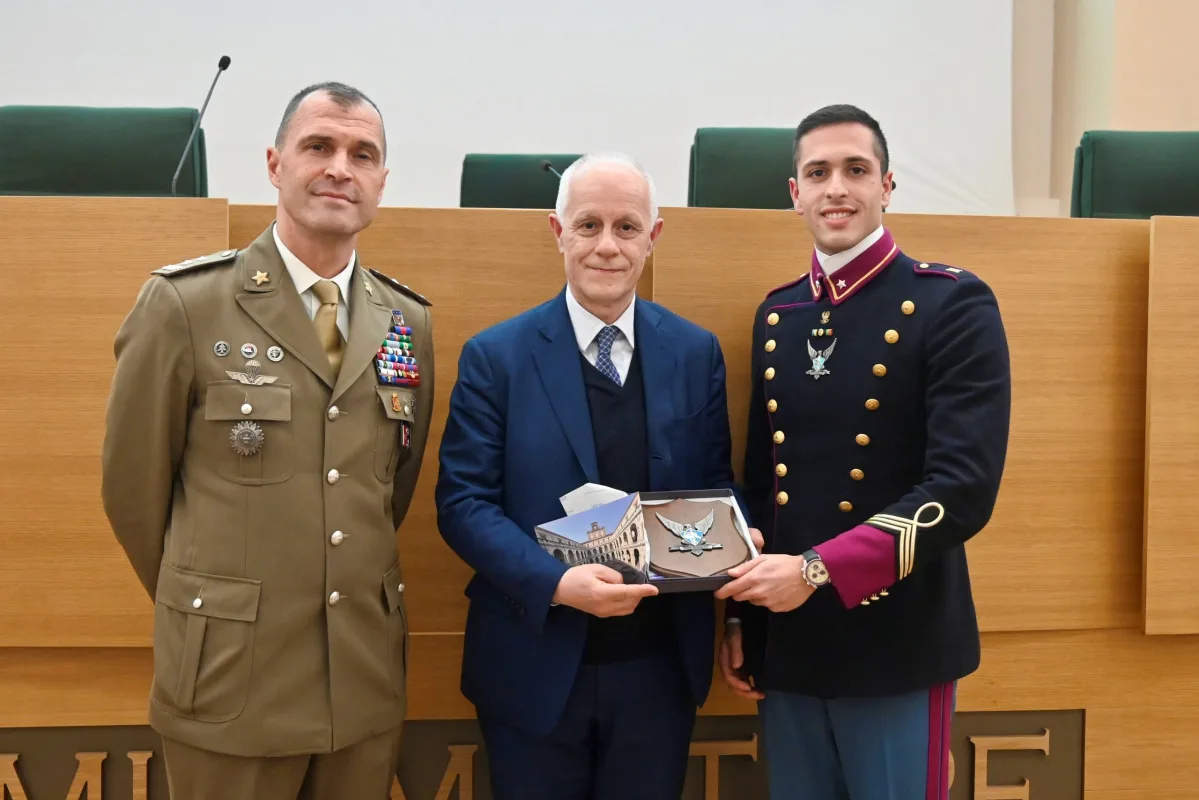
In this context, the conference by the director of Corriere della Sera, Dr. Luciano Fontana, hosted on February 13, 2026, by the Military Academy of Modena with the title “The role of media in the current strategic scenario”, assumes a significance that goes beyond the usual cultural events: it is a political signal in the highest sense of the term, that is, a signal about the relationship between truth, public responsibility, and competence.
The Academy as a “civil laboratory” of complexity
The Military Academy did not present information as a decoration of the curriculum, but as part of an educational path for future commanders called to read complex phenomena and distinguish facts from manipulations. It is a vision that recognizes a reality often removed: today communication is not just a “means”, but a strategic factor that affects decisions, social cohesion, and the legitimacy of institutions.
The added value of the initiative lies not only in the prestige of the guest but in the framework: a “systemic, integrated, and interconnected” education, shared also with other Army schools and the Carabinieri component. In other words: a training culture that does not fear stepping out of its own boundaries and measuring itself against a world, the media-digital one, often hostile by nature to simplifications.

The ethics of information as a discipline of freedom
In Fontana's speech, the point was not “social media is harmful” (banalities from talk shows), but the profound transformation of times, languages, and incentives of public information: speed, polarization, attention economy, competition for visibility. In this environment, freedom does not coincide with noise: it coincides with verification, with the distinction between facts and interpretations, with responsibility towards the community.
Here a crucial point is touched: independent and “ethically correct” culture is not the one that takes refuge in the lounges of certainties, but the one that accepts the weight of truth as a criterion. And it is precisely what ideally unites quality journalism and the military ethos taught at the Academy: discipline, rigor, duty, service, and awareness of the consequences of one's choices.
The contrast: the case of the University of Bologna and the temptation of closure
This model of openness contrasts with what emerged in the recent controversy related to the University of Bologna, where the project of a three-year course (in the philosophical field) aimed at officer cadets of the Modena Academy generated contrasts and a “backtrack” that, according to journalistic reconstructions, was marked by errors, frictions, and political pressures.
In particular, reasons of opposition related to equity criteria towards other students and the “dedicated” nature of the initiative were reported. At the same time, the affair was read by other actors as a signal of ideological closure: not so much a debate on content, but an identity reflex—the fear that “military” and “university” cannot coexist without contamination.
This is where the word “myopia” becomes pertinent, but only if used honestly: not as an insult, but as a diagnosis of a cultural risk. Myopia, in fact, is confusing autonomy with isolation, and mistaking symbolic purity for intellectual quality. A university is great when it knows how to include complexity and differences without losing its standards; when it discusses methods and guarantees, not when it turns an interlocutor into a label.

The Corriere della Sera and independence as practice (not as pose)
In this confrontation, the meeting in Modena becomes almost a counter-manifesto: a historic newspaper, led by a director with a profile recognized even by encyclopedic and cultural sources, enters the Academy not to “celebrate” the Army, but to discuss an uncomfortable and decisive topic—the information as a battlefield of modernity.
Cultural independence, here, is not a brand. It is the willingness to share different skills: soldiers studying the complexity of the world and journalists willing to talk about truth, manipulation, and responsibility in front of those who, tomorrow, will bear operational decisions and human consequences. It is an implicit pact between two public functions: to inform and to serve.
A point of arrival (and a starting point)
The event of February 13, 2026, in its essence, suggests a clear thesis: the excellence of military values does not need to be defended with slogans, because it withstands cultural confrontation very well when called to reason about the real—especially about that digital reality that confuses, accelerates, and polarizes.
And it also suggests the opposite: every cultural institution that reduces confrontation to an ideological reflex renounces, a little, its own mission. Because ethics—the true one—is not a fence. It is a daily practice of verification, responsibility, and intellectual courage.





Comments
No comments yet. Be the first!