




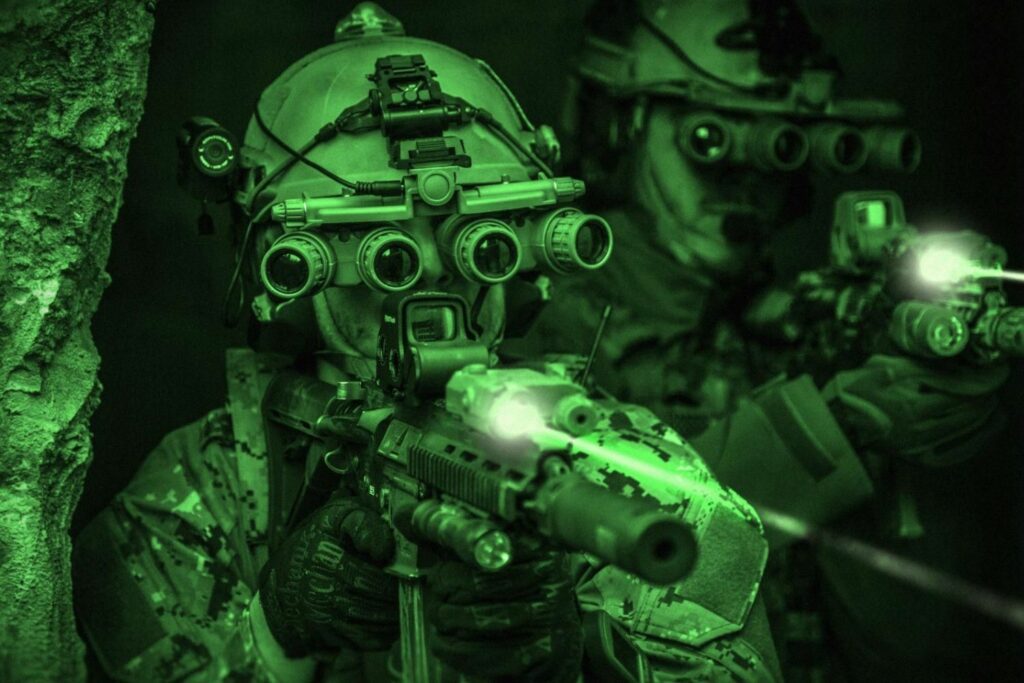
A new technology in the field of infrared sensors could radically revolutionize the night vision of paratroopers. It is a discovery that drastically reduces dependence on rare Chinese materials and removes the need for bulky cooling systems.
Traditionally, thermal night vision sensors require cryogenic cooling systems to function properly. The most widespread technology uses mercury-cadmium telluride detectors, which must be maintained at about -196 °C. This results in high energy consumption, weights, and volumes incompatible with the compact equipment used by advanced military units, drones, satellites, or even civilian autonomous vehicles.

However, the needs in this area are continuously growing. The U.S. air and ground forces, as well as special operations units, are seeking lighter, autonomous devices less bound by complex logistics. The same applies to the emerging industry of autonomous vehicles, which require reliable thermal sensors even in adverse weather conditions.
In response to these needs, an international team led by Professor Jeehwan Kim from MIT has developed an innovative process called “atomic lift-off” (ALO), published in the journal Nature. Thanks to this technique, it was possible to obtain ultra-thin layers of independent crystalline material, without the need for supports like graphene. The result is a "film" less than 10 nanometers thick, extremely sensitive to heat.
PMN-PT: the new material that beats the cold
The heart of this innovation is the material used: PMN-PT, a crystalline compound with exceptional electromechanical properties. This material is capable of detecting thermal variations with sensitivity up to 100 times greater than commonly used materials, such as lithium tantalate.
But the revolutionary aspect is that it works at room temperature. No more expensive and heavy cooling systems are needed. PMN-PT sensors cover the entire far-infrared spectrum, allowing for a broader and more detailed vision compared to current night vision systems. This is particularly useful in complex environments or adverse weather conditions (fog, rain, smoke), where traditional sensors and optical cameras may fail.

The team has created membranes 10 mm wide and just 10 nanometers thick, maintaining intact crystalline quality. Thicker versions (80 nm) have also been produced to facilitate scale processing: out of 108 sensors made, all functioned correctly. The thinner sensors, although more difficult to handle, still showed comparable performance.
In addition to extraordinary precision, the sensors maintain their electrical properties even after being transferred to different surfaces. In conducted tests, the devices demonstrated time stability comparable to the best-cooled sensors currently in use.
This technology not only promises high performance but also simplified production. The ALO method indeed allows for large-scale sensor production with minimal thickness and reduced costs.
Reducing Dependence on China and Innovating Defense
Besides the technical benefits, this discovery has significant strategic implications. Currently, China is one of the main global exporters of essential materials for thermal vision, such as germanium and chalcogenides, as well as providing a significant share of thermal imaging equipment.
The ability to produce effective sensors without resorting to these resources significantly reduces the industrial and strategic vulnerability of the United States, especially in scenarios of tension or commercial conflict with Beijing. In an unstable geopolitical context, autonomy in the production of critical technologies becomes a fundamental asset.
The project received funding from the Air Force Office of Scientific Research and the U.S. Department of Energy, demonstrating strong federal interest in developing independent, scalable, and safer solutions for military and civilian applications.
Indeed, this technology could find applications in a wide range of sectors: from defense to public safety, to the autonomous automotive industry. The ultra-light and highly sensitive sensors could be integrated into paratrooper helmets, reconnaissance drones, or autonomous vehicles, drastically improving environmental perception and real-time decision-making capabilities.
This innovation is not just a step forward in material science, but a true paradigm shift for the night vision industry. It represents a concrete demonstration of how multidisciplinary research – involving institutions like MIT, Seoul National University, and others – can produce cutting-edge technologies with an immediate impact on the operational field.




Comments
No comments yet. Be the first!