


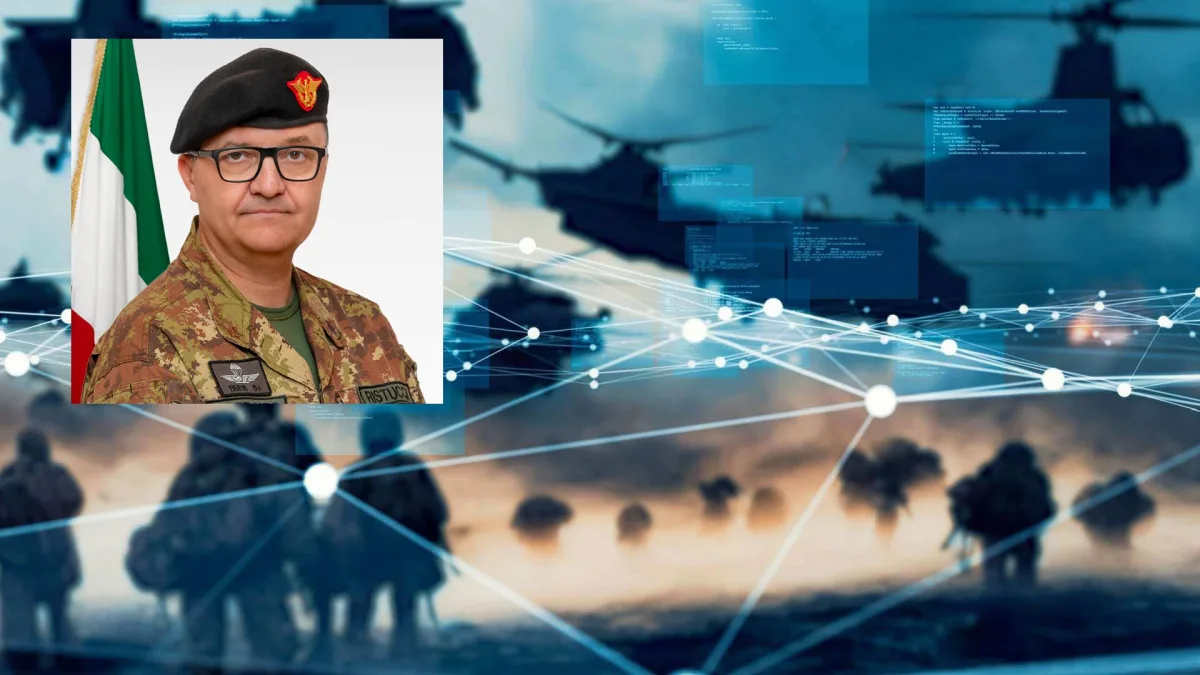

In the time of permanent uncertainty, war no longer presents itself with the clear traits of the past. It is not always declared, it does not always have recognizable boundaries, and it almost never can be understood with the traditional categories of state opposition. This is the picture presented by the army corps general Angelo Michele Ristuccia, logistics commander of the Italian Army, who spoke on March 13, 2026, at LetExpo in Verona.
His words are striking because they describe a reality where peace and war seem to overlap. Modern conflict no longer has a clear beginning or a recognizable end, but manifests in diffuse, intermittent, often indirect forms.
Among the strongest points of his speech, the general stated:
“We are facing an unprecedented situation. We live in constant uncertainty. We do not know if we are in a time of war or peace, it is difficult to understand who is friend and who is foe.”
A reflection that also recalls the image of the “piecemeal third world war”, used by Pope Francis, and which according to Ristuccia aptly describes the current international framework: a fragmented global scenario, marked by simultaneous crises, hybrid threats and permanent instability.

Logistics, resources, and consumption: the true heart of modern conflicts
The heart of General Ristuccia's analysis is a point often underestimated in public debate: today war is not fought only with weapons, but with the ability to sustain men, means, supplies, energy, and transport over time.
As logistics commander of the Army, Ristuccia has brought back to the center a fundamental principle of contemporary military strategy:
“War is a matter of consumption”
It is a simple but powerful phrase. It means that the endurance of an army and a state increasingly depends on logistics, the resilience of infrastructures, the security of supply chains, and national industrial capacity. In other words, the conflict is also played out in ports, energy networks, supply chains, transport, and maintenance.
In this context, logistics is no longer a secondary support to military action, but a decisive component of strategic power. And this is precisely one of the aspects that Ristuccia knows best, thanks to a long career in operational theaters and multinational commands.
The authority of Ristuccia: field experience and knowledge of hybrid wars
The general's statements gain even more weight when read in light of his professional path. Ristuccia is not just a high-level commander: he is an officer who has gained direct experience in some of the main crisis scenarios of recent years, between Iraq, Kosovo, and Lebanon, in addition to top positions in NATO and the Italian Army.

He commanded the “Ariete” Brigade, the “Vittorio Veneto” Division, the COMFOP Sud, and led the national contingent in Erbil in the operation “Prima Parthica”. Furthermore, he served as commander of the NATO mission KFOR in Kosovo, during a delicate phase for Balkan stability. Sources like brigatafolgore.net also highlight his profile as an officer with a “vast professional and experiential background”, emphasizing his determination and deep knowledge of the operational and organizational tools of the Armed Force.
It is from this concrete experience that his analysis of the transformation of war arises. According to Ristuccia, today conflicts can no longer be attributed solely to state rivalry, but develop in a broader and more unstable ecosystem, where irregular actors, transnational networks, and economic powers also operate.
He explained it with clear words:
“The recognition of the inviolability of borders has been lost and war can no longer be attributed to the exclusive rivalry between states”
And again:
“Non-state actors also intervene in the economy of war and are able to influence it. It has become a complex ecosystem, characterized by unknown variables and the absence of univocal answers”
This is where the general's reflection also becomes a prediction about the future. The coming war will be less and less linear, less and less readable, increasingly hybrid. And the winner will not only be the one with more strength, but the one who understands the complexity of the new scenario before others.


Comments
No comments yet. Be the first!