


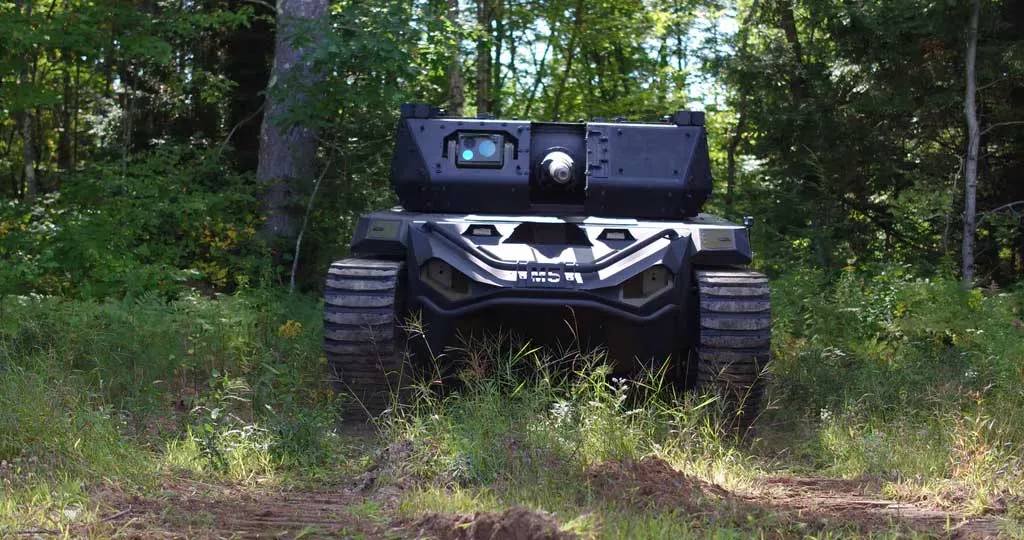

The American program dedicated to the introduction of robotic systems in the armed forces has a history spanning several decades, during which investments have grown significantly. Since 2014, when the investment in the US Army alone amounted to 20 million dollars, there has been a surge exceeding 300 million dollars approved by Congress in 2020.

These figures refer to public data, as since 2021, most information related to these investments has become classified and subject to state secrecy, making it difficult, if not impossible, to estimate the extent of future investments.
Despite the confidentiality surrounding recent figures, statements made during the AUSA Global Force conference by a senior US Army officer shed light on a further significant development, announcing that a platoon of drones and robotics could be introduced within armored combat brigades.
In particular, Brigadier General Geoffrey Norman, director of the Next Generation Combat Vehicle Cross Functional Team, confirmed that updates are underway on the remodulation of forces: "We are proceeding with integration through the current defense system, it is still early to talk about numbers" he stated.
These new platoons would be identified as robotic and autonomous systems, or RAS Platoons, marking a step forward in the integration of robotics into military operations.
With 11 active armored combat brigades and five in the National Guard, the US Army could deploy 16 RAS platoons, assigning one per brigade, in addition to extending them to other types of combat brigades, such as infantry, further increasing this number.

Ukraine and Russia have been using drones since the beginning of the conflict, employing ground robots for missions ranging from evacuating the wounded to transporting supplies in areas under attack. The US Army currently has two RAS platoons, one in the 82nd Airborne Division and an experimental platoon at the Maneuver Center of Excellence.
The RAS platoons recently demonstrated their capabilities during the Project Convergence, a military technology testing event where robotic vehicles transported by drones flew over a city before armed ground robots went into action, at the National Training Center in Fort Irwin, California, using a variety of drones, including the Ghost-X and the Squad Multipurpose Equipment Transport (SMET), a transport vehicle that can be equipped with a Javelin anti-tank weapon.
Norman emphasized that modularity, understood as the ability to replace components to adapt to different missions, represents a fundamental element of the program.
However, despite the progress made, several issues still need to be addressed.
General Glenn Dean, program manager for ground combat systems, highlighted the challenges associated with controlling high-speed vehicles, revealing that vehicles exceeding 25 miles per hour struggle to send images quickly enough for soldiers to react in real-time, due to network restrictions and the available frequency spectrum.

Delving deeper, Dean pointed out a systemic issue: "There is not enough spectrum allocated to military operations in the way we conduct them today" referring to the limitations in frequency bands used by both military and civilian users, ranging from radar to WiFi, and highlighting the need for an update or expansion of the dedicated frequency spectrum to accommodate the communication needs of military operations.
Direct control of robots is still an important element as the systems do not yet have sufficient capability to operate autonomously "Autonomy has not yet reached the levels we aspire to achieve" concluded Norman.
Travis Thompson, deputy director of the Soldier Lethality Cross Functional Team at the Army Futures Command, highlighted that the refinement of RAS Platoons will have a significant impact on soldier safety, who traditionally represent the majority of casualties in conflicts.
If the army manages to optimize the use of these systems, we can save numerous lives on the battlefield" he emphasized "We are talking about trading steel for human lives".






Comments
No comments yet. Be the first!