


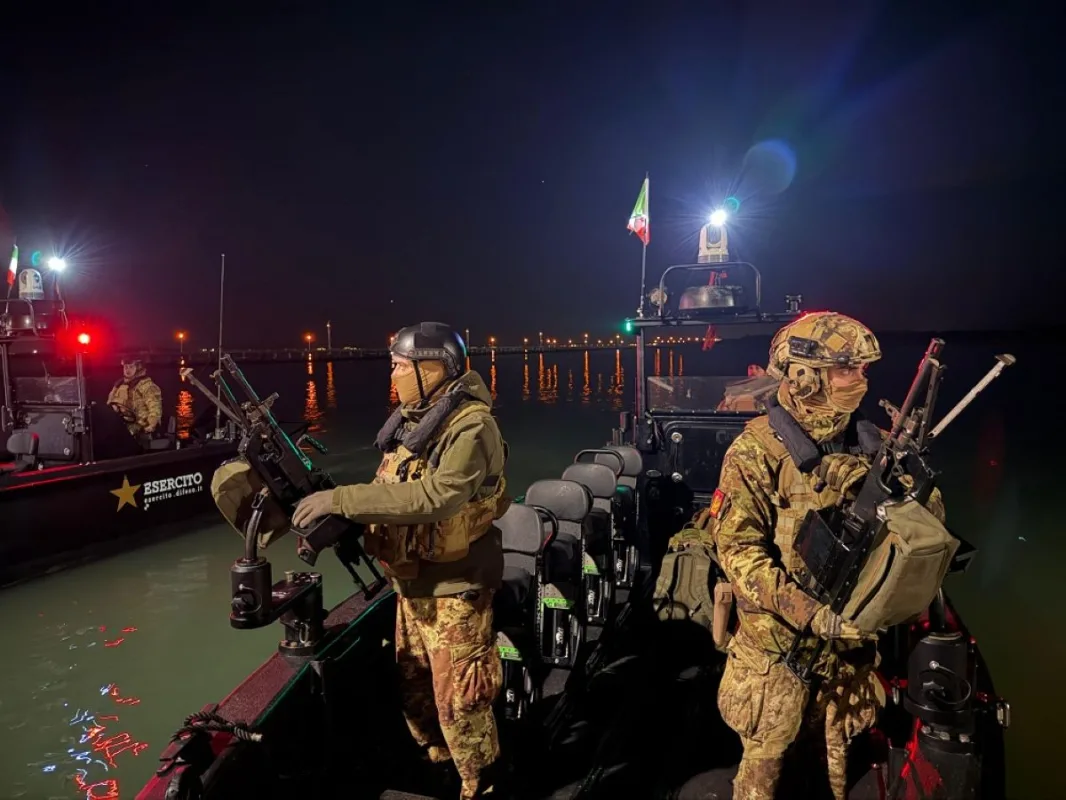

The intense exercise “Bragadin 1-25” concluded on November 14, conducted at the Reggimento Lagunari Serenissima, an elite unit of the Cavalry Brigade “Pozzuolo del Friuli”. The activity, which began on November 3, represented a crucial testing ground to assess and update the technical-tactical procedures essential to face the threats of the modern battlefield.
Today's operational scenario is indeed marked by the pervasive presence of drones, the limited capacity for constant communication, the need to decentralize command, and a logistical autonomy reduced to the essentials. In such a context, preparation and decisive speed become fundamental to ensure survival and effectiveness.
The exercise stems from this awareness: to offer continuous and realistic training, capable of simulating complex operational conditions and consolidating the moral component, the true engine of psychophysical resilience. For two weeks, the men and women of the “Serenissima” operated day and night, strengthening their operational resilience and maintaining a high level of readiness.
A multi-arm and interagency commitment in the heart of the Venetian lagoon
The structure of the exercise included a phase dedicated to planning and issuing orders, followed by a multi-arm and interagency phase of conduct. The Commanders applied tactical decision-making processes focused on terrain assessment, resource management, and projecting capabilities in terrestrial and amphibious environments.
The operational phase involved various institutional actors: a platoon of the 4th Carabinieri Battalion “Veneto”, a unit of the Rescue Drones Network of the Civil Protection, artillery assets, electronic warfare units, logistics units, and attack helicopters of the 5th AVES Regiment “Rigel”. About 400 participants operated between the Venetian lagoon, the coastal area, and the military complex of Malcontenta di Mira.

The conduct with opposing parties, thanks to the SIAT simulation system, allowed for the reproduction of extremely realistic combat conditions, verifying in the field the effectiveness of the maneuver and the decisions made. Great attention was paid to the use of direct and indirect fire, the prolonged occupation of conquered areas, and cooperation between heterogeneous units.
The Venetian lagoon, with its complex environment, represented an ideal training theater, allowing the refinement of the Lagunari's amphibious capabilities. The variety of scenarios required adaptability, execution speed, and precise synergy between the different assets involved.
Resilience, concealment, and new procedures to counter emerging threats
One of the most significant aspects of the exercise was the development of updated procedures to increase survival on the battlefield. The need to conceal from ISTAR assets – now capable of identifying targets with extreme precision – required the adoption of techniques aimed at reducing the visual, thermal, and electromagnetic signature.
The spread of drones, electronic surveillance, and the multidimensional nature of combat require the adoption of dynamic and flexible tactics. Among the fundamental elements of the training are defensive thinning, controlled dispersion, work on the first-time battlefield, and the ability to maintain cohesion even in the absence of constant communications.

The “Bragadin 1-25” allowed for the validation of new experimental procedures and the consolidation of essential operational capabilities to effectively respond to emerging threats. The “Serenissima” Lagunari regiment, thanks to rigorous training and close interforce cooperation, confirms its strategic centrality in the national defense system.
The conclusion of the activity provides a highly positive assessment: two weeks of intense preparation have strengthened professionalism, interoperability, and operational readiness. In a world characterized by rapidly changing threats, the ability to prepare for complex scenarios today represents the key to ensuring security, effectiveness, and timeliness of action.



Comments
No comments yet. Be the first!