


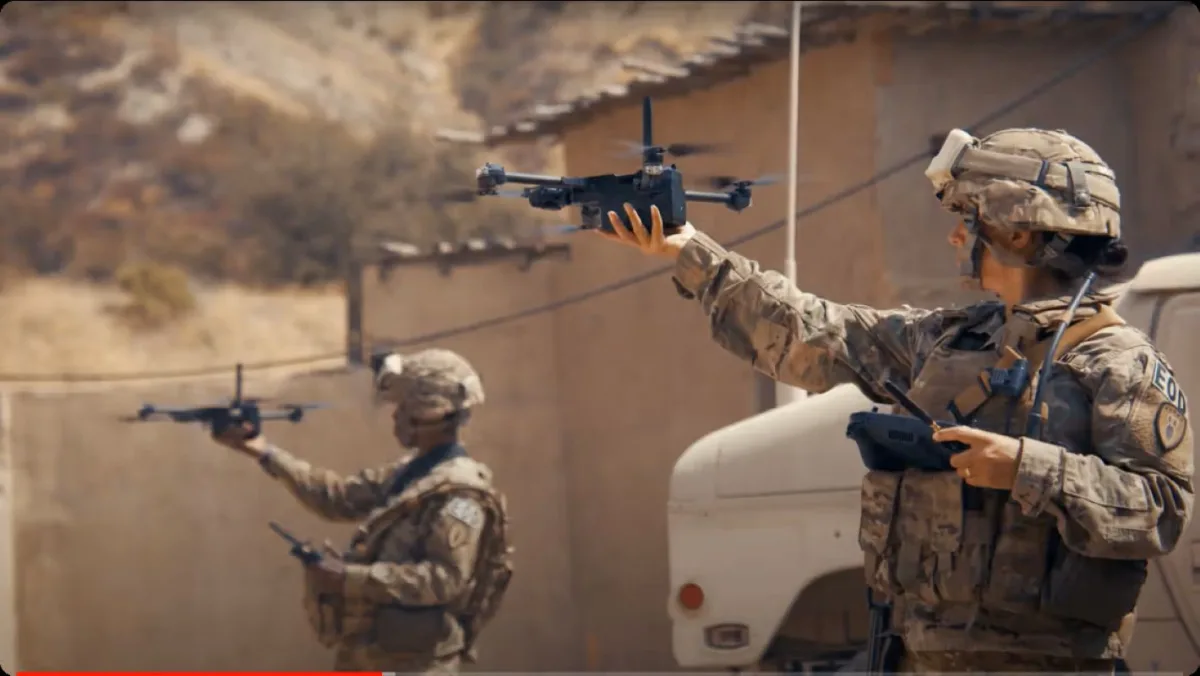

The Pentagon is preparing to order 30,000 disposable attack drones and the most important data is not just quantitative. The real signal is political, operational, and industrial: the United States is trying to integrate the tactical drone into the regular structure of the armed forces, down to the lowest levels, treating it not as a marginal capability but as a tool for daily use.
The message is clear: small drones are no longer a battlefield accessory, but a structural component of ground combat. They must be purchased quickly, tested in realistic conditions, distributed to units, updated, replaced, and repurchased at a pace incompatible with traditional military procurement times. For Italy, this news should not be read as mere American news, but as a direct call. Because if even Washington feels the need to accelerate, it means the problem is no longer whether to invest in drones, but how quickly you can do it.
The decisive lesson from Ukraine: update in weeks
However, the most interesting reference point is not even the Pentagon. It is Ukraine. And this is where the clearest gap emerges between the pace of real war and that of Western administrations. In the American debate, it was noted that in Ukraine drone manufacturers work with update cycles that can reach two weeks. This is the data that should strike more than any other. Because it means that the drone is not thought of as a finished, stable, and durable product, but as a system in continuous evolution.
Frequencies change, software is modified, payloads are rethought, vulnerabilities identified in the field are corrected, countermeasures against jamming and electronic warfare are introduced. What works today may not work in a few weeks. Superiority, therefore, does not depend only on the initial technical quality of the platform, but on the ability to adapt it faster than the enemy. The real lesson for Italy is here: in the drone war, the speed of learning is as valuable as production capacity.

The risk of arriving late
This is where the main problem for many Western countries emerges. If the drone innovation cycle is extremely rapid, systems purchased through lengthy procedures risk reaching units when they are already technologically outdated.
The risk is not so much not having drones, but having drones that are already old at the time of their operational introduction. This is especially true for small tactical systems and expendable drones, which by their nature must be continuously updated and replaced frequently.
In other words, the problem is not only industrial or technological. It is primarily a matter of time.
For this reason, it might be useful to complement traditional programs with more flexible and experimental tools.
One hypothesis could be to allocate dedicated funds to Brigades for rapid experimentation and acquisition programs of small drones and components, reducing the gap between operational use, feedback, and new purchases.
At the same time, a direct presence in contexts where this technology evolves more rapidly — like Ukraine — could allow for observing, testing, and better understanding the solutions emerging from the battlefield.
The goal would not be to replace the national industry, but to accelerate the learning capacity.

The German strategy: joint venture with Ukraine
An interesting signal comes from the growing collaboration between Germany and Ukraine in the field of drones and military technologies. Berlin has understood that the value of Ukrainian experience lies not only in the systems developed but especially in the method by which they are designed, updated, and adapted to the battlefield. For this reason, Germany is promoting joint ventures between German companies and Ukrainian industries, with the aim of combining the know-how gained at the front with European industrial and financial capacity.
In this model, Ukraine brings operational experience, rapid development, and continuous innovation capability, while Germany contributes with production capacity, industrial infrastructure, and access to European defense markets. The result is an ecosystem where technology and combat experience are integrated to produce systems that can evolve rapidly, following the pace imposed by the drone war.
This approach demonstrates that cooperation with Ukraine is not just a gesture of political support, but also a strategic choice to accelerate European military innovation. A model that could offer interesting insights for other countries, including Italy, if the goal is to quickly build a credible industrial capacity in a sector that is evolving at unprecedented rates.

Two years to absorb know-how and create a national supply chain
Allocating resources to Brigades would mean empowering the operational level, which is the one that most needs to understand what is really needed. It would also mean shortening the distance between use, feedback, and new acquisition. A procurement cell in Ukraine would also have a broader value: not only to purchase but to observe, learn, select, and transfer knowledge.
For two years, Italy would not only buy platforms but time, method, and know-how. Direct purchase in Ukraine should indeed be a temporary measure, useful for building a true national capacity. The risk today is not only to produce little but to start a supply chain without sufficient operational experience and without understanding the pace imposed by the drone war.
For this reason, direct purchases should be used primarily as a learning tool: to understand what really works, how systems are updated, how to react to electronic warfare, and which solutions deserve to be brought into national production.
The choice, ultimately, is not between buying abroad or producing in Italy. It is between continuing to learn slowly or accelerating to build a credible capacity.
In the drone war, indeed, the decisive factor is not only having the technology but the speed with which you can understand, update, and employ it. Bridging this gap requires first and foremost a clear strategic and political choice, capable of placing the issue at the center of national priorities.






Comments
No comments yet. Be the first!