



"This compass does not point north, but in the direction of the thing you want most in this world." Twenty years ago, Jack Sparrow in the cinema read the world by chasing desires and intuitions. Today, in the era of permanent unpredictability, the new compass of geopolitics does not look at suggestions, but at data. And it tries to transform weak signals, scattered information, and fragmented dynamics into predictive capabilities.
It is within this scenario that Deeplomacy is positioned, an initiative born in the ecosystem of the University of Turin and later recognized as an academic spin-off of the university. The project is linked to the HighESt Lab of the Department of Economics and Statistics “Cognetti de Martiis”, a laboratory founded in December 2024, which presents Deeplomacy as its first startup already active in the market.
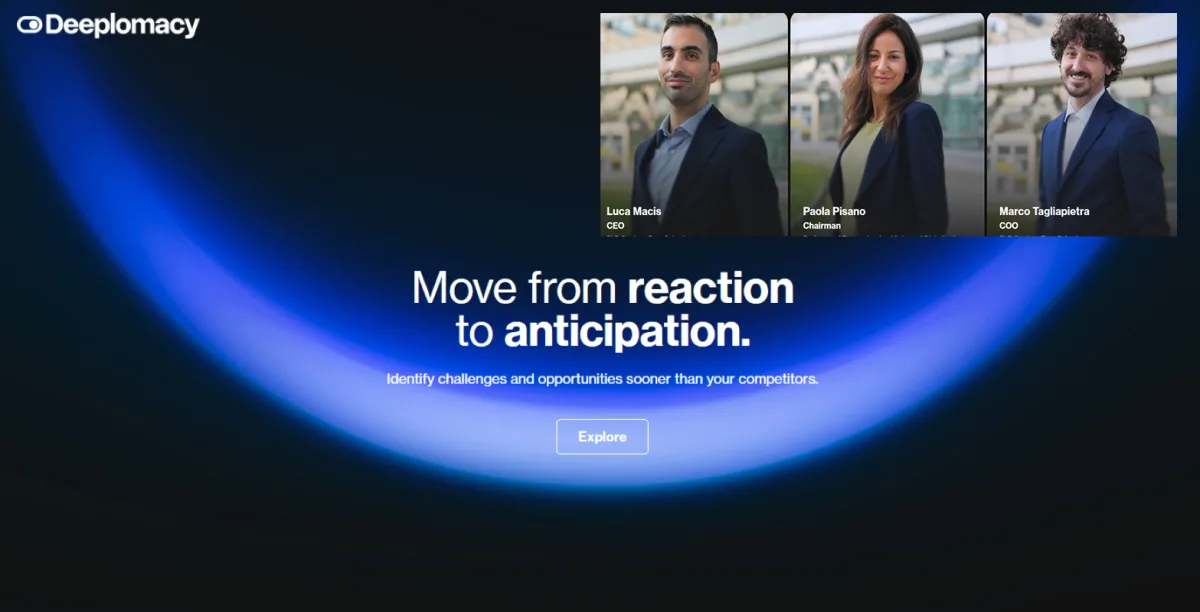
The promise is ambitious: to move from reaction to anticipation. On its website, the platform defines itself as a system of explainable AI capable of monitoring diplomatic events in real-time, predicting geopolitical risk, and suggesting preventive actions. The engine analyzes hundreds of information sources with updates every 15 minutes, along with over 100 social and economic indicators, to offer a risk assessment in more than 200 countries.

What indicators does the AI consider?
The point is not just to collect more data, but to connect them better. Deeplomacy integrates global news, diplomatic events, relationships between actors, economic and social variables, and translates them into a Geopolitical Instability Index readable even by human decision-makers. The platform insists on a crucial element: explainability. Not just an alert, therefore, but also the drivers that generated it, the confidence level, and the associated temporal scenarios.
This is a direction consistent with what European institutions are also doing. The European Union has strengthened its early warning tools by more systematically including climatic and environmental factors in the analysis of conflict risk. The most recent models indeed combine drought, temperature variations, migrations, pressure on resources, and political-institutional fragility.
In other words, artificial intelligence does not "see" war as an isolated event. Instead, it reads the accumulation of stress: inflation, water scarcity, forced population movements, ethnic tensions, hostile language in the media, diplomatic escalation, armed mobilizations, health crises, disruptions of logistical chains. When these variables start to move together, the risk rises.
Which areas are most at risk?
Predictive platforms do not replace geopolitical analysis, but they help identify where the ground is already more flammable. Available public evidence converges on certain areas: the Sahel, the Horn of Africa, the Sudan-Red Sea quadrant, and the broader Middle East. Here, widespread violence, armed fragmentation, institutional fragility, and growing political instability persist.
The overall picture has also deteriorated. Major international observers report an increase in conflict events, with a growing weight of international and interstate violence, especially in the Middle Eastern space.
Here, the use of AI can make a difference precisely on the preliminary signals: not when the conflict has already erupted, but when the indicators show abnormal clusters and connections that the human eye, alone, risks catching too late.

Operational suggestions
The lesson for governments, businesses, and international organizations is clear. First: continuous monitoring systems are needed, not episodic analyses. Second: data must be integrated, because a geopolitical crisis almost always arises from the intertwining of politics, economy, society, and climate. Third: prediction is only valuable if accompanied by human interpretation, diplomatic skills, and operational procedures. Deeplomacy itself insists on models developed by university research and validated by diplomatic experts, precisely to avoid the “black box” effect.
Then there remains a decisive point: predicting does not mean determining. No algorithm can say with certainty where and when the next conflict will explode. However, it can increase the ability to read frictions earlier, order informational noise, and offer a precious advantage: a few weeks, sometimes a few months, to act before the crisis becomes irreversible.
The new compass, in short, does not promise infallibility. But in a world crossed by continuous shocks, it can help transform uncertainty into preparation. And today, on the edge of global tensions, that is already a lot.






Comments
No comments yet. Be the first!