


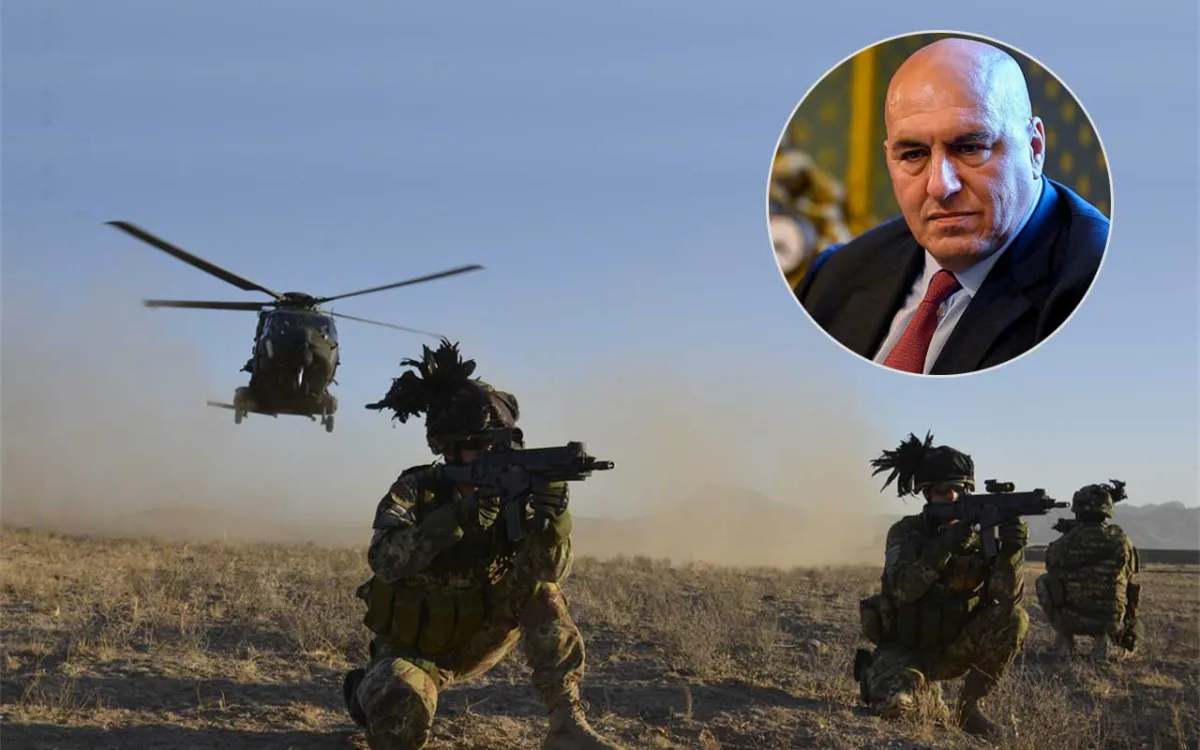

The Italian Minister of Defense launches a historic proposal to the New York Times and international partners: a new European-led military alliance, also open to Ukraine, to overcome dependence on Washington.
"To guarantee Europe, we must build a continent of defense". With these clear words, entrusted to an interview with the New York Times, the Italian Minister of Defense Guido Crosetto outlines what could prove to be the most profound restructuring of European collective security since the end of World War II. An ambitious plan that aims to complement the current US-led system with a new defense structure entirely governed by Europeans.
The diplomatic initiative officially began last April, through a letter sent by Crosetto to the continent's defense ministers, as well as to the leaders of the European Union and NATO. In the passages of the letter viewed by the American newspaper, the minister clarifies the need for a paradigm shift: "A credible European defense policy can no longer be limited exclusively to the Union's member states. The continent's security goes beyond the EU's borders and requires the full participation of all partners who share vital interests and significant responsibilities. It must therefore be conceived as a true continental project".

The Role of Ukraine and the European Axis
Among the key points of the project, based on "voluntary participation", Crosetto highlights the absolute centrality of Ukraine. Although not part of either the EU or NATO, the country under attack is considered by the minister as "destined to remain a leading pillar of European security".
This proactive approach reflects a broader awareness among the continent's leaders after years of cuts and underestimation of military apparatuses, but also responds to repeated efforts by American President Donald Trump to reduce the US military presence in Europe, challenging allies to take on greater responsibilities.
The Italian vision fits into an already heated debate: while French President Emmanuel Macron has long supported the need for greater military autonomy, and the EU's defense chief Andrius Kubilius has suggested a unified army, Italy has already moved concretely. Rome has indeed initiated collaborations with the United Kingdom, France, Germany, and Poland to create a new, more restricted military partnership that excludes the United States.
This marked Europeanism also signifies an evolution in the political line of Prime Minister Giorgia Meloni. Elected almost four years ago on a platform critical of centralization and inter-European cooperation, Meloni has progressively rethought her approach, and Crosetto's move – co-founder of Fratelli d'Italia – is tangible proof of this.
A Global NATO Against the "Elite Club"
The Italian plan, however, is not born in opposition to Washington. Crosetto has clearly stated that the new architecture is not intended to be an alternative to NATO, but rather a tool to "strengthen its European pillar".
Nevertheless, the minister suggests that the Atlantic Alliance itself must change to adapt to a profoundly changed world, opening up to global non-European partners such as Australia, Brazil, India, Japan, and South Korea. "NATO was created to offer security and stability to a part of the world," Crosetto explained. "Now we need an organization that can offer security and stability to the entire world. It cannot remain a club for the elite of the Global North".

Diplomatic Tensions and Internal Issues
The interview was also an opportunity to take stock of the relations on the Rome-Washington axis, recently strained by harsh criticisms expressed by Trump towards Italy and Pope Leo XIV, accused of not supporting the American military action in Iran. Crosetto downplayed the friction with a domestic metaphor: "We handled it like you do when you're at home and there's a family argument. You pretend not to listen".
The minister also denied that the Trump administration ever communicated through official channels the intention to withdraw troops from Italy, despite the tycoon's statements about a possible cut of 5,000 soldiers in Germany. "There has never been a political statement expressing the desire to reduce troops or resources".
The real pressure from the White House is instead focused on the request to increase defense spending. A goal that is anything but simple on the domestic front, generating tensions within Meloni's own governing coalition. The executive is indeed faced with balancing the costs of rearmament with the need to finance subsidies for the high fuel prices caused by the conflict in the Middle East.
"The problem is making people understand that the world we live in is much more turbulent and less secure than it was 10 years ago," Crosetto concluded, describing the difficulty of public debate and the constant clash with electoral rhetoric. "With voters, the usual line is: 'Do you prefer a tank or a school, a kindergarten, a hospital?'. I try to explain that those are two completely different things that you cannot compare".



Comments
No comments yet. Be the first!