



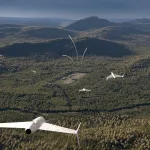
Imagine a mini-drone that “is born” already at altitude: it is released from an airplane or helicopter, stabilizes, ignites propulsion (if provided), and within seconds begins the mission under the control of an operator, on board or on the ground. It is a capability transitioning from concepts to real tests, as it allows sensors and small unmanned systems to be brought quickly, flexibly, and often more safely near the area of interest.
The point is that it's not enough to just “release”: it must be done while respecting two essential conditions. The first is that the drone survives the separation, as it suddenly finds itself in a turbulent airflow at the speed of the aircraft. The second is that the drone does not endanger the aircraft releasing it: no collisions, no bounces, no getting stuck in critical zones or apparatus. This is why air launching is a topic where simulations and real tests always go hand in hand.

Why Launch a Drone from the Air
Air launching is mainly used to “advance” the drone:
- Extends the useful range: the carrier transports the drone close to the point of use, and the drone uses its autonomy where it matters.
- Reduces time: you arrive on the scene faster without having to take off from nearby or advanced bases.
- Increases flexibility: an aircraft can release multiple drones, with different sensors or tasks (observation, reconnaissance, relay, corridor exploration, etc.).
- In some civil/scientific fields, it allows measurements in areas too risky for manned flight.
There is also an “extra” reason, often underestimated: if large transports increasingly become ideal platforms for releasing (and sometimes managing) drones, then strengthening strategic air transport is not just a logistical choice, but also a way to multiply future operational options. In other words, enhancing the fleet and readiness of Italian strategic airlift also means preparing the ground for “mothership” concepts, cooperation with drones, and distributed missions, as argued in the analysis referenced at the end.

The Three “Families” of Air Launch
- Launch from ramp or door
The drone is released from a rear hatch (typical of transports) or side doors (also on helicopters). It's intuitive, but requires enormous attention to flows, wakes, and separation distances in the very first seconds. - Tube/canister launch (tube-launched)
The drone exits from a standardized container: ejection, surface opening, stabilization, and mission. This method is favored because it facilitates integration: the same “standard” launch on different platforms. - Launch and recovery in flight (the “flying aircraft carrier”)
It is the most ambitious level: release plus recovery in the air, without landing. It reduces reuse times and opens up to “mothership” concepts that deploy and retrieve assets.
What Makes Air Launch Difficult
The technical challenges are not theoretical: they are “ruthless” seconds in which aerodynamics and control must work without margin.
- Aerodynamic separation: trajectories and rotations in the first 2–5 seconds, within wakes and turbulence.
- Carrier safety: avoiding collisions with fuselage, tail, rotor (for helicopters), ramps/doors, and apparatus.
- Transition from “fall” to “controlled flight”: stabilization, engine start, attitude, and in some cases parachute or wing deployment.
- Handover: control transfer (for example, from onboard crew to a ground operator) and data link robustness.
- Definition of the release envelope: at what speeds, altitudes, and attitudes the release remains safe and repeatable.
Case Study: Tests and Demonstrations Highlighting the Trend
France: mini-drones released from Gazelle and A400M
The DGA reported test campaigns with releases from the side door of a Gazelle helicopter and from an A400M (trap/ramp rear and side doors), after numerical simulations and experimental validations. Essentially: “model first, then test,” until the separation profile becomes reliable.
A400M “mothership” and Remote Carrier (Airbus)
Airbus described a test in which an A400M released a demonstrator based on a modified Do-DT25; after release and engine start, the onboard crew handed over to a ground operator who commanded and landed the drone. It is a clear example of distributed human-machine cooperation.
USA: Launched Effects and ALTIUS 700
The US Army reported a demonstration that produced positive data on all operational phases (launch, flight, landing, and recovery) for the ALTIUS 700, within the “Launched Effects” framework: drones designed to be launched from different platforms and quickly employed as modular “effects.”
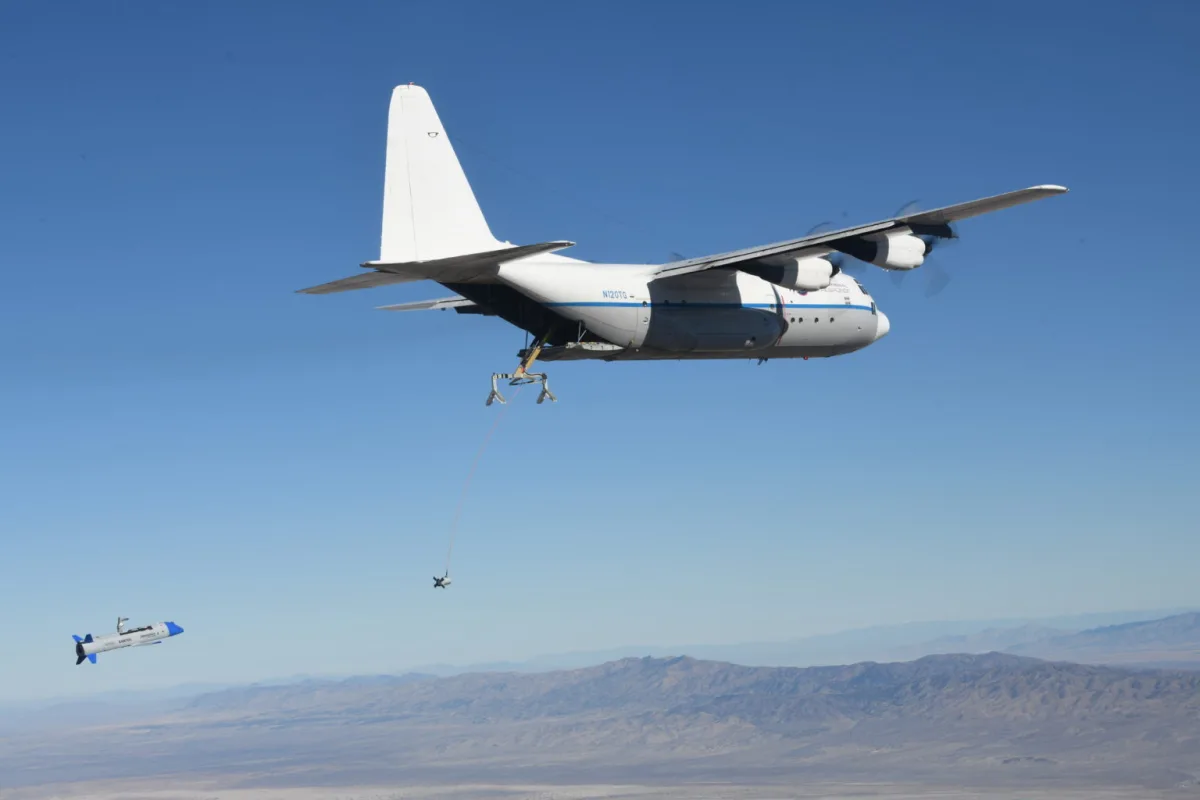
DARPA Gremlins: airborne recovery towards C-130
The Gremlins program has become iconic because it does not stop at release: it includes capture and recovery in flight. DARPA announced an airborne recovery demonstration of an X-61 towards a C-130, highlighting how complex the “return” part is compared to just the launch.
NOAA: Coyote inside a hurricane
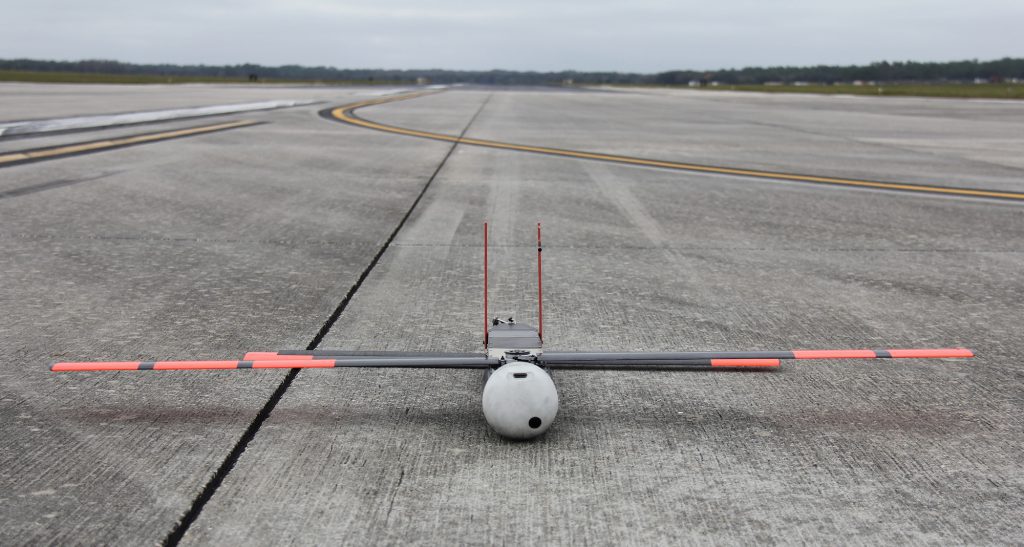
NOAA documented the use of the Coyote UAS released from a P-3 “Hurricane Hunter” to collect weather data in areas and altitudes too dangerous for a manned platform. Here, air launching is a bridge to otherwise inaccessible measurements.
Perdix: micro-drones and swarm behavior
The DoD reported a demonstration with 103 Perdix micro-drones released from F/A-18 Super Hornet, with cooperative swarm behaviors (collective decision-making, adaptation, “self-healing”). It is proof that, when the scale decreases, air launching can become a mode for deploying quantities, not just single assets.

Where This Technology is Heading
Two directions seem increasingly clear: standardizing the launch (tubes/canisters and common interfaces) and making drones modular, “mission package” based. In parallel, the mothership concept is growing: not just transport, but management and coordination of multiple drones, with handover and integrated procedures. In this scenario, the availability of transport aircraft and their operational readiness are becoming increasingly important, as they become enabling platforms, not just “flying trucks.”
Links and Sources
[1] DGA, “Et maintenant on largue les drones depuis les avions et hélicoptères…” (Ministry of Defense)
[2] Airbus, “Remote Carrier demonstrator released and operated from flying A400M” (handover to ground operator, Do-DT25) (Airbus)
[3] DARPA, “Gremlins Program Demonstrates Airborne Recovery” (X-61 towards C-130) (darpa.mil)
[4] Air & Space Forces Magazine, in-depth on the Gremlins test (Air & Space Forces Magazine)
[5] NOAA AOML, note on Coyote UAS launched from P-3 Hurricane Hunter (darpa.mil)
[6] DoD/Navy CIO, “Successful Micro-Drone Demonstration” (103 Perdix)
[7] U.S. Army, communications on “Launched Effects”/ALTIUS 700
[8] DifesaNews, “Strategic Air Transport: Italy Must Strengthen Its Workforce” (Difesa News)


Comments
No comments yet. Be the first!