


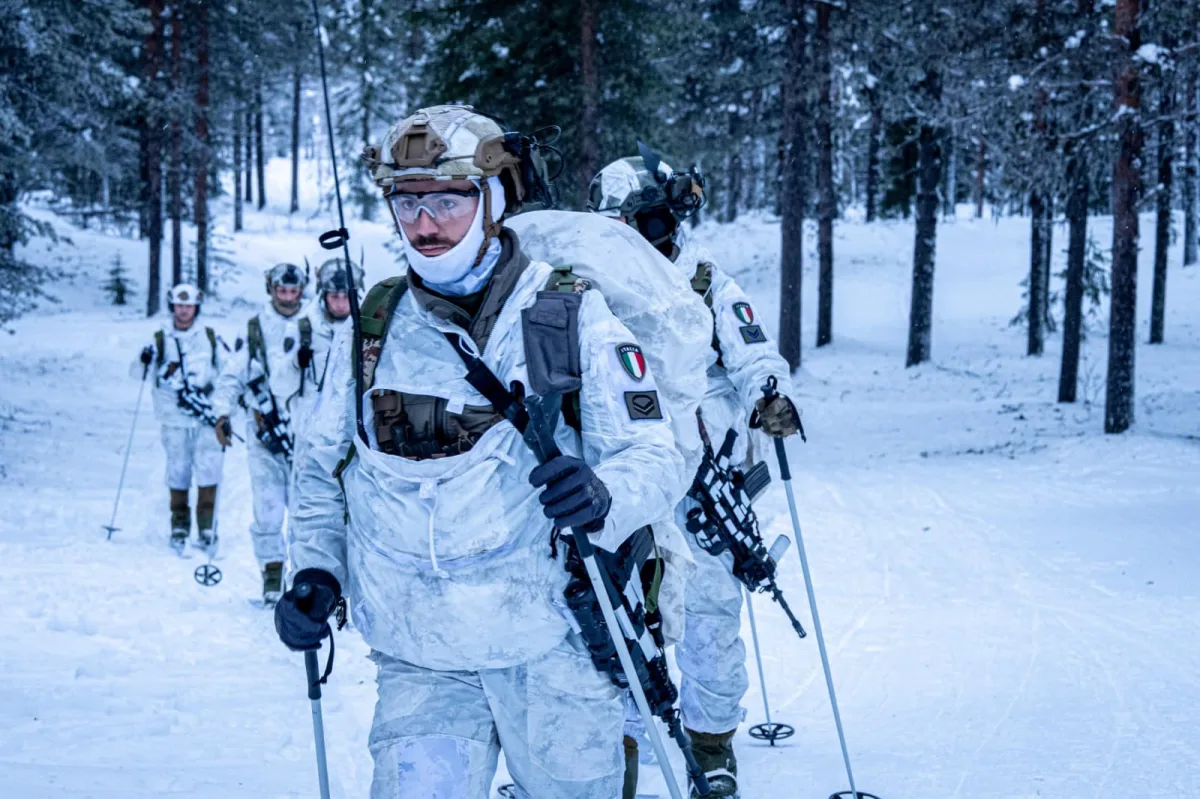

ROME – The Cold Response 26 has officially concluded, the most extensive Arctic training activity of the year, which saw the participation of about 32,500 military personnel from 14 NATO countries. The operations, conducted between March 9 and 20, involved the territories of Norway, Sweden, and Finland, confirming the strategic importance of the northern quadrant for collective security.

The Italian Contribution: The Alpini of Taurinense
Italy responded to NATO's call by deploying over 170 military personnel from the Alpini Brigade "Taurinense". The core of the contingent was composed of a Company from the 3rd Alpini Regiment, supported by specialized units:
- 32nd Engineer Regiment: for mobility and protection in hostile environments.
- Tactical Information Brigade: with multi-sensor units for battlefield surveillance.
- Medical Support: provided by Medical Officers from the Military Academy completing their training.

Training to the Limit: Survival and Combat
Operating in an Arctic environment is not just a tactical challenge, but a test of human and technological endurance. With temperatures reaching -25°C, Army personnel had to apply advanced techniques of:
- Movement and survival: Refined during a specific mountain preparation phase before departure.
- Familiarization: Immediate integration with the equipment and materials provided by allies.
- Electromagnetic Monitoring: Use of technologies for spectrum control and defense against hybrid threats.

The Operational Scenario
During the peak phase of the exercise, the Italian Alpini were integrated into a French-led multinational Battlegroup, operating under the command of a Finnish Brigade.
"The Italian component acted in a context of opposing forces, performing defensive tasks aimed at repelling a simulated enemy offensive. Reconnaissance capabilities, anti-tank systems, and mortars were employed in perfect multi-weapon coordination."

Why is Cold Response 26 Strategic?
The success of the exercise is not only measured in firing capability but in the consolidation of interoperability. The ability of different armies to speak the same "operational language" and integrate their logistical and medical systems in record time is what makes NATO a credible deterrent force, especially in prohibitive climates where every mistake can be fatal.



Comments
No comments yet. Be the first!