


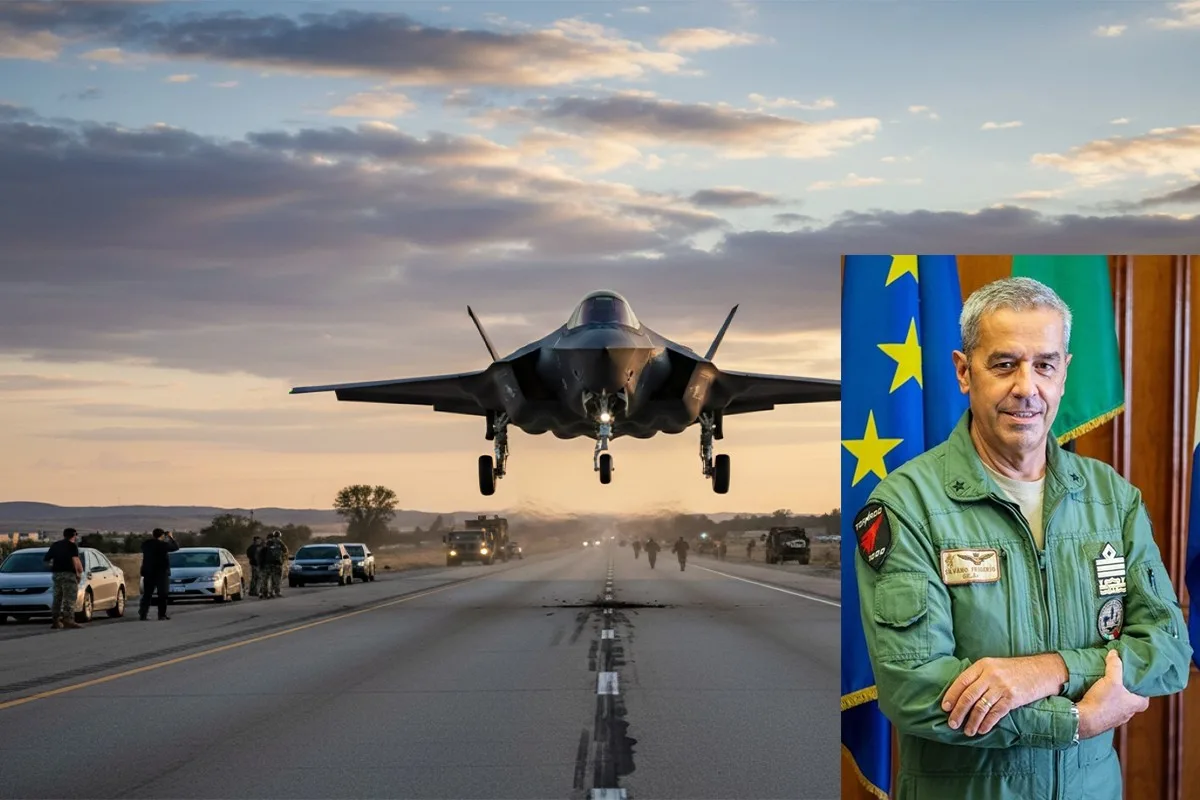

Rome, February 4, 2026 – The most difficult threat to “measure” and stop today does not necessarily come from fighters or missiles, but from small, cheap, and numerous objects: drones. This is the message that Air Force General Silvano Frigerio, Commander of the Air Force Command and First Air Region of the Air Force, reiterated on the sidelines of the conference “Global Domain: Geopolitics and Aerospace in a Changing World,” organized by the CeSMA (Giulio Douhet Aerospace Military Studies Center) at the Air Force Palace. The picture that emerges is one of a defense that must run on multiple tracks: countering UAS, economic sustainability of responses, cooperation with allies and industry, and – in the background – the vulnerability of supply chains of strategic materials and rare earths.
The New Urgency: The Swarm and “Time” as a Weapon
Frigerio emphasized a type of threat that is gaining ground in contemporary crises: low-cost drones, capable – with increasingly autonomous guidance systems (in some cases even through unconventional connections like fiber optics) – of reaching a target with minimal investment and potentially enormous impact.
The point is not only technological but temporal and quantitative. In “covered” scenarios, where the launch can occur from mobile means and with very short notice, seconds become crucial: identifying, classifying, and reacting in a timely manner is often more difficult than having the single engagement system. Hence the key idea: against multiple attacks, “the perfect solution” is not enough; a widespread network of discovery and counteraction, integrated and numerous, is needed.
The general highlighted a well-known paradox in air defense: neutralizing a cheap drone with expensive ammunition can become unsustainable in the long run. It is not just a budget issue, but one of resilience: if the response relies on a few “precious” tools, the adversary can aim for saturation.

For this reason – in the outlined reasoning – the response must combine:
- early warning and faster surveillance/identification capabilities;
- proportional and replicable countermeasures, suitable even for numerous threats;
- a territorial distribution consistent with the objectives deemed vital, including critical infrastructures (logistic nodes, ports, railway and highway junctions).
The symbolic target, cited as an example, is the high-tech platform: even limited damage to an advanced aircraft can produce significant economic and operational consequences. In other words, the “economic” attack aims to generate a “costly” effect.
Highways as Runways? A Hypothesis Under Study for Rapid Dispersion
Among the most discussed points that emerged on the sidelines of the meeting is also the evaluation – not yet a planning – of the possibility of using highway sections as an alternative option for flight operations in exceptional circumstances, particularly in case of aerial threat against main bases.
The concept is that of rapid dispersion of assets: quickly redeploying aircraft and essential supports to multiple points, to reduce vulnerabilities and ensure operational continuity. It is an approach already known within NATO and already practiced in some allied countries; however, Frigerio highlighted how the comparison is not automatic: in Italy the configuration of the highway network and infrastructural conditions make the idea more complex, especially on the logistical and security levels.
Very concrete elements enter into the preliminary reasoning: suitability of the section, management of adjacent areas, security, access, but also the presence of support infrastructures (electric networks, rest areas, services) and the possibility of “transforming” a civilian space into a temporarily military infrastructure without generating collateral risks.
Industry: No Longer Just “Client-Supplier”
On the industrial front, Frigerio indicated a need for method: faster development and commissioning times require a different relationship with companies. It is not enough to purchase a “finished” product: co-development, joint experimentation, effectiveness verification, and acceleration towards production are needed, with a more integrated approach between the Armed Forces and the technological supply chain.
The subtext is clear: in an environment where the threat evolves rapidly (and at low costs), long cycles risk delivering solutions that are already “old” at the time of delivery.
The other red line concerns the less visible but decisive dimension: strategic resources and rare earths. Frigerio clarified that not all systems depend equally on these materials, but the issue becomes critical when thinking in terms of stocks and the sustainability of a prolonged confrontation.
Here competition comes into play: if a producing country has to meet high internal demand, deliveries naturally tend to prioritize national priority. From this awareness comes a pragmatic choice: diversify supplies and reduce dependencies and bottlenecks, maintaining operational options even when production and supply chains are under pressure.
A System Defense: Technology, Quantity, Logistics, Resources
The thread that unites all the points raised is the idea of an aerospace defense built as an ecosystem: not only advanced platforms but networks of discovery, numerical capabilities, flexible logistics, allied cooperation, and industrial solidity. “Low-cost” drones have shifted the balance: they force a rethink of tools, costs, and times, imposing a more resilient and distributed model.
And in this context, even a hypothesis that sounds extreme – like the use of highway sections – becomes an indicator of how the key word is changing: operational continuity, wherever and whenever, if the threat should hit the main nodes.



Comments
No comments yet. Be the first!