


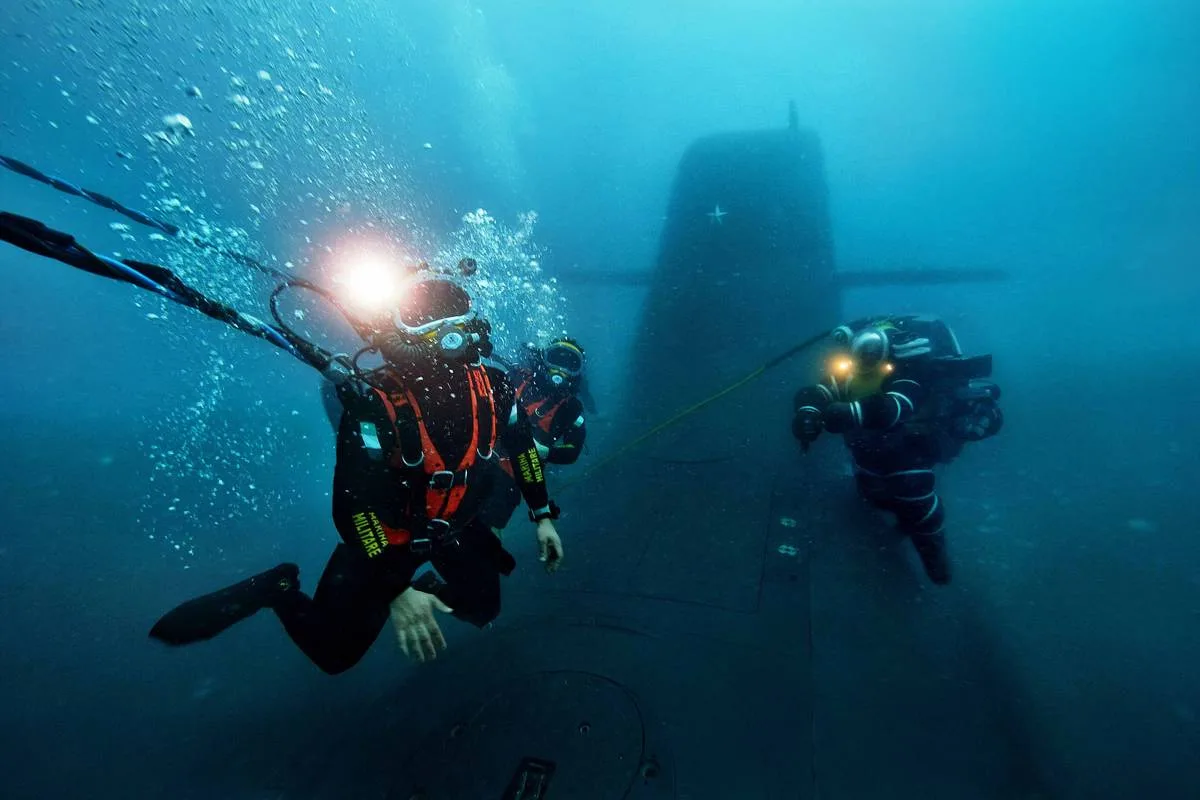

The seizure of the tanker Marinera by the United States (January 7, 2026) is just the most visible episode of a maritime competition that now goes far beyond the barrel of crude oil: it involves circumvented sanctions, arms trafficking, drone and missile attacks against civilian shipping, but also – and above all – the less photographable part of the confrontation, the underwater aspect, where cables, data, and energy pass and where “gray” actions difficult to attribute can be conducted.
This scenario is also described in Guido Olimpio's analysis in the Corriere: a “duel on the seas” made up of shadow fleets, interdictions, sabotage, and cut cables, where the maritime dimension involves large navies but also allows less structured entities (like the Houthis in the Red Sea) to strike global routes.
In this context, the question is not whether Italy should “return” to the sea: it is already there. And the Italian Navy is building a coherent response to threats above and below the surface, combining operational presence, multi-role platforms, and an acceleration in the “underwater dimension.”

The “Above the Sea” Threat: Opaque Ships, Drones, Interdictions, and Escorts
1) Shadow Fleet and Trafficking: Control, Identification, Boarding Needed
The “shadow fleets” exploit flags, shell companies, transponder shutdowns/spoofing, ship-to-ship transfers, and peripheral routes. It’s a game of persistence (being on site), recognition (understanding who is who), and legal/operational action (inspections, seizures, escorts).
Here the Navy operates on two levers:
- Maritime Surveillance: the maritime patrol aircraft P-72A is designed precisely to locate and track contacts at sea by integrating radar, electro-optical/IR sensors, ESM systems, and AIS.
- Multi-role Units for Presence and Escort: the PPA (Multipurpose Offshore Patrol Vessels) are designed to monitor and control maritime spaces of interest, oversee economic activities, and contribute to the escort of naval and merchant groups; they are “flexible” platforms, useful both in patrolling and in more tense security frameworks.
2) The Red Sea Case: “Poor” but Lethal Aerial Threat
Attacks against commercial traffic in the Red Sea have shown that even non-state actors can impose enormous costs with relatively inexpensive means (drones, missiles, small boats, “social” intelligence). And the most concrete response is close defense and escort, in open sea, for days and weeks.
In this field, the Navy is already at the forefront with:
- EU Operation ASPIDES, created to protect freedom of navigation in a vast area (Red Sea, Gulf of Aden, Arabian Sea, Gulf of Oman, and Persian Gulf). Italy has also taken on tactical command roles, and the mission has been extended until the end of February 2026.
- Rotations of units (e.g., return of Ship Caio Duilio and replacement with other ships), a sign of a sustained device over time.

The “Below the Sea” Threat: Cables, Pipelines, Underwater Drones, and “Unattributable” Sabotage
If above the surface the world sees, films, and comments, below the rule is the opposite: few sensors, great depth, uncertainty of attribution. Precisely for this reason, the underwater dimension has become an ideal ground for pressure and intimidation without a declaration of war.
The same Italian Navy describes the increase in risks against critical infrastructures (energy lines, communication cables, platforms), in parallel with the proliferation of robotic systems and increasingly accessible underwater drones.
And Rivista Marittima highlights the need to continuously monitor and safeguard infrastructures on the seabed like cables, oil pipelines, and gas pipelines.

1) The Underwater “Guardian”: Sensors, Mapping, Intervention
The response is not a single “anti-cut cable” ship, it is a complete chain:
- Environmental Knowledge (seabeds, currents, bathymetry, anomalies);
- Surveillance (naval and aerial sensors + dedicated networks and systems);
- Reaction (inspection, securing, clearance, restoration).
On this, the Navy is pushing on multiple fronts:
- Development of the Underwater Dimension as an operational and industrial pillar, with a system approach.
- National Underwater Dimension Hub (PNS): even from tenders and initiatives, interest emerges towards technologies like “intelligent underwater cables” for marine monitoring and tools for precise navigation/positioning in the underwater environment.
2) The “Hard” Component: Submarines, ASW, and Underwater Forces
When the threat is an adversary submarine, an underwater drone, or sabotage on the seabed, specialized capabilities are needed:
- Submarines: the Navy is evolving the line with the U212 Near Future Submarine (NFS), presented as a significant leap in terms of systems and operational concepts compared to the previous class.
- Anti-Submarine Warfare (ASW): on the FREMM frigates, the sonar architecture is a key element (bulb sonar, high-frequency sonar with mine detection capability, underwater telephone), that is, tools designed to “hear” and understand what is happening below.
- COMSUBIN: for the last mile – inspections, clearance, complex underwater interventions, and special operations – the Navy has a dedicated command with the Operational Raiders Group and the Operational Divers Group (divers). This is exactly the type of capability needed when the threat is not a “radar target,” but an anomaly on a seabed or an intrusion on an infrastructure.

Conclusion: The Sea as “Infrastructure” and as a Battlefield
The point that links seized tankers, cargo with weapons, drones launched from the coast, and cut cables is simple: the sea has become a global infrastructure, not just a passageway. Whoever controls routes, choke points, seabeds, and data controls pieces of the economy and national security.
The Italian Navy is positioning itself on this fault line with a modern logic: surveillance, escort, defense above the surface; monitoring, deterring, intervening below the surface; and doing so in coalition, because no European state can cover such a vast and “opaque” domain alone.



Comments
No comments yet. Be the first!