


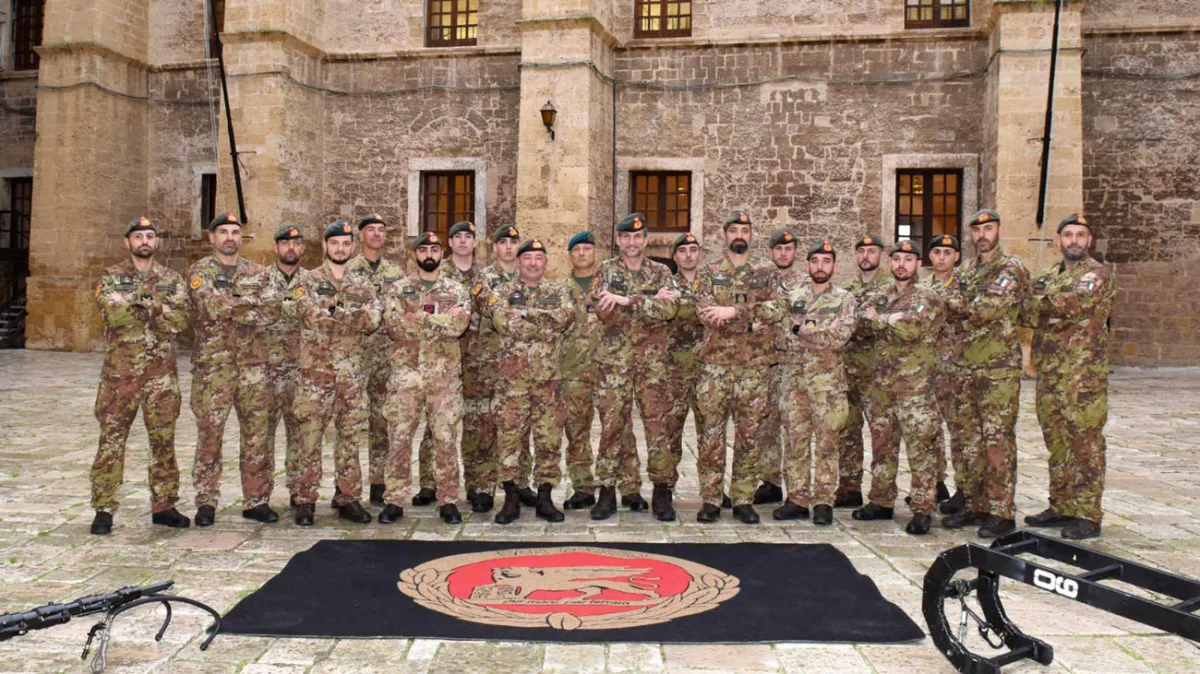

In the solemn setting of the Castello Svevo, a historic symbol of the city's maritime and military presence, the ceremony took place that marked the completion of the training modules 18th Obstructed and 13th Opposed, with the consequent qualification for Maritime Interdiction Operations (MIO) of thirteen marines from the Brigata Marina San Marco.
The operators, selected at the end of an intense and highly specialized course, now officially join the ranks of the 2nd San Marco Regiment, an elite unit of the Navy tasked with conducting maritime and naval operations aboard the Naval Squadron's Units.
The ceremony was presided over by Admiral Michele Orini, Commander of the Brigata Marina San Marco, who in his speech highlighted how the regiment's boarding teams constitute one of the most strategic capabilities of the Armed Forces, essential for ensuring maritime security, countering illegal activities, and protecting national interests in complex operational contexts.
The Admiral also emphasized the professional quality of the attendees, praising the commitment required to overcome a training process that replicates scenarios where rapid decision-making, self-control, and advanced close engagement techniques are crucial.
Concepts echoed by the Commander of the 2nd Regiment, Captain Marco Maccaroni, who reiterated the importance of continuous training to maintain levels of efficiency and operational credibility adequate to national and multinational commitments. The preparation of the operators, he recalled, is the core of the intervention capability in MIO.
Training Built on Real Scenarios
The final module included a particularly intense training cycle, structured on:
- high-risk day and night boardings, with approaches on moving Naval Units via high-speed surface boats;
- combat techniques in confined environments;
- advanced use of tactical materials;
- procedures for managing casualties and evacuating the injured;
- procedures for distinguishing between friendly, hostile, and unknown personnel.
A course designed to simulate real operational conditions, where every movement and command can determine the mission's outcome.
The Transition from Trainees to Operators
The awarding of certificates represented a moment of strong symbolic value, marking the transition from trainees to fully qualified operators. Particularly significant was the presence of operators already in service in the 2nd Regiment, lined up to welcome the new recruits in a gesture of professional continuity and unit tradition.
For the thirteen newly qualified, the operational phase now begins: they will be employed in the regiment's teams, ready to operate aboard the Navy's Naval Units with the aim of ensuring maritime security, safeguarding communication routes, and protecting national interests.


Comments
No comments yet. Be the first!