


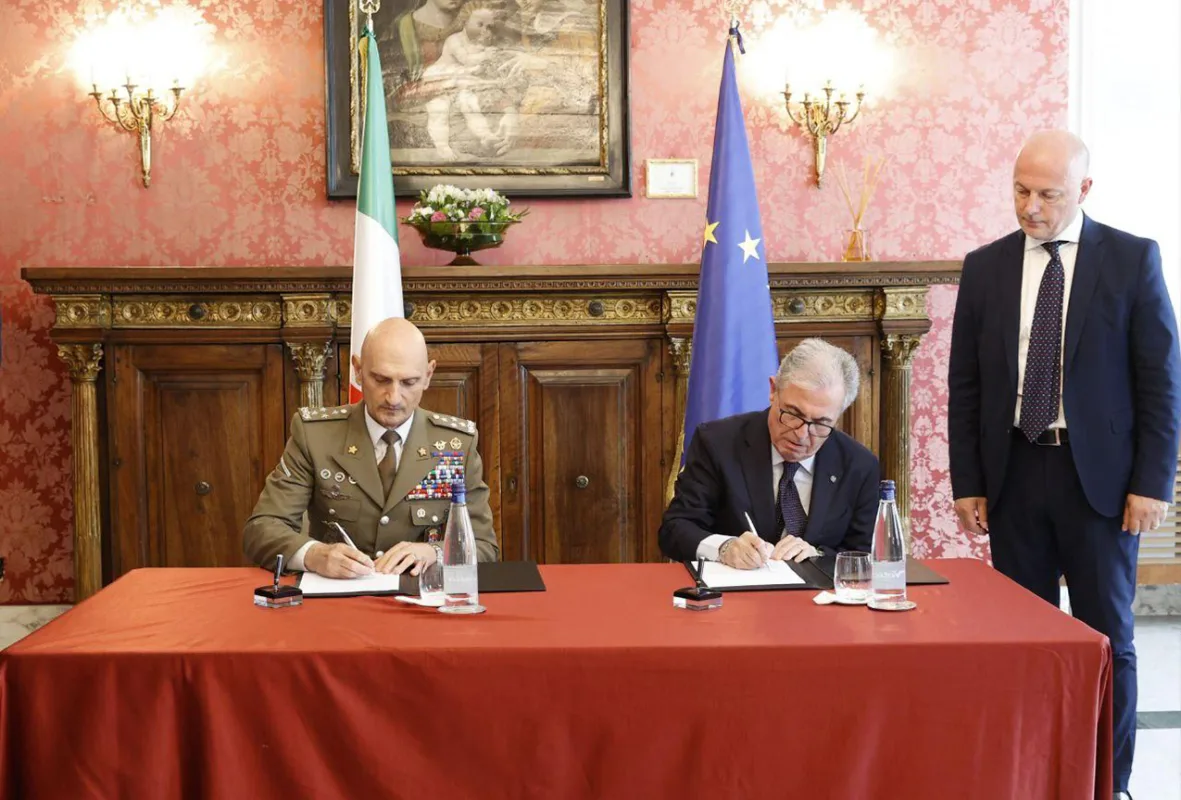

Rome, June 10, 2025 – In an era marked by constantly evolving digital threats, the Ministry of Defense and the National Cybersecurity Agency (ACN) today signed a strategic agreement aimed at strengthening the resilience of the national cybersecurity system. The signing of the agreement took place in Rome, in the presence of the Undersecretary of Defense, Hon. Matteo Perego di Cremnago, the Chief of Defense Staff, General Luciano Portolano, and the Director General of ACN, Prefect Bruno Frattasi.
An institutional alliance to face hybrid threats
The agreement represents a significant turning point in the cooperation between the military and civilian sectors, with the aim of building an integrated cyber defense model. “The agreement marks a decisive step for the protection of national strategic assets, in a context increasingly marked by hybrid, pervasive, and multi-domain threats,” said Perego. Cybersecurity is thus recognized as a fundamental element of the broader national defense strategy.
Exponential growth of digital threats
The decision comes at a critical moment: according to ACN's annual report, 2024 saw a +40% increase in cyber events and a +89% increase in incidents compared to the previous year. The threat landscape has become more fragmented, unpredictable, and decentralized. Not only hostile states, but also non-state actors and criminal groups are now capable of compromising networks, critical infrastructures, and information systems.
“Digitalization has multiplied attack surfaces,” Perego reminded. “In the cyber domain, offensive potential can bypass traditional resources: even a single actor can generate strategic damage.”
Training, interoperability, and incident response
The agreement provides for the initiation of concrete activities:
- exchange of personnel between Defense and ACN to promote cross-pollination of skills;
- joint training on cybersecurity and crisis management topics;
- operational cooperation in responding to attacks and active vulnerabilities;
- sharing of information and intelligence on emerging threats.
An operational synergy aimed at building a more cohesive, prepared, and resilient cyber ecosystem, capable of acting quickly and in coordination during critical moments.

A new legal framework in line with Europe
The agreement is part of the implementation process of the European directive NIS 2, which imposes stricter obligations on the security of networks and information systems, and of the Legislative Decree 138/2024, recently adopted in Italy to update the national regulatory framework. The new rules aim to improve governance, define responsibilities, and increase the protection of strategic infrastructures.
Towards an integrated cyber defense
“We can no longer delay the creation of an integrated cyber weapon,” emphasized the Undersecretary, hoping for the creation of a mixed civilian-military unit with offensive and defensive capabilities in the digital domain. A proposal that echoes the approach already adopted in other NATO countries, where cyber warfare is recognized as a crucial component of strategic posture.
This vision translates into a new paradigm of national security, where physical protection is accompanied by the defense of information, data, and digital infrastructures. Cyberspace thus becomes the fifth operational domain, alongside land, sea, air, and space.
A strategic challenge for digital sovereignty
“The real challenge is anticipation,” declared Perego. “We cannot limit ourselves to responding to attacks: we must be able to prevent them, through technology, research, and solid governance.” In this perspective, cooperation with universities, research centers, start-ups, and technology companies will be a key element to fuel innovation and national strategic autonomy.

Conclusion
The agreement between Defense and ACN paves the way for an integrated and proactive cyber defense, which strengthens the national posture in the Euro-Atlantic context. In an era where cyber threats can paralyze entire systems, building a common front represents an unavoidable priority.
Italy thus positions itself as a conscious, resilient, and leading actor in European cybersecurity, in defense of its citizens, its institutions, and its digital sovereignty.






Comments
No comments yet. Be the first!