

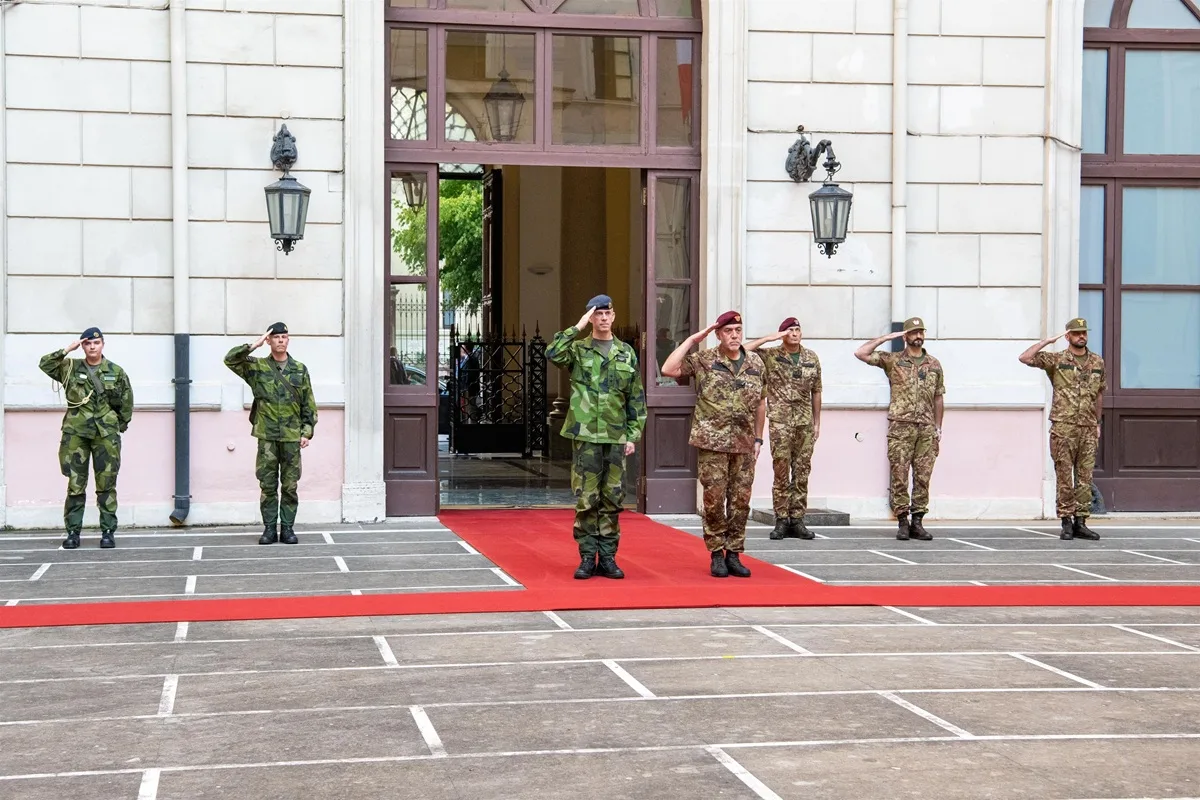

On September 30, 2025, Major General Jonny Lindfors, Chief of Staff of the Swedish Army, made a significant working visit to Italy, hosted by the Italian Army General Staff. The reception at Palazzo Esercito was official and solemn, with military honors rendered by the Italian Armed Forces, underscoring the importance attributed to the meeting. He was welcomed by Corps General Carmine Masiello, Chief of Staff of the Italian Army, with whom the Swedish general held a bilateral meeting.
The day continued with a briefing in the “Montezemolo” Room, dedicated to crucial topics for European military cooperation: the modernization of the Italian land instrument, national and international missions, and common operational challenges.
The topics covered ranged from the increase in interoperability between operational units and complex commands, to collaboration in the capability and doctrinal field, to the joint development of industrial and technological research programs. A central point was the exchange in the field of advanced military training, which represents a pillar for the development of a common strategic culture among the officers of the two Armed Forces.
General Masiello, at the conclusion of the meeting, emphasized how Euro-Atlantic security challenges are increasingly complex today, with hybrid conflicts, pervasive technological pressures, and constantly changing scenarios. Cooperation with Sweden, which recently joined NATO, is therefore part of a strategic path aimed at strengthening the European defensive posture and adapting the Alliance to new forms of confrontation.
The visit concluded in Rome with the signing of the Honor Book in the “Gonzaga del Vodice” Room and the traditional exchange of institutional gifts, sealing a growing bilateral relationship.
The In-depth at Solbiate Olona: The NATO Dimension
After the Roman stop, the Swedish delegation reached the NATO Rapid Deployable Corps – Italy (NRDC-ITA), at the headquarters in Solbiate Olona, where they were welcomed by Corps General Gianluca Carai, Commander of the multinational Corps.
Major General Lindfors met with representatives of the countries contributing to the NRDC and received an informative briefing on the organization, tasks, and future prospects of the Command. In particular, emphasis was placed on the role of the headquarters as Allied Reaction Force (ARF) Headquarters, one of the pillars of the new NATO architecture supporting the Alliance's missions.
The guidelines presented clarified the three essential functions of the Command:
- Deterrence and defense, meaning the ability to respond quickly to any conventional or hybrid threats;
- Crisis prevention and management, with the ability to lead stabilization operations in unstable contexts;
- Cooperative security, aimed at strengthening dialogue and collaboration with partner countries and international organizations.
The meeting confirmed the joint commitment of Italy and Sweden to strengthen the multinational dimension of European and Atlantic defense. Sweden's recent accession to NATO represents an important piece in this process, as it expands the operational and strategic base of the Alliance, ensuring greater geographical coverage in Northern Europe and strengthening the defensive posture on the Arctic and Baltic fronts.

The presence of the Swedish delegation at NRDC-ITA thus has both symbolic and operational value: it demonstrates the willingness to quickly integrate Sweden into the Alliance's military structures, fostering mutual learning and the development of common capabilities.
A Piece of Euro-Atlantic Cooperation
The visit of Major General Lindfors goes beyond protocol, representing a concrete step towards a deeper synergy between Rome and Stockholm. In an era marked by geopolitical crises and the return of high-intensity confrontation dynamics, strengthening bilateral cooperation between Italy and Sweden serves a dual purpose:
- consolidating the resilience of the Atlantic Alliance;
- accelerating the creation of a European strategic culture that values the continent's industrial and technological autonomy.
Cooperation in the defense research and industry sector could open new perspectives, for example in cybersecurity, land robotics, and the use of unconventional systems in hybrid scenarios. Also on the training level, Italy and Sweden share a tradition of multinational exercises that, with Sweden's entry into NATO, can be further expanded.
An aspect to highlight is the geographical and operational complementarity of the two countries. Italy, a strategic bridge in the Mediterranean, and Sweden, a new actor in the Baltic and Arctic area, contribute to ensuring the security of the entire Euro-Atlantic space. In this sense, bilateral cooperation is also a political signal: European security can no longer be thought of as a sum of national interests, but as an integrated collective effort.

The signing of the Honor Book and the exchange of institutional gifts, moments of military tradition, thus assume the value of a symbol: Italy and Sweden not only strengthen bilateral relations but contribute to a new European security balance, in which land cooperation plays a decisive role.
The visit of Major General Lindfors to Italy, articulated between Rome and Solbiate Olona, confirms how the bond between the two Armed Forces is destined to consolidate in the coming years, in a path that intertwines joint operations, technological development, and strategic training. A clear signal, in a time of global uncertainty, that Europe intends to strengthen its capacity for collective response and defense.



Comments
No comments yet. Be the first!