




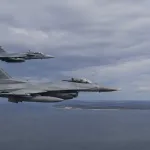
Immediate takeoff, aircraft identification, and route monitoring. This was the scenario that occurred on Wednesday, March 18, 2026, in the Baltic skies, when two Italian fighters engaged in the NATO Air Policing mission were scrambled to intercept a Russian Sukhoi Su-30 Flanker H. According to the reconstruction released by NATO, the jets of the Italian Air Force, deployed at the Ämari base in Estonia, executed an “Alpha Scramble”, which means a rapid alert takeoff to identify an aircraft deemed of operational interest.
The intervention of Italian fighters in the Baltic
The episode was made known by the NATO air command, which reported the interception of a Russian Su-30 by Italian aircraft deployed in Estonia as part of the enhanced Air Policing mission on the northeastern flank of the Alliance. The Italian presence at Ämari is part of the permanent surveillance system with which NATO controls and protects the airspace of the Baltic countries, one of the most sensitive areas in the confrontation with Moscow.

What happened on March 18
The most significant news that emerged in the following hours is that, according to Estonian authorities cited by Reuters, the Russian fighter violated Estonian airspace near the island of Vaindloo in the Gulf of Finland, remaining there for about a minute. Tallinn specified that there was no immediate threat to national security but summoned the head of the Russian diplomatic mission in Estonia for a formal protest. This would be the first such incident recorded by Estonia in 2026.
Why the “Alpha Scramble” was initiated
In NATO terminology, an “Alpha Scramble” indicates the order for immediate takeoff directed at fighters in operational readiness. It does not automatically equate to a hostile action or an imminent clash: it is a standard air defense procedure used to reach an aircraft, visually identify it, track its movements, and verify that it does not pose a threat or violate controlled airspace. In this case, the response of the Italian jets fits into the ordinary framework of Air Policing missions that NATO maintains active 24/7.

The NATO framework on the Eastern flank
The episode is part of a phase of strengthening NATO's posture along the eastern border. On the official Alliance website, the Eastern Sentry initiative is described as a multi-domain activity launched in September 2025 to increase vigilance, coordination, and deterrence capabilities along the entire Eastern flank, following a series of airspace violations by Russian drones and aircraft. Eastern Sentry does not coincide with the sole Baltic Air Policing mission but integrates it into a broader framework of defense and rapid response.
A signal that goes beyond the single episode
The intervention of the Italian fighters confirms Italy's growing role in NATO's advanced surveillance missions and highlights a context in which airspace control has become one of the most delicate areas of confrontation between the Atlantic Alliance and Russia. More than an isolated incident, the episode of March 18 shows how the Baltic remains a high strategic sensitivity zone, where even a brief incursion or suspicious approach can trigger the allied deterrence mechanism within minutes.




Comments
No comments yet. Be the first!