


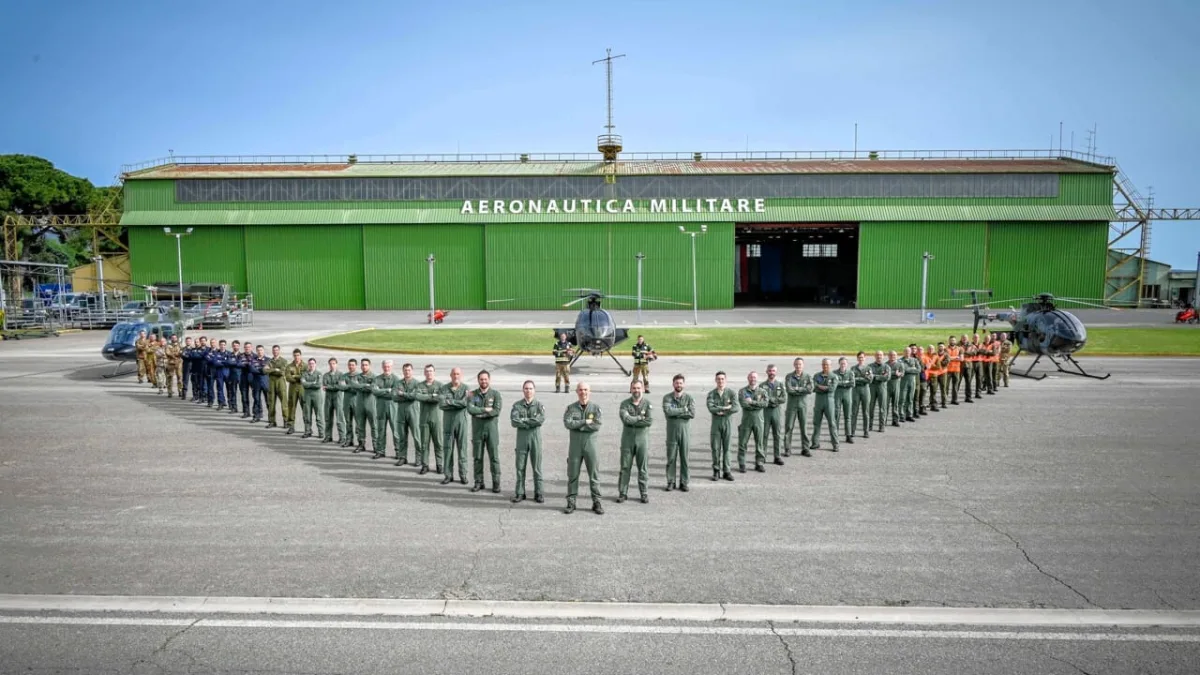

With the official establishment in Viterbo, the New Helicopter School (NSE) represents a significant step in the evolution of the national military instrument. The transfer of the 72nd Wing from its base in Frosinone to the capital of Tuscia is part of a long-term plan aimed at rationalizing and enhancing rotary-wing training through the creation of a unified training center.
The NSE is configured as an interforce entity, under the guidance of the Italian Air Force, with the mission of ensuring the training of helicopter pilots for the Air Force, other Armed Forces, and State Armed Corps, also allowing for the participation of personnel from allied and partner countries. This setup reflects contemporary operational needs, characterized by integration, interoperability, and standardization of training processes.
The goal is to establish a unique rotary-wing training center, based on shared syllabi and homogeneous procedures, capable of ensuring high-quality training. The model allows for the optimization of available resources and achieves benefits in training, logistics, and maintenance, overall strengthening the effectiveness of the Defense's training system. In perspective, the NSE is configured as a strategically significant asset, with potential positive impacts also in the field of international cooperation.
Viterbo as a hub for military aviation training
From January 15, the New Helicopter School officially started its activities at Tommaso Fabbri Airport. From this date, the training functions have been progressively concentrated at the new location, and training courses are provided by the 72nd Wing relocated to Viterbo. The establishment confirms the city's role as a central hub in the Italian Defense training system.

The transfer of the Helicopter School is structured as a gradual process, spanning over three years, to ensure operational continuity and organizational sustainability. Training activities have commenced at the new site, while the completion of the transfer of maintenance functions is expected by the end of 2027. The year 2028 represents the reference point for a comprehensive review of the organizational structure, in line with the established planning.
Within the same airport area, the Air Force Non-Commissioned Officers School continues its institutional activities regularly. The simultaneous presence of multiple training entities strengthens Viterbo's role as a national reference center for military aviation training, contributing to the stability and continuity of institutional functions in the area.
Frosinone and the continuity of the training function
The transfer of the 72nd Wing to Viterbo marks the end of a long historical phase for Frosinone, which for decades hosted the training of helicopter pilots of the Italian Air Force. This experience has been an important element in the overall framework of national aviation training and has contributed to the development of skills consolidated over time.
In the new planned setup, the Frosinone airport is set to assume a function consistent with the technological and operational evolution of the Defense. The site is indeed oriented to become an interforce school for training on remotely piloted systems, in line with the growing importance of unmanned platforms in modern operational scenarios.

This reconfiguration allows for the enhancement of existing infrastructures and their integration into an updated training context, complementary to that developed in Viterbo. In this perspective, Viterbo and Frosinone are positioned within an integrated system, where traditional rotary-wing training and training related to remotely piloted systems jointly contribute to strengthening the Defense's capabilities.
The transition of the 72nd Wing from Frosinone to Viterbo is therefore configured as a planned organizational evolution, aimed at adapting the Italian military aviation training system to present and future needs, in the spirit of institutional continuity and operational innovation.






Comments
No comments yet. Be the first!