


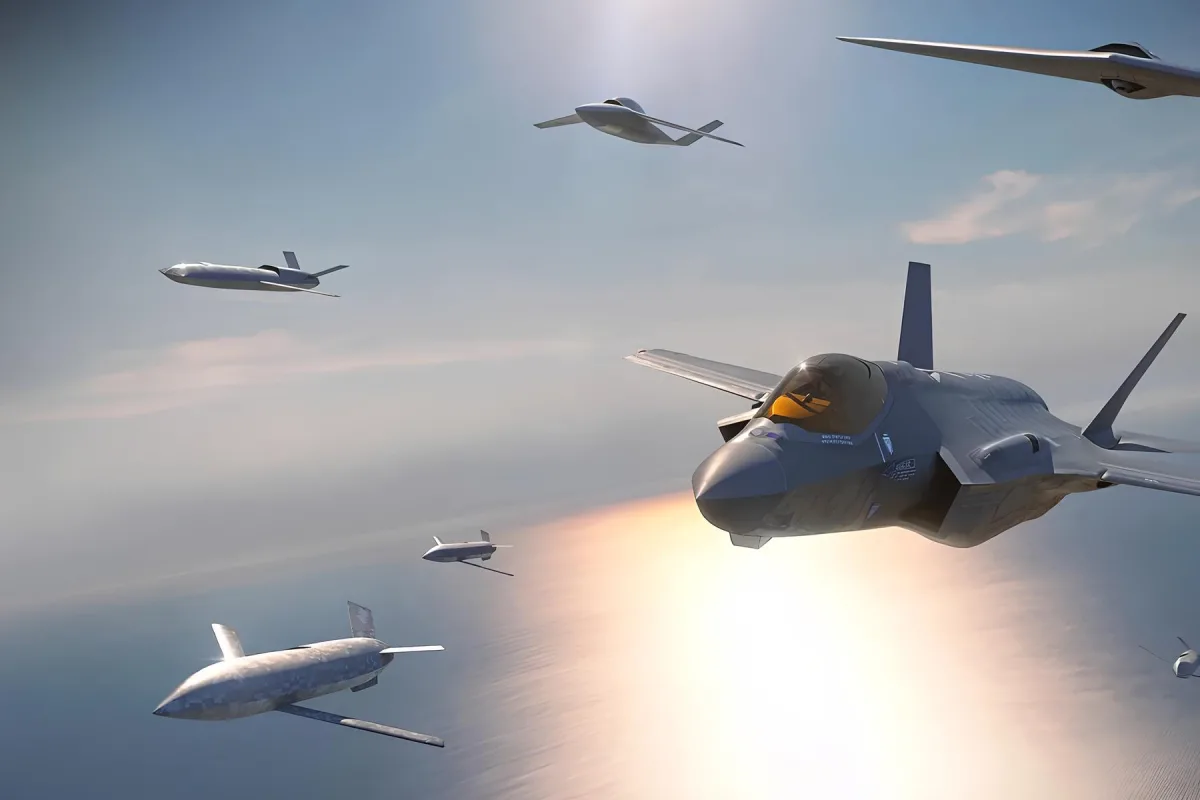

The United States Air Force is considering the creation of independent squadrons dedicated to collaborative combat drones – the so-called Collaborative Combat Aircraft (CCA) – set to change the face of American air power. The announcement came from General Kenneth Wilsbach, appointed as the new Chief of Staff of the USAF, during his confirmation hearing before the Senate Armed Services Committee. “We are thinking that the CCAs will not be integrated into the current fighter squadrons, but will have their own autonomous units,” Wilsbach stated, noting that the formula could also be extended to the Air Force Reserve and the Air National Guard.
The CCA program is an integral part of the broader Next Generation Air Dominance (NGAD) system, an ecosystem of integrated platforms – both manned and unmanned – designed to ensure U.S. air superiority in future conflicts. The CCA drones, designed to operate in synergy with fifth and sixth-generation fighters like the F-35 and the future NGAD, will have roles in attack, reconnaissance, electronic warfare, and support for complex missions. According to initial forecasts, each new manned aircraft will be able to rely on multiple robotic “wingmen,” with a ratio of two drones for each NGAD.

CCA Program: Development, Prototypes, and Operational Bases
In 2024, companies General Atomics and Anduril Industries received the first contracts for the development of prototypes of the so-called “Increment 1,” the first production phase of the program. General Atomics has already started flight tests with its YFQ-42A, while Anduril is ready to launch its own YFQ-44A. The Air Force will adopt a modular approach, with multiple successive phases (“increments”) introducing different and progressively more advanced capabilities.
General Wilsbach confirmed that the program “is meeting timelines, costs, and technical objectives,” with a final production decision expected for fiscal year 2026. In parallel, the USAF is establishing a CCA Aircraft Readiness Unit (ARU) at Beale Air Force Base in California, which will be responsible for maintaining the drones in operational readiness and ensuring rapid deployment in case of emergency.
The decision to create dedicated autonomous units stems from the need for strategic flexibility: separating the CCAs from manned squadrons will allow them to be assigned to different missions and platforms as needed, maximizing their effectiveness. Additionally, independent squadrons will have specialized technical personnel, simplifying logistics, maintenance, and management of advanced autonomous systems.

Towards a Distributed and Multi-Domain Air Force
The concept proposed by Wilsbach is part of the broader transformation process that the USAF is undergoing: moving from a traditional structure centered on manned aircraft to a distributed, digital, and multi-domain force. The CCA drones will act as intelligent nodes in an interconnected network of sensors and weapon systems, capable of sharing real-time information with piloted fighters, space systems, and ground units. The goal is to achieve decision-making speed, informational superiority, and operational resilience, three key factors of modern warfare.
The creation of autonomous squadrons represents a conceptual breakthrough: drones will no longer be mere supports, but autonomous combat forces capable of operating with increasing levels of decision-making independence. However, challenges remain. Interoperability between drones and piloted aircraft requires highly secure command and control systems, resistant to interference and cyberattacks. Crucial questions also remain open regarding the costs and infrastructure needed to base and maintain the new generation wings.
Despite these uncertainties, the Collaborative Combat Aircraft program is confirmed as one of the most ambitious initiatives of American defense. If successfully realized, it could redefine the very concept of an air squadron, blending artificial intelligence, autonomy, and human-machine cooperation into a single operational system. With the first production decisions expected in 2026 and entry into service by the end of the decade, the CCAs promise to usher in the new era of U.S. air power.



Comments
No comments yet. Be the first!