


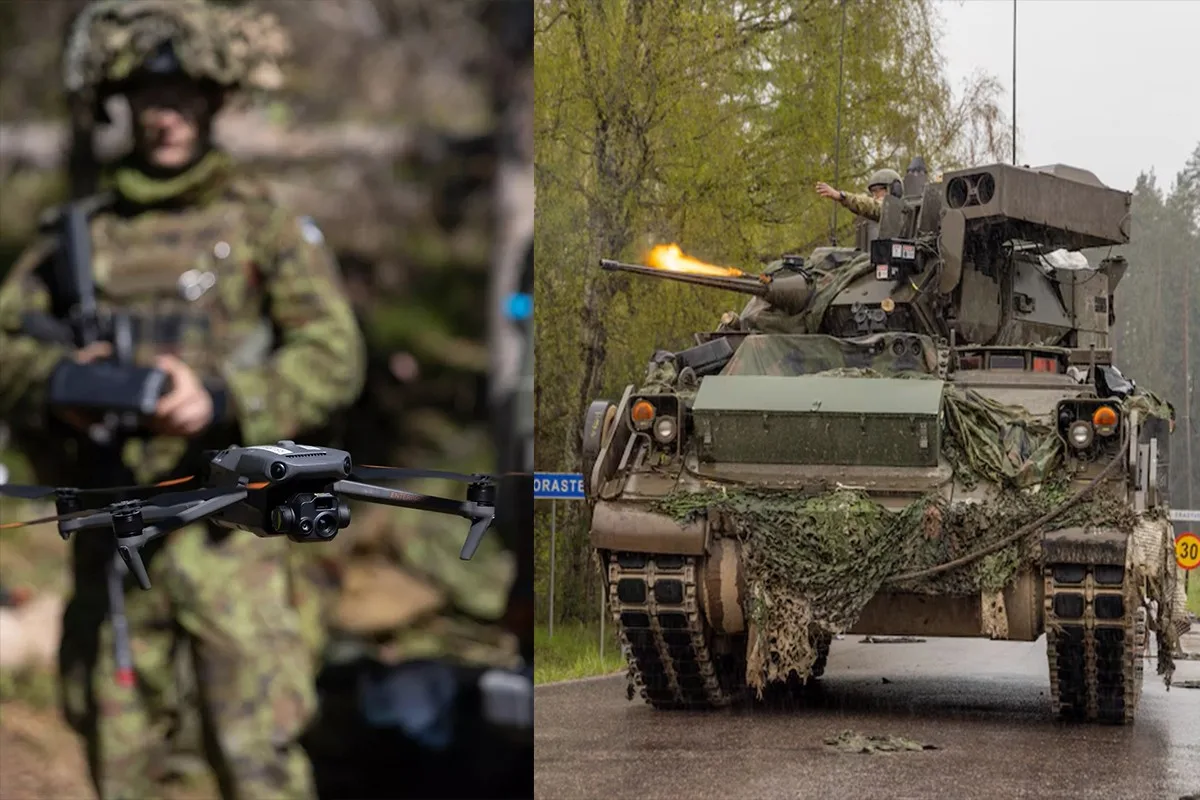

In the Western strategic imagination, the “war of the future” is often described as a technological leap: sensors everywhere, data flowing without friction, commands faster than the adversary. But when, in May 2025, Estonia hosted Hedgehog 2025 (Siil 2025) — one of the largest exercises in its recent history — reality told a different story: a small Ukrainian team, using drones and the DELTA software system, challenged numerically superior NATO units, exposing doctrinal weaknesses and, above all, a data management still too “siloed”.
The episode, reported by several international outlets and highlighted in Italy by Il Giornale in the article “Bitter Lesson for NATO: How Kiev's Drones Expose the Alliance's Weaknesses”, serves as a wake-up call: it's not enough to buy drones or jammers if doctrine, procedures, and interoperability lag behind the pace set by the Ukrainian battlefield.

Hedgehog: Numbers, Scenario, and “Stress Test” Objective
Hedgehog 2025 took place from May 5 to 23, 2025, involving over 16,000 military personnel (conscripts, reservists, and active Estonian forces, plus allies) and aimed to test operational planning and interoperability in a framework of Estonian territorial defense.
Unlike the static nature of many parts of the front in Ukraine, the exercise scenario simulated a war of movement, with units able to maneuver and concentrate. This is where the lesson comes in: in a “more permissive” environment, NATO should have capitalized on mobility and mass; instead, the Ukrainian team demonstrated how the battlefield transparency created by drones can quickly nullify traditional advantages when tactical discipline and decision-making chains are not up to par.

The Breaking Point: Drones + DELTA = Faster Kill Chain
According to reconstructions reported by several media, in one scenario a NATO force of several thousand men (including a British brigade along with Estonian units) attempted an offensive against the Ukrainian team, with an outcome described as “devastating” for the attackers.
The Ukrainian advantage was not “the drone” itself, but the combination:
- continuous reconnaissance (drones as low-cost, high-persistence sensors);
- rapid data fusion and sharing;
- accelerated engagement (the kill chain: see–decide–strike).
This is where DELTA comes into play, a Ukrainian battlefield management/situational awareness system that integrates feeds from drones, sensors, and other sources into a shared digital map, facilitating coordination and secure information exchange across different levels. DELTA has also been tested in NATO interoperability contexts (CWIX) and presented as a mature platform for coalition environments.
A key aspect, often overlooked in public debate, is that “speed” is not just technology: it is also trust, sharing rules, organizational culture. And precisely on this — according to the analysis reported in the Italian article — many NATO units still show reluctance to share sensitive data in real-time with the tactical level, limiting the effectiveness of any digital network.

The NATO Paradox: Proclaimed Interoperability, Data Still Too “Siloed”
For years, the Alliance has invested in interoperability and modern C2. Yet Hedgehog 2025, according to readings circulated in recent weeks, highlighted a paradox: forces with excellent means and traditional training can become “slow” if their information architecture does not allow for rapid transformation of discovery into effect.
An analysis by CSIS, discussing the Ukrainian case and DELTA, argues that Ukraine offers a pragmatic model of data integration useful also for Western multi-domain command and control programs (CJADC2), precisely because it originates in a context where adaptation is continuous and driven by operational urgency.
Not Just Drones: The Real Vulnerabilities Exposed
From the combined reading of sources (Italian article, international reports, and official exercise materials), at least four recurring critical points emerge:
- Signature discipline and camouflage “from the pre-drone era”
Moving, halting, and deploying as if aerial observation were episodic is now a luxury. In a battlefield saturated with drones, the visual/thermal/electromagnetic signature becomes a target. - Decision cycle too slow
If the adversary compresses the time between detection and attack, even a small team can generate disproportionate effects. On DELTA, for example, it has been reported that the adoption of the system drastically reduced latency between intelligence and fire in various operational contexts. - Insufficient data sharing between levels and nations
Technology without policy and culture does not scale. If data remains “stuck” in separate channels, a rapid and resilient kill chain does not form. - Incomplete integration between sensors, C2, and anti-drone countermeasures
Countering drones does not just mean shooting them down: it also means seeing them (sensors), attributing them (identification), deciding (C2), neutralizing them (EW/kinetic), and doing so in a coordinated and repeatable manner.

Why This Lesson Matters (Even More Than the Exercise Itself)
Hedgehog 2025 is not the definitive “proof” of NATO's state: it is an exercise, with constraints and rules, and with an extremely specialized Ukrainian OPFOR. But precisely for this reason, it is valuable: it shows what happens when high-intensity war experience (the Ukrainian one) meets allied structures designed for a different pace.
And while NATO strengthens posture and deterrence on the eastern flank (also through large-scale exercises in Estonia), the question that remains on the table is very concrete: how quickly will the Alliance be able to transform the “drones + data” lesson into doctrine, training, and standard procedures, avoiding that quantitative or industrial superiority is eroded by adversaries faster in learning?



Comments
No comments yet. Be the first!