


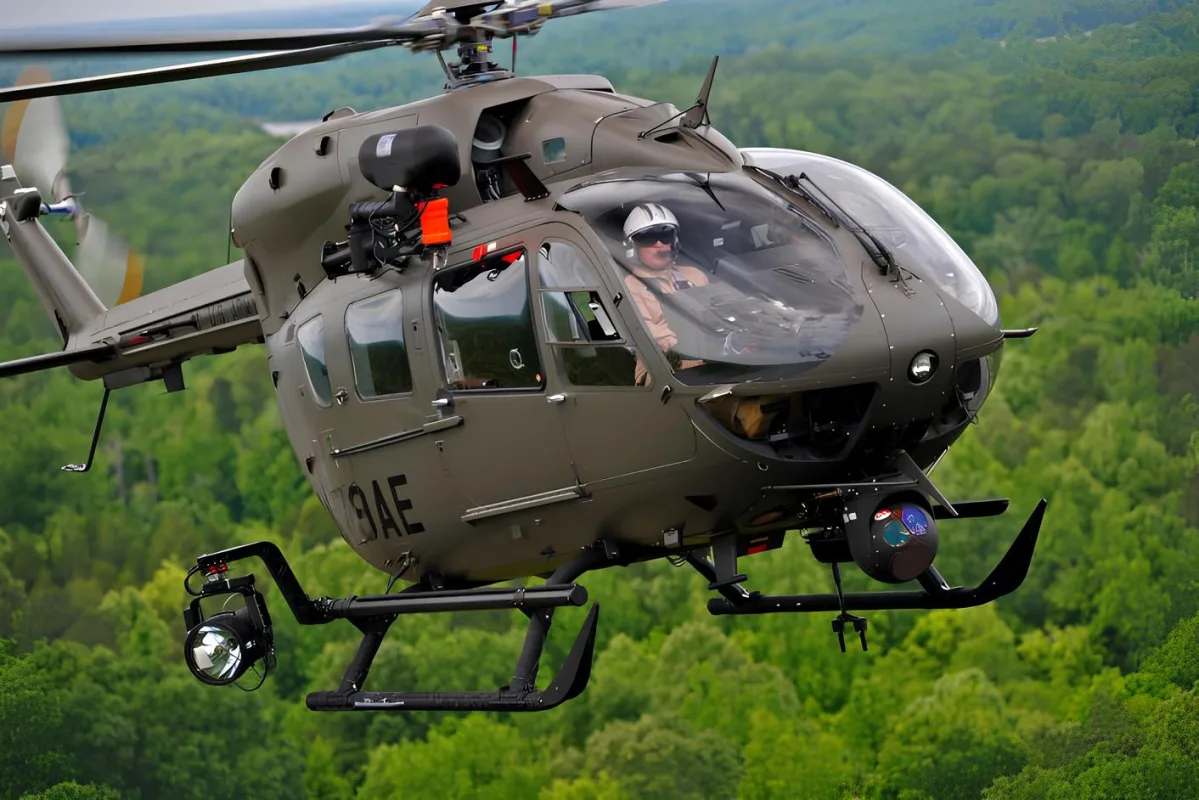

Leonardo and Boeing have announced a collaboration to meet the requirements of the U.S. Army Flight School Next, the program aimed at defining the next generation of systems and platforms for training American military pilots. The joint proposal offers a turnkey integrated solution, based on proven technologies and a management model that ensures efficiency, reliability, and operational continuity.
The agreement combines the complementary experiences of the two companies: Boeing, with a solid tradition in training and operational support for the U.S. Army, and Leonardo, with the training helicopter AW119T, already successfully employed in the American and international markets. The goal is to offer a realistic, modular, and technologically advanced training system, in line with the new digital training needs of the U.S. Army.
As stated by John Chicoli, Senior Director of Boeing Global Services, “two industry leaders join forces to offer the U.S. Army an integrated, innovative, and long-term solution, capable of enhancing the readiness and quality of pilot training for the entire duration of the program.”
AW119T: A Proven and Flexible Platform
A central element of the proposal is the AW119T, a single-engine training helicopter that has accumulated over 100,000 flight hours, including more than 16,000 under instrument flight rules (IFR) and over 40,000 autorotation landings. The model is already adopted by the U.S. Navy for training its pilots and supported by a consolidated logistics network, which includes 130 operational units and a technical assistance center in Florida, located near the U.S. Army base at Fort Rucker (Alabama), the main training hub for American military aviation.
According to Clyde Woltman, CEO of Leonardo Helicopters U.S., “the AW119T is a proven platform that supports the training of military pilots in the United States every day. The collaboration with Boeing allows us to offer the U.S. Army capabilities and value over time through the Flight School Next program.”

The helicopter features advanced safety characteristics, such as reinforced cabin and tanks, the ability to perform autorotation landings, and training dedicated to in-flight emergency management. All this contributes to a reduced risk profile and immediate full operability, in line with the U.S. Army's need for ready and high-performance training tools.
Digital Training and Operational Advantages
The Boeing-Leonardo proposal includes a comprehensive training system, which includes helicopters, simulators, instructors, spare parts, and maintenance, for an integrated, flexible, and scalable offer.
The training approach is competency-based and involves a multi-phase learning path, combining real flights, virtual simulations, digital instructors, and data analysis. This methodology allows for customizing pilot training, improving efficiency, and optimizing the use of flight hours, ensuring a better balance between costs and operational results.
From a logistical perspective, the model includes optimized maintenance programs, adaptive training scheduling, and automated logistics, with the aim of maximizing aircraft availability and reducing downtime. The integration of predictive analytics for preventive maintenance further strengthens the overall safety and efficiency of the system.
On the industrial side, Boeing provides its experience in mission services and support for AH-64 Apache helicopters, as well as established expertise in system integration, simulation, and instructor program development. Leonardo, for its part, brings the production capacity of the AW119T and a fully operational technical support network in the United States.

The collaboration fits within the framework of transatlantic industrial cooperation, demonstrating how the union of European technological excellence and American operational capability can generate competitive and innovative solutions for the defense sector.
With this initiative, Leonardo and Boeing aim to consolidate their presence in the U.S. market and contribute to defining new standards for global military helicopter training, where advanced simulation, real platforms, and integrated digital management represent the key to training the pilots of the future.



Comments
No comments yet. Be the first!