


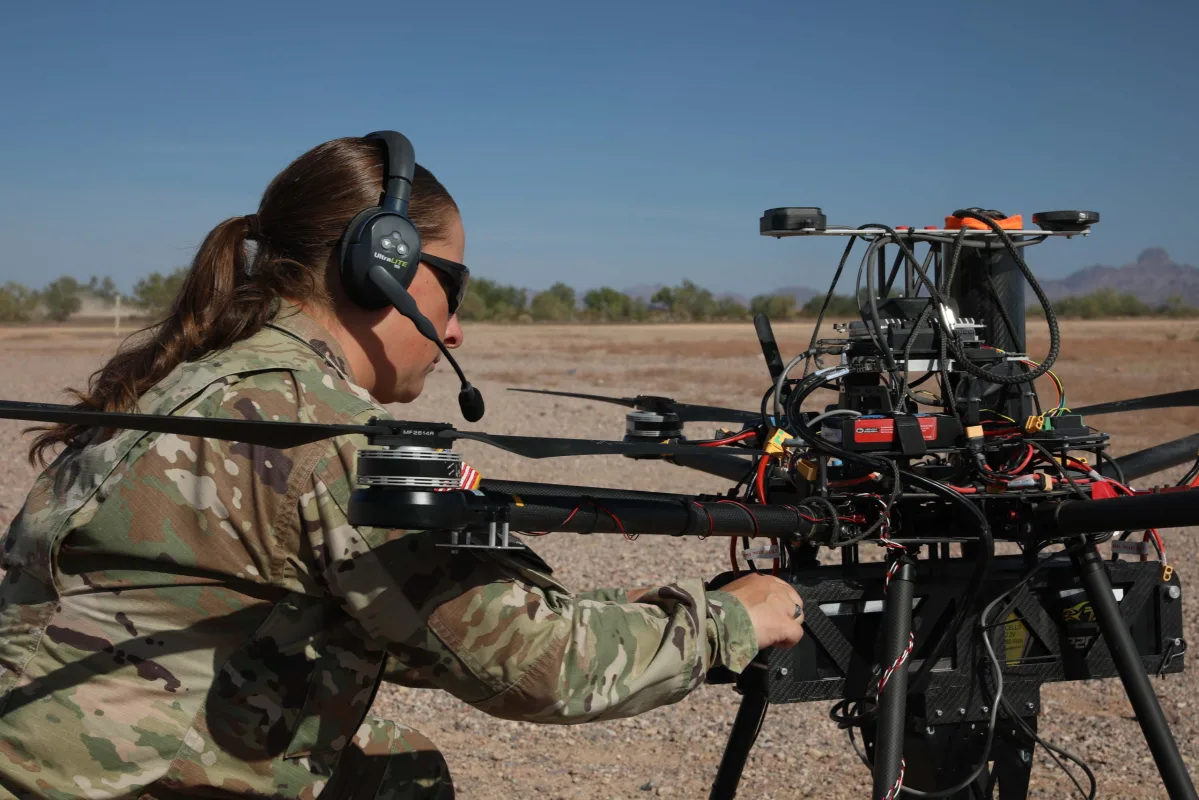

The Pentagon launches an ambitious program to revolutionize the way the United States designs, tests, and deploys military drones. It's called Project GI, initiated on Monday by the Defense Innovation Unit (DIU), and aims to replicate the speed and flexibility with which Ukraine is adapting and improving its drones amid the conflict with Russia.
A Continuous Cycle of Field Innovation
Unlike traditional military tenders, often bound by rigid timeframes, Project GI accepts proposals on a rolling basis until December 31. The goal is ambitious: to create a perpetual cycle that starts from direct feedback from soldiers on the front lines to quickly modify or design new drones.
The model is clear: Ukraine, under the pressure of aggressive electronic warfare by Russia, has learned to adapt in extremely short times, making the long bureaucratic processes that characterize the U.S. Department of Defense obsolete.
The Pentagon's Slowness: An Obstacle to Overcome
According to Trent Emeneker, head of the Blue UAS program at DIU, the Department of Defense has long recognized the urgency to innovate, especially after the 2017 operations against ISIS in Syria and Iraq. But, as he pointed out in an interview, the changes so far have been more bureaucratic than operational.
“Even 'accelerated' efforts take years,” Emeneker explained. “Five years to start working on a prototype is considered fast. We are not talking about delivery, but just about the prototype.”
The Advantage of Adversaries
The Ukrainian experience shows how, today, modern warfare is also played out in the rapidity of technological adaptation. Non-state actors, or more agile armies, can modify their tactics and tools much faster than large Western apparatuses. And this represents a crucial challenge in a context like the Indo-Pacific, where a potential future conflict will require the same speed of reaction seen in Ukraine.
For this reason, Emeneker insists on the importance of creating a direct link between those who build the drones and those who use them on the front lines, bypassing the figure of traditional contract officers. A concrete example is that of some American companies operating side by side with Ukrainian military, gathering feedback directly a few kilometers from the front.
The Shield AI Case: Adaptation in 24 Hours
One of the most involved companies is Shield AI, founded by Brandon Tseng, a former Navy SEAL. Tseng reported that the company has operational teams in Ukraine 24/7, capable of transmitting problems to engineers in the United States in real-time.

In a specific case, in August 2024, Ukraine faced heavy GPS jamming by Russia, which prevented effectively targeting enemy missiles. The team in Ukraine communicated the problem, American engineers developed a solution overnight, tested it in the United States the next day, and immediately sent it to the front: within 24 hours, the new software version was already operational in the field.
Continuous Innovation and Autonomous Supply Chain
According to Emeneker, the goal of Project GI is to reduce the development time of new prototypes from years to a few months for hardware, and even less for software updates. “We want to start solving problems within 24 hours,” he stated.
However, he also highlighted an important limitation: the U.S. dependence on China for key components of the drone production supply chain, such as magnets, lenses, and actuators. This constraint represents a strategic obstacle for large-scale production.
According to Emeneker's estimates, even by immediately committing to an industrial reshoring policy, it would take at least six months to see tangible improvements in production capacity, 12 months for stable production, and 15 months for exponential growth in deliveries.
With Project GI, the Pentagon aims to radically change the paradigm: move from a rigid and slow industrial system to a flexible, responsive network integrated with those fighting on the ground. The Ukrainian example shows it's possible. The American challenge now will be to replicate that speed not only in the lab but on a large scale and sustainably.






Comments
No comments yet. Be the first!