




If there is a military corps surrounded by an almost mythological aura of invincibility, iron discipline, and esprit de corps, it is undoubtedly the United States Marine Corps (USMC). Commonly known as "the Marines," these soldiers are not simply a branch of the U.S. armed forces; they represent a true elite culture.
But how did a small group of sharpshooters, born even before the United States itself, become the most famous rapid reaction force on the planet? To understand this, we must jump back in time over two centuries.

1775: It All Begins in a Tavern
The history of the Marines has a decidedly unusual and fascinating beginning. It does not originate in a stern government building, but among the wooden tables and beer mugs of Philadelphia's Tun Tavern.
On November 10, 1775, the Second Continental Congress approved a resolution to establish two battalions of Marines to be used as landing troops and security aboard ships during the War of Independence against Britain. The first commander, Samuel Nicholas, used the tavern as the main recruitment center.
The requirements of the time were simple but strict: robust men, capable of shooting accurately from the swaying masts of ships and ready for hand-to-hand combat during boarding actions. From that moment, November 10 became the most sacred day for every Marine, celebrated every year worldwide.

From the Shores of Tripoli to the Halls of Montezuma
The official hymn of the Marines begins with a famous phrase: "From the Halls of Montezuma to the shores of Tripoli". This line summarizes the Corps' early great exploits in the 19th century, which cemented its reputation and iconography.
The First Barbary War (1805)
In North Africa, Barbary pirates threatened American merchant ships. Under the leadership of Lieutenant Presley O'Bannon, a handful of Marines undertook an epic march across the Libyan desert to capture the city of Derna (Tripoli). It was on this occasion that Ottoman Prince Hamet Karamanli presented O'Bannon with the famous Mameluke sword, which is still part of the official uniform of Marine officers today.

The Mexican-American War (1847)
A few decades later, during the Battle of Chapultepec in Mexico City, the Marines stormed the eponymous castle (the "Halls of Montezuma"). Legend has it that the red stripe on the blue dress uniform trousers of the Marines (the Blood Stripe) was introduced to honor the blood shed by officers and non-commissioned officers in that bloody battle.
Key points of Marine identity:
• Motto: "Semper Fidelis" (Always Faithful), adopted in 1883.
• Symbol: The Eagle, Globe, and Anchor (EGA), representing the nation, global reach, and naval roots.
• Nickname: "Leathernecks," due to the stiff leather collar they wore in the 19th century to protect against saber blows.

The Great Wars and the Birth of the "Devil Dogs"
The 20th century transformed the Marines from a naval security force into a global amphibious war machine.
World War I and Belleau Wood (1918)
Sent to the Western Front in France, the Marines faced German troops in the forest of Belleau Wood. Despite devastating losses, the Marines counterattacked with such ferocity that the terrified German soldiers dubbed them Teufelhunden — or "Devil Dogs", a nickname the Corps still carries with immense pride today.

World War II and the Pacific Campaign
If World War I gave the Marines fame, World War II defined their modern strategic role through the doctrine of amphibious warfare.
Facing the Japanese Empire, the Marines undertook the brutal "island hopping" campaign in the Pacific. Places like Guadalcanal, Tarawa, Saipan, and Peleliu became synonymous with unimaginable sacrifices. The symbolic peak was reached on February 23, 1945, atop Mount Suribachi during the Battle of Iwo Jima, where the photograph of six Marines raising the American flag became the most iconic image in U.S. military history.
From the Cold War to the 21st Century
In the post-war period, the very existence of the Corps was questioned by those who considered the Marines a duplicate of the Army. However, subsequent conflicts demonstrated the need for a flexible and ready-for-anything force.
- Korean War (1950): In the freezing Chosin Reservoir, surrounded by hundreds of thousands of Chinese soldiers, the Marines wrote one of their most glorious pages of resistance. When asked if they were retreating, General Oliver P. Smith replied: "Retreat? Hell! We're just attacking in another direction!".
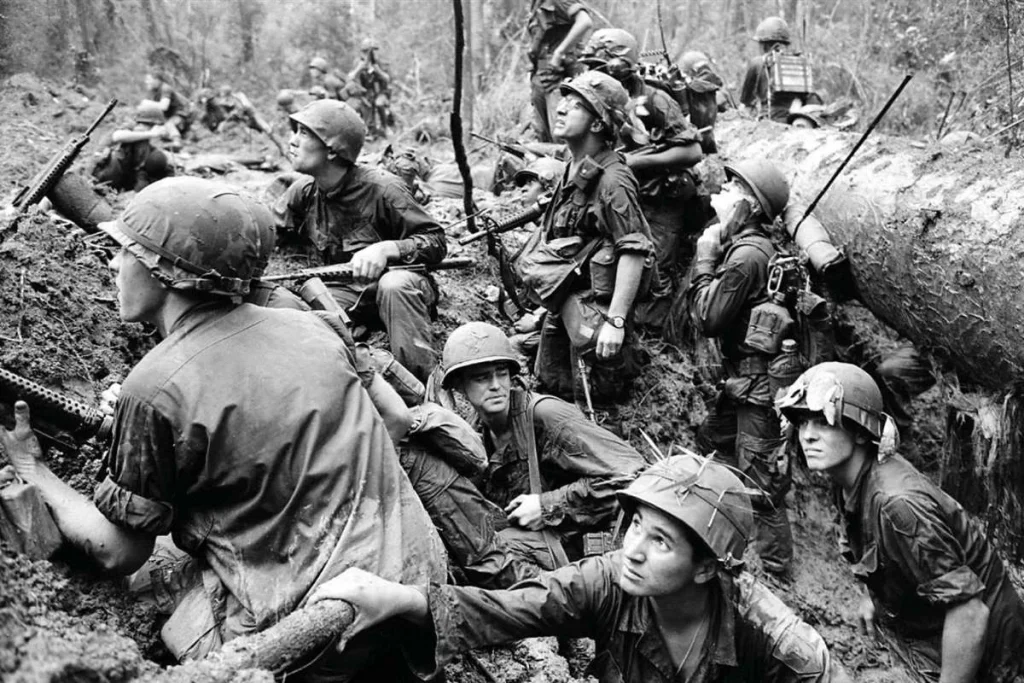
- Vietnam War (1965-1973): The Marines faced asymmetric warfare in the jungle and epic sieges like the one at Khe Sanh and the bloody urban battle to retake the city of Huế during the Tet Offensive.
- The War on Terror (2001-present): After the September 11 attacks, the Marines have been at the forefront in Iraq and Afghanistan. Urban battles like the second battle of Fallujah (2004) confirmed the Corps' lethality and preparedness in modern close-quarters combat.

What Does It Mean to Be a Marine Today?
Today, the United States Marine Corps operates as an elite joint force, equipped with its own aviation, mechanized infantry, and special forces (Marsoc). The transition to modern geopolitical scenarios sees them refocusing on their roots: controlling maritime routes and rapidly projecting power in hot theaters, such as the Indo-Pacific.

The transition from civilian to Marine is considered one of the toughest in the world. The training camps of Parris Island and San Diego are famous for their psychological and physical rigor. Unlike other armed forces, one does not become a Marine just for the job, but for the identity: an indissoluble bond summarized in the concept that "there are no ex-Marines, only Marines serving in civilian clothes".

With over 250 years of history behind it, the Corps continues to walk the fine line between a manic respect for its traditions and the need to evolve to dominate the battlefields of the future. A story born in a tavern and destined never to end.


Comments (1)