


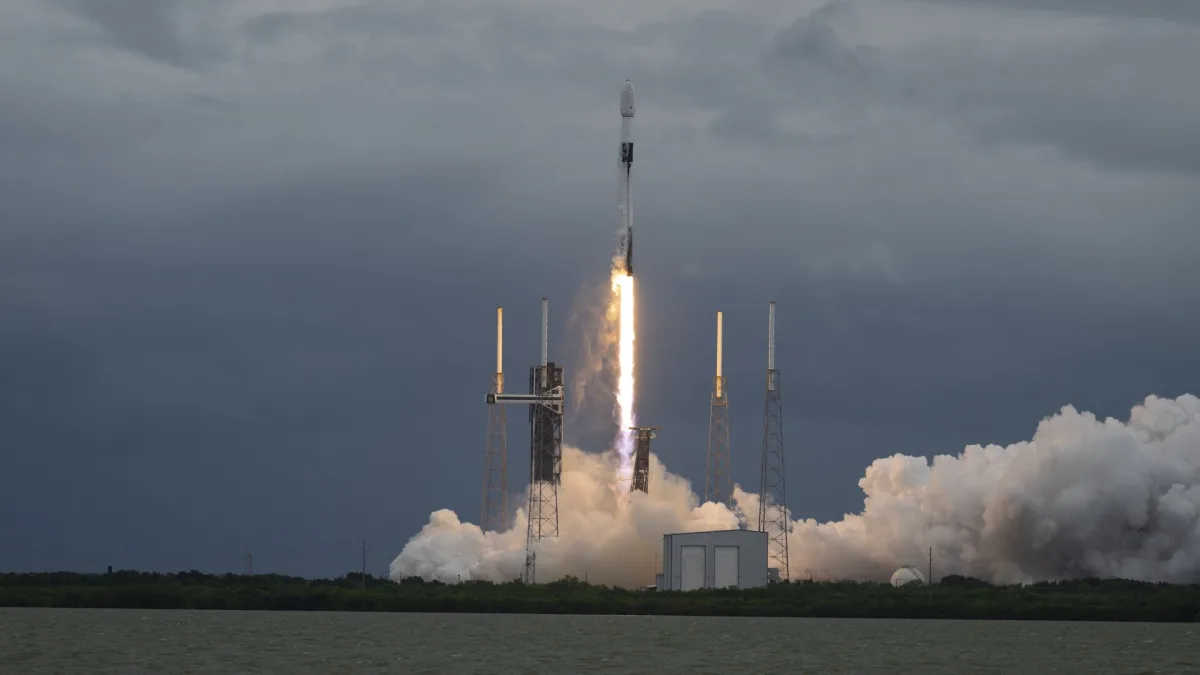

2025 was a turbulent year, and the space sector was one of the most evident reflections. Among new geopolitical balances, unprecedented military choices, and profound industrial changes, space has become a central domain for international security.
A scenario that directly involves Italy, a founding country of ESA, an industrial leader in Europe, and a significant player within the EU and NATO.
European Space Agency Enters the Defense Field
For decades, ESA maintained a strict separation between civil and military activities. In 2025, this line was crossed: during the ministerial at the end of November, the 23 member states officially approved a role for the agency in support of defense, accompanied by funding of one billion euros.
For Italy, which has strategic expertise in Earth observation, telecommunications, and launchers, new industrial opportunities arise, but also political questions on dual use, governance, and national priorities.
The United States Loosens Constraints on Offensive Space Operations
Throughout the year, Washington strengthened the decision-making autonomy of Space Force and US Space Command on the use of anti-satellite capabilities.
This is a profound doctrinal change, confirming that space is now considered an operational domain on par with land, sea, and air.
For Europe – and for Italy – this shift strengthens the debate on the need for autonomous capabilities, to reduce an increasingly evident strategic dependence on the United States.

Space Missile Defense: The Return of a Controversial Idea
The revival of space interceptors under the “Golden Dome” initiative has evoked the specter of the “Star Wars” of the 1980s.
The real surprise, however, is the industrial model: prize competitions and strong private self-financing, without contractual guarantees.
An approach that could also influence future European choices, pushing towards new models of public-private cooperation in the advanced space sector.
SpaceX Increasingly Central: Even Defense Looks to Musk
SpaceX has consolidated its position not only in launches but also as a global satellite operator, positioning itself to provide critical communication and data transmission services to the US Department of Defense.
The willingness of American institutions to resort to almost exclusive contracts with a single private actor raises questions in Europe about competition, resilience, and technological sovereignty.
For Italy, the risk is falling behind without a truly competitive European supply chain.

Stop to Satellite Images for Ukraine: The Signal That Shook Europe
The temporary suspension of Ukrainian access to US commercial satellite images had a huge political impact.
The message was clear: space data is a tool of strategic power.
The European reaction – with new initiatives on Earth observation, security, and strategic autonomy – opens up significant action space. Italy, thanks to its satellite capabilities and role in ESA, can become one of the key players.

A Look at 2026
2025 has shown that space is no longer a neutral domain, but a central element of defense and security policies.
For Italy, the future involves targeted investments, European cooperation, and protection of technological sovereignty.



Comments
No comments yet. Be the first!