


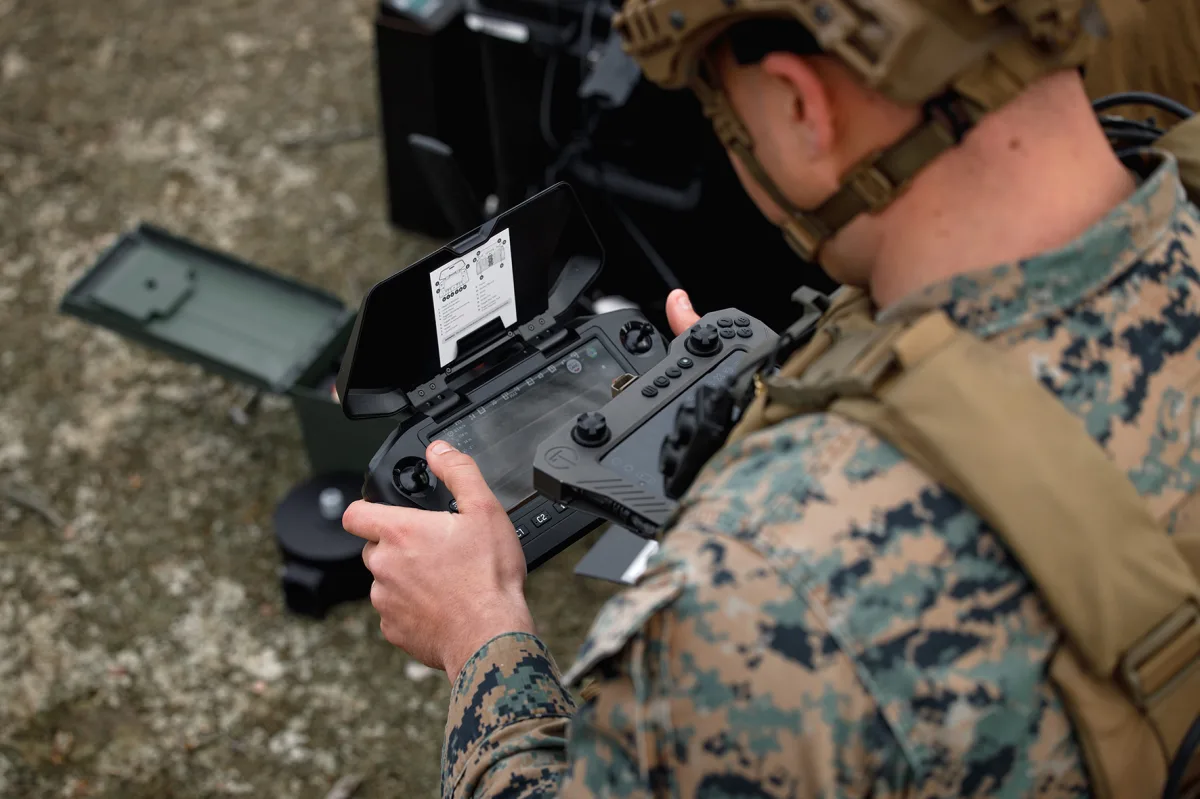

On January 3, 2025, at the Marine Corps Base in Quantico, Virginia, the Marine Corps Attack Drone Team (MCADT) was officially established, marking a decisive turning point in the operational evolution of the United States Marine Corps. The creation of the new team was signed by Major General Anthony M. Henderson, commander of the Training Command, and Brigadier General Simon M. Doran, head of the Marine Corps Warfighting Laboratory.
The initiative stems from the growing awareness of the threat posed by armed first-person view drones (FPV), which have emerged as a crucial weapon in recent conflicts, particularly in Eastern Europe. Viral images from the Ukrainian front, showing small, inexpensive drones used with lethality and precision, have also raised alarms among Pentagon leaders.
In Quantico, Colonel Scott Cuomo, commander of the Weapons Training Battalion, has been personally tasked with developing a program that could replicate the historical effectiveness of the Marine Corps Shooting Team, active for over a century, but applied to the aerial and technological domain of drones.
The MCADT aims to be a center of excellence for the tactical integration of armed drones within the Fleet Marine Force (FMF). The team is not limited to training and experimentation but will also represent the Marine Corps in inter-service, national, and international competitions, such as the Military Drone Crucible Championship to be held in Florida from June 30 to July 3, 2025, with the participation of elite units like the 75th Ranger Regiment.

2. Training, Innovation, and Skills: The Precision Model
The MCADT will be based at the Weapons Training Battalion in Quantico, leveraging synergy with the Precision Weapons Section and the legacy of the Shooting Team, a longstanding pillar of precision shooting culture in the Marines. The mission is clear: integrate lessons learned in modern conflicts and impart concrete operational skills through training, competitions, and tactical development.
According to Major Alejandro Tavizon, commander of the battalion's headquarters company and head of the MCADT, “our goal is to provide Marines with organic FPV drone attack capabilities, which have been absent so far, to increase the lethality of small units.” This translates into a series of targeted activities: development of training courses, experimentation with new technologies, analysis of competition results, and constant redefinition of employment tactics.
A fundamental aspect is economic convenience. The FPV drones used, many of which are built in the lab directly by the Marines, can be assembled for a few hundred dollars. As Cuomo points out, “we can build an effective system for $2,000, capable of hitting targets at 15 kilometers, while a single Javelin missile costs over $200,000 with a range of only 2.5 km.”
Moreover, each drone can be equipped with different payloads – anti-personnel, anti-material, anti-tank – offering unprecedented operational flexibility. This scalability allows the capability to strike well beyond the range of a standard assault rifle, making each rifle squad a far more lethal, economical, and autonomous threat.

3. Drones as Ammunition: Changing the Operational Culture
The real change, however, is cultural. “We must stop thinking of drones as aircraft and start considering them ammunition,” stated General Jason Woodworth, head of the Marine Corps Installations Command. This statement encapsulates the philosophy that the MCADT is trying to promote: drones should not be seen as elite systems, but as standard tools in every Marine's equipment.
To address challenges related to regulations, military airspace, certifications, and frequency approvals, the team works closely with the Defense Innovation Unit, which has drawn up a “blue list” of reliable components and companies. However, as highlighted by the president of the United States National Drone Association, Nathan Ecelbarger, the pace at which new technologies emerge in the sector is so rapid that waiting for formalization could prove counterproductive.
Inside the workshops of Quantico, Marines are learning to solder circuits, program remote controls, and configure FPV systems with surprising speed. Sergeant Major Gregory Brown stated: “Three weeks ago, I knew nothing about electronics. Today I can teach it to other Marines.”
In addition to competitions, the MCADT will organize events within the Competition-in-Arms Program, extending the historic shooting matches to armed drones. In 2026, a final championship and selection event will also be held, during which the best operators will be permanently integrated into the team.
In conclusion, the Marine Corps Attack Drone Team represents not only a response to an emerging threat but also a concrete step towards a deeper transformation: every Marine must also become a drone operator, ready to bring the lethality and adaptability of the Corps into the new paradigm of technological warfare.



Comments
No comments yet. Be the first!