




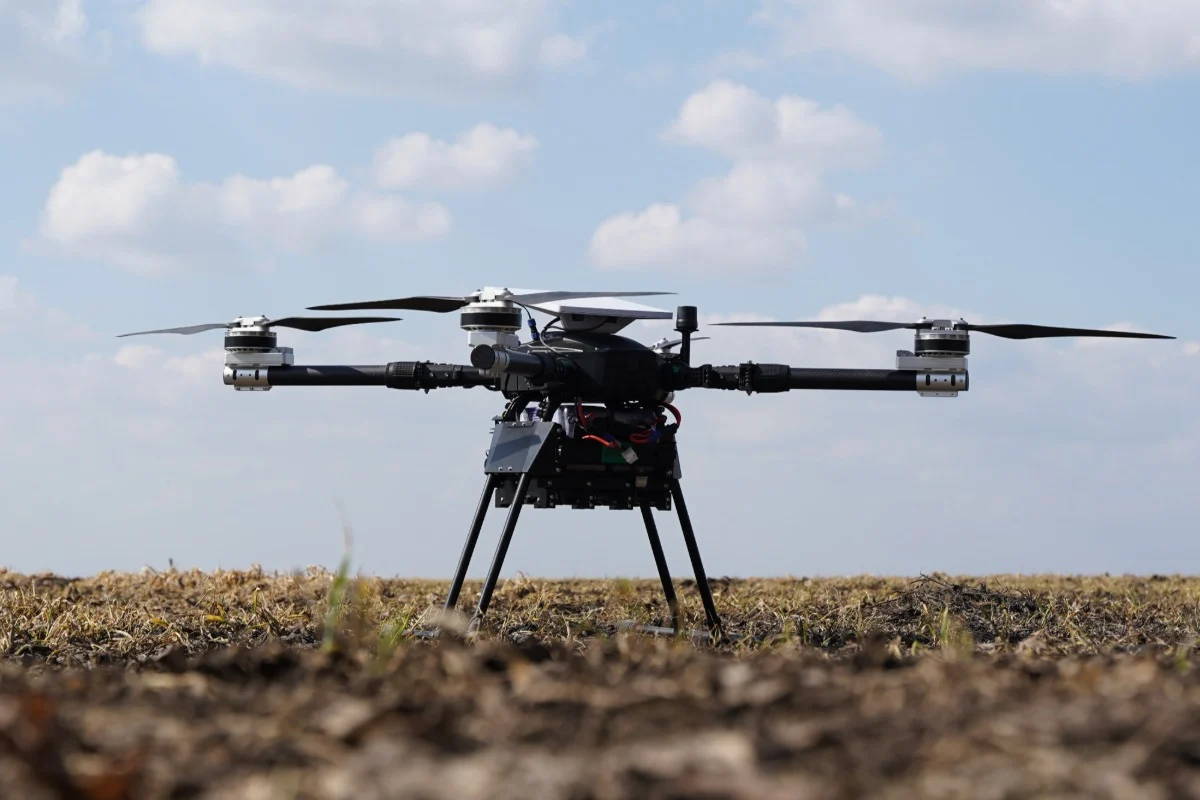
The drone war in Ukraine has just surpassed a technological and geographical barrier that completely redefines the rules of short-range aerial combat. The Ukrainian tech company Martyn Tech has unveiled Adis, a heavy quadcopter drone specifically designed to overcome the structural limits of conventional radio frequencies.
The real breakthrough? Thanks to an integrated satellite communication terminal, the drone can be piloted from anywhere on Earth, eliminating the need for operators to be near the front line.
Satellite Control eliminates the "Radio Horizon" and protects pilots
In traditional drones used on the battlefield, the pilot and the aircraft communicate via direct radio waves. This involves the so-called radio horizon problem: the Earth's curvature, the presence of obstacles (hills, buildings), and electronic warfare (EW) interference limit the range to about 10-30 kilometers.
Even more serious, this physical proximity exposes pilots to deadly dangers: Russian forces have learned to track radio frequencies to locate command stations and immediately strike them with artillery.
The leap forward of Adis: By exploiting commercial satellite networks, the geographical link between pilot and drone is definitively severed. The operator can be in a safe bunker in Kyiv, in a training center on the other side of Europe, or even on another continent, while the drone carries out the mission in the highly contested airspace of Donbas.
Technical Specifications and Field Performance
Adis is a quadcopter with impressive load and range capabilities, optimized to operate mainly at night to evade the enemy's visual and optical tracking.
| Feature | Technical Specification |
| Standard range | 20 km with 10 kg payload |
| Extended Configuration (Load) | 20 km with 12 kg payload |
| Extended Configuration (Distance) | 50 km with 3 kg payload |
| Cruise / Maximum Speed | 65 km/h / 90 km/h |
| Standard operating altitude | 400 meters (invisible and inaudible from the ground at night) |
| Flight autonomy | About 1 hour |
| Target detection (Day/Night) | 600 meters / 150 meters (dual camera) |
A Modular Platform for Three Critical Missions
Adis has already completed the official coding for Ukrainian military procurement. To meet the urgent needs of the front, Martyn Tech has designed a modular structure, allowing soldiers to reconfigure the same drone in minutes for three different operational scenarios:
- Precision Strikes (Strike): As a heavy bomber drone, it can drop significant ordnance on fortifications, armored vehicles, and enemy personnel.
- Precision Mining: Utilizing its ability to land and take off again, Adis can lay landmines precisely on enemy logistical lines, with surgical precision impossible to achieve with artillery.
- Logistical Resupply: Delivery of ammunition, food, water, and emergency medical kits to advanced and isolated Ukrainian positions, where ground vehicles cannot safely reach.
A Name that Unites Technology and Memory
Adis is not just a concentration of satellite technology; it carries a deep emotional significance. The drone is named after a soldier from the 72nd Separate Mechanized Brigade (known as the Black Zaporozhians), who fought under the battle name "Adis", killed in June 2022 in the Donetsk Oblast.
Illia Samoshkin, head of Martyn Tech, commented:
"Adis is the logical evolution of our product line. It was born in direct response to the front's requests to perform complex missions in limited radio horizon conditions. It has been integrated into combat scenarios that will inflict critical losses on the enemy, but we can only talk about this after victory."
With the introduction of satellite control on heavy tactical drones, Ukraine once again demonstrates how flexible technological innovation can neutralize traditional numerical and artillery advantages.



Comments
No comments yet. Be the first!