




In May 1982, as the Falklands/Malvinas War approached its most intense phase, the Argentine Navy faced a concrete problem: British ships were approaching the coast at night and bombarding Argentine positions around Puerto Argentino with naval gunfire.
The Argentine Air Force had already demonstrated the effectiveness of the Exocet AM39 launched by the Super Étendard, but at night the problem remained unresolved. An armament was needed that could threaten British units from the shore without relying on complex and risky air missions. From this necessity arose one of the conflict's most unique solutions: the ITB, the Instalación de Tiro Berreta, an improvised system for launching Exocet MM38 naval missiles from land.
The name was ironic. In Argentina, “berreta” indicates something poor, makeshift, and unrefined. But that seemingly precarious installation would manage to strike a Royal Navy warship: the destroyer HMS Glamorgan.
The idea: bringing the Exocet from ship to shore
The idea took shape at the beginning of May, when the Argentine Navy considered the possibility of using Exocet MM38 missiles from land, which were normally intended for launch from naval units. The task was assigned to Frigate Captain and engineer Julio Marcelo Pérez, an officer of the Argentine Navy with solid experience in the missile sector.
Pérez was not just any technician. He had studied electronic engineering and specialized in missile control and guidance at the Faculty of Aerospace Engineering at the University of La Sapienza in Rome. In the 1970s, he had worked on installing Exocet MM38s on old Argentine destroyers of U.S. origin. He was therefore one of the most suitable men to attempt an emergency solution.
At Puerto Belgrano, at the Taller Central de Misiles and the Naval Arsenal, a feverish work began. Pérez was joined by civilian technicians and specialists, including Antonio Shugt and José Luis Torelli, who were already involved in activities related to the Exocet systems.
The problem was complex: the Exocet MM38 was designed to receive data and commands from a real naval firing installation. It was not enough to fix the missile container on a trailer. The missile had to be “fooled” by simulating the signals it would normally receive from the ship.

The launchers of the ARA Seguí
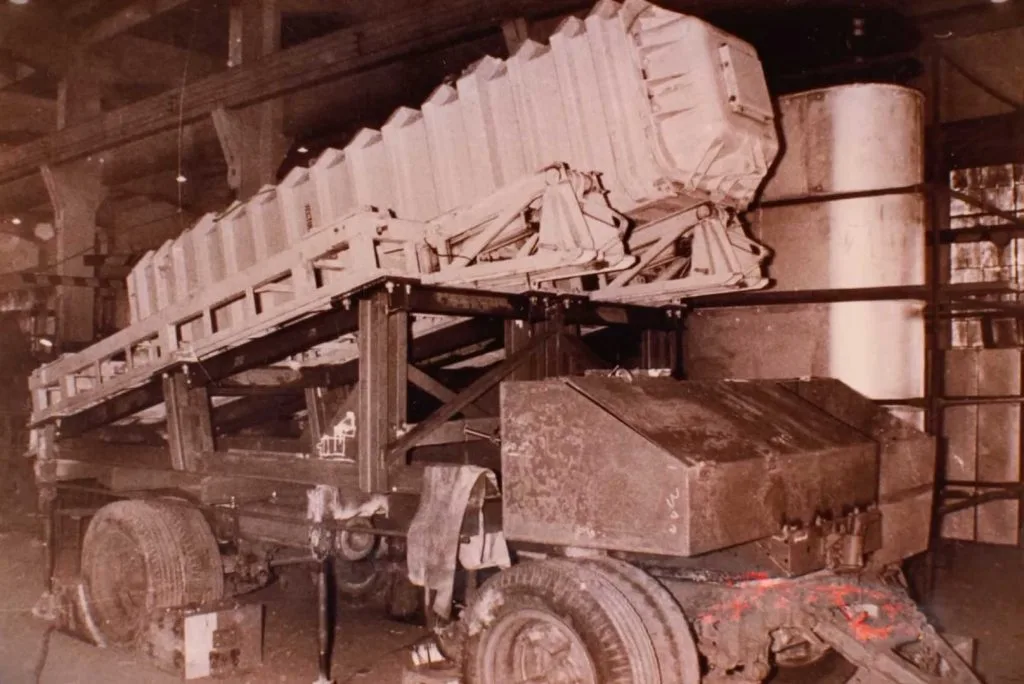
The container-launchers used came from the Argentine destroyer ARA Seguí, one of the units on which the Exocet MM38 missiles had been installed.
At Puerto Belgrano, work was done day and night. The system could not be a complete copy of the onboard installation: it would have been too large, too heavy, and too slow to dismantle, transport, and reassemble on the islands. Pérez estimated that transferring an entire naval installation would have taken about 45 days, time that the Argentine garrison did not have.
The solution was to create a much simpler apparatus: a series of electronic “boxes” capable of sending the necessary sequences to the missile for launch. Circuits, simulated tests, and continuous adaptations were made. According to Pérez's own account, numerous simulated launches were conducted with the missile simulator before considering the system usable.
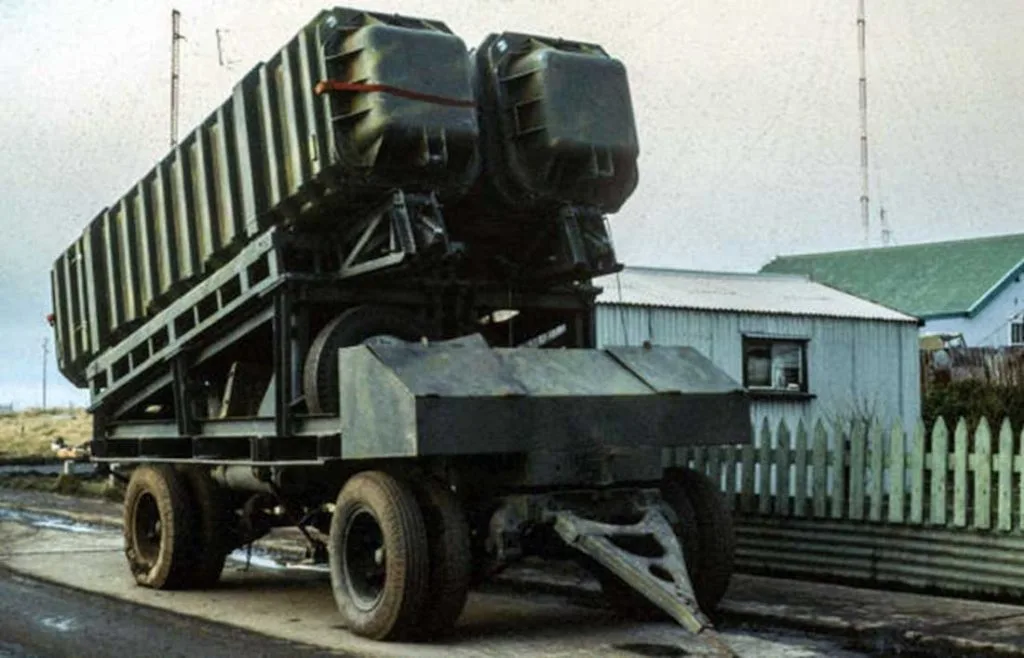
In parallel, at the Talleres Generales of the Arsenal of Puerto Belgrano, two large trailer carts were built: one to support the two Exocet containers, the other for the generator and control equipment. The system also used an old Siemens generator, technology dating back to the 1930s, originally used for the anti-aircraft searchlights of the Infantería de Marina.
It was a heavy, crude, and difficult-to-maneuver system. But it worked.

The flight to the islands
Once completed, the ITB had to be transferred to the Falklands/Malvinas. For the operation, two C-130 Hércules of the Argentine Air Force were used. The cargo included the ramp, the containers with the missiles, the generator, and the control equipment, with a total weight of several tons.
The transfer was not simple. The Hércules had to fly at very low altitude to avoid British radar. After several failed attempts due to the operational situation at the airport, the system finally managed to arrive on the islands on the evening of May 31, 1982. From that moment, the ITB became a hidden threat along the southern sector of Puerto Argentino/Stanley.
A coastal battery that appeared only at night
The ITB was installed along the road connecting Puerto Argentino to the airport. The choice was not random: that area allowed the system to be oriented towards the sea and the routes followed by British ships engaged in night bombardments.
However, the battery could not remain exposed. During the day it would have been vulnerable to British aerial reconnaissance and attacks. For this reason, the installation was set up at night and dismantled before dawn. The components were hidden and dispersed, then brought back into position the following evening.
The system operated with the help of a ground radar Rasit, used to identify and track naval targets. The radar provided direction, distance, and speed of the target; those data were then transformed into the parameters necessary for launching the Exocet.
It was a complex, manual procedure, with high margins of error. But the context was that of war: perfection was not sought, a concrete possibility of hitting was.
The night of June 1st presented a first opportunity. The system was prepared and the missile was launched, but the attempt was unsuccessful. According to some reconstructions, one missile did not launch correctly and another went off course, probably due to haste and the difficulty in quickly recalculating firing data.
Despite the failure, the system was not abandoned. It was now clear that the ITB could work. New missiles and a new opportunity were needed.
The night of June 11-12
The night between June 11 and 12, 1982, the Royal Navy was engaged in naval fire support for British ground operations. During those hours, fierce fighting took place on the heights around Puerto Argentino/Stanley, including Mount Longdon, Mount Harriet, and Two Sisters.
Around 03:30-04:00 in the morning, the Argentine radar intercepted a British ship moving away after a naval bombardment mission. It was the destroyer HMS Glamorgan, a County-class unit.
The target was at the limit of the system's operational capabilities. 29960 meters according to telemetry data recorded and released by the Argentine Ministry of Defense, that is, near the useful range of the radar and the effective range of the missile. The data were quickly calculated and the launch order was given.
The Exocet MM38 was launched from the coast.
The launch was recorded by Argentine journalist Nicolás Kasanzew, the only Argentine television correspondent present on the islands for the entire duration of the conflict.
The impact on HMS Glamorgan
Aboard HMS Glamorgan, the missile was detected and the ship tried to maneuver to reduce its exposure. The British reaction was swift: the destroyer turned sharply, presenting the stern to the missile and thus reducing the impact's effectiveness. A response with a Sea Cat missile was also attempted, without success.
The Exocet still hit the ship in the stern area, near the helicopter hangar. The damage was severe. The Glamorgan did not sink but was put out of action. Furthermore, 14 British sailors were killed and many were injured.
There are different versions regarding the explosion point: British sources claimed that the missile's warhead did not fully explode and that the fire was exacerbated by residual fuel and the Wessex helicopter present in the hangar. In any case, the operational result was clear: HMS Glamorgan was severely damaged and forced to withdraw from action.

Not the first coastal missile, but a unique solution
The ITB was not the first coastal missile system in history. Coastal anti-ship defense systems already existed, especially in the Soviet sphere. The peculiarity of the ITB was different: it was not a system designed by industry, but an emergency transformation.
A naval missile, born to be launched from a ship, was adapted in a few weeks for land use. It was a makeshift solution, realized without the support of the French manufacturer, with limited means, in full war and under operational pressure.
This is the true importance of the ITB: not the invention of the coastal missile, but the demonstration that a complex weapon system could be understood, adapted, and employed outside its original context.

The Legacy: from ITB to the British Excalibur
After the war, the British studied the ITB experience with great attention. From that experience, the idea of a British coastal Exocet battery was reinforced. The system was then known as Excalibur and installed in Gibraltar, where it remained operational for years.
The British system was more structured, integrated, and consistent with regular military standards. But the Argentine precedent had demonstrated something precise in combat: an Exocet launched from land could hit a warship.
A Lesson Still Relevant Today
The story of the ITB speaks of improvisation, but not of random improvisation. It speaks of technical competence, deep knowledge of the available material, and the ability to adapt in extreme conditions.
Today, coastal defense has returned to the forefront of modern naval warfare. Mobile missiles, radars, drones, distributed sensors, and stealth capabilities make coasts dangerous zones even for technologically superior fleets. The principle is the same that the ITB demonstrated in 1982: an expensive and complex ship can be threatened by a much cheaper land-based system if the latter can detect, lock onto, and hit the target.
The ITB was not elegant. It was not sophisticated. It was not born from a long industrial program. But on the night of June 11-12, 1982, it did what it was intended to do: it forced the Royal Navy to acknowledge that even from a seemingly missile-defense-free coast, an Exocet could be launched.
Its success against HMS Glamorgan did not change the outcome of the war, which was nearing its conclusion, but it left an important military lesson: in war, technological superiority does not eliminate the value of adaptation, technical knowledge, and the ability to use what is available in unexpected ways.
The ITB was called “berreta” (poor) by its own creators. But in the history of coastal warfare, it remains far from being a trivial system.



Comments
No comments yet. Be the first!