



In June 2004, in Sderot, an Israeli town near the Gaza Strip, a Qassam rocket launched by Hamas killed little Afik Ohayon, only four years old. That episode shook the Israeli public opinion and deeply affected Daniel Gold, general and head of the Research and Development department of the Ministry of Defense. Son of Holocaust survivors, Gold reacted by turning pain into action.

He decided that Israel needed a defense system capable of intercepting enemy rockets before they hit the ground. Initially, the proposal was met with coldness: considered too expensive, too ambitious, too futuristic. But thanks to the former mayor of Sderot Amir Peretz, who became Minister of Defense, the project finally received political and economic support. With the help of the company Rafael Advanced Defense Systems, the design of the system that would be called Iron Dome, "Iron Dome" or, in Hebrew, Kipat Barzel, began.
The technological core of the Iron Dome
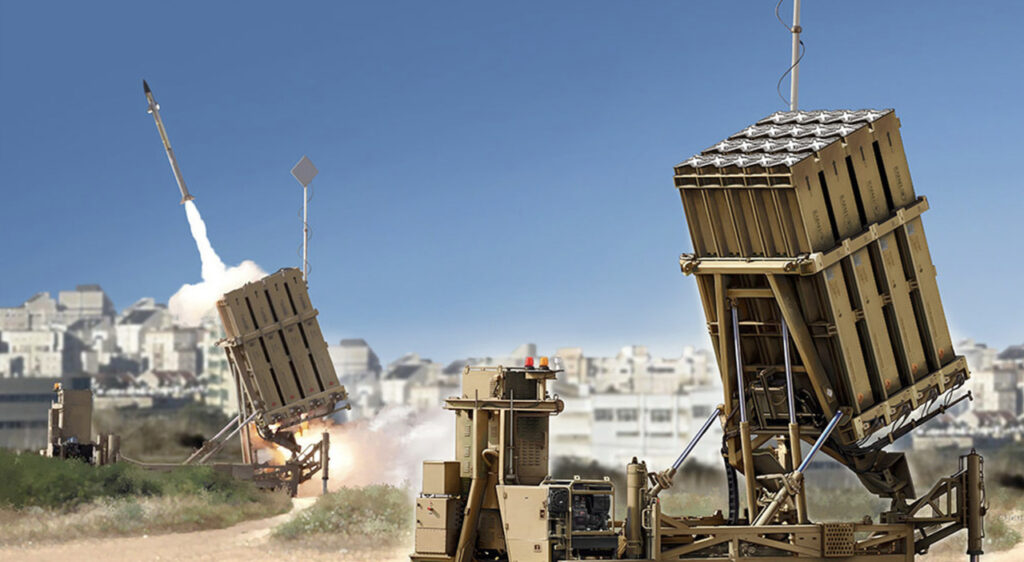
The system entered service in 2011, and since then it has become a cornerstone of Israeli defense strategy. Iron Dome is designed to intercept and destroy rockets, artillery shells, and short-range missiles. It is highly technological, mobile, and operational in any weather condition, day and night. Each unit is composed of three key elements:
- Detection and tracking radar, which detects the threat.
- Fire control center, which calculates the trajectory of the incoming rocket and assesses whether it poses a risk to populated areas or critical infrastructure.
- Mobile launchers, which host up to 20 Tamir interceptor missiles, ready to intervene only if the threat is real.

The response process takes place in three main phases:
- Detection: the radar identifies the rocket as soon as it is launched.
- Analysis and selection: the system calculates if the impact will be in a populated area.
- Interception: if necessary, a Tamir is launched, guided by the radar and an internal navigation system, to destroy the projectile in flight.
This selective intelligence allows saving resources and minimizing collateral damage. Each missile costs about $50,000, while a complete battery can cost up to $100 million.
Iron Dome can intercept multiple threats simultaneously, managing multiple attacks, but not infinitely. In the event of massive and close launches – as happened during the Hamas attack on October 7, 2023 – the system can be overloaded, especially in the time needed to recharge the batteries. It is precisely in these moments that the vulnerabilities of the system manifest.
Effectiveness, limitations, and social impact
In its first decade of use, Iron Dome has intercepted over 90% of rockets directed towards populated areas, saving thousands of lives. It has become a national symbol, celebrated by Forbes among the “12 most innovative weapons of the decade” in 2019. But its effectiveness, although high, is not absolute. Experts warn that Iron Dome cannot be considered a definitive solution to the conflict, but rather a means of damage mitigation.
The system is part of a broader triad: together with David’s Sling, which protects against short and medium-range threats with hit-to-kill interceptors, and the Arrow 2 and Arrow 3 systems, designed to stop ballistic missiles at high altitude, it constitutes the entire Israeli air defense network.
In parallel with technology, Israel has developed an efficient network of public and private shelters. Since 1991, every new home must include a fortified room (mamad), and the Home Front Command (Pikud HaOref) constantly updates the population through Apps and alert systems.
Iron Dome has profoundly changed the perception of security in Israel, it is one of the most advanced active defense systems in the world, capable of offering the Israeli population concrete protection against sudden attacks.





Comments
No comments yet. Be the first!