


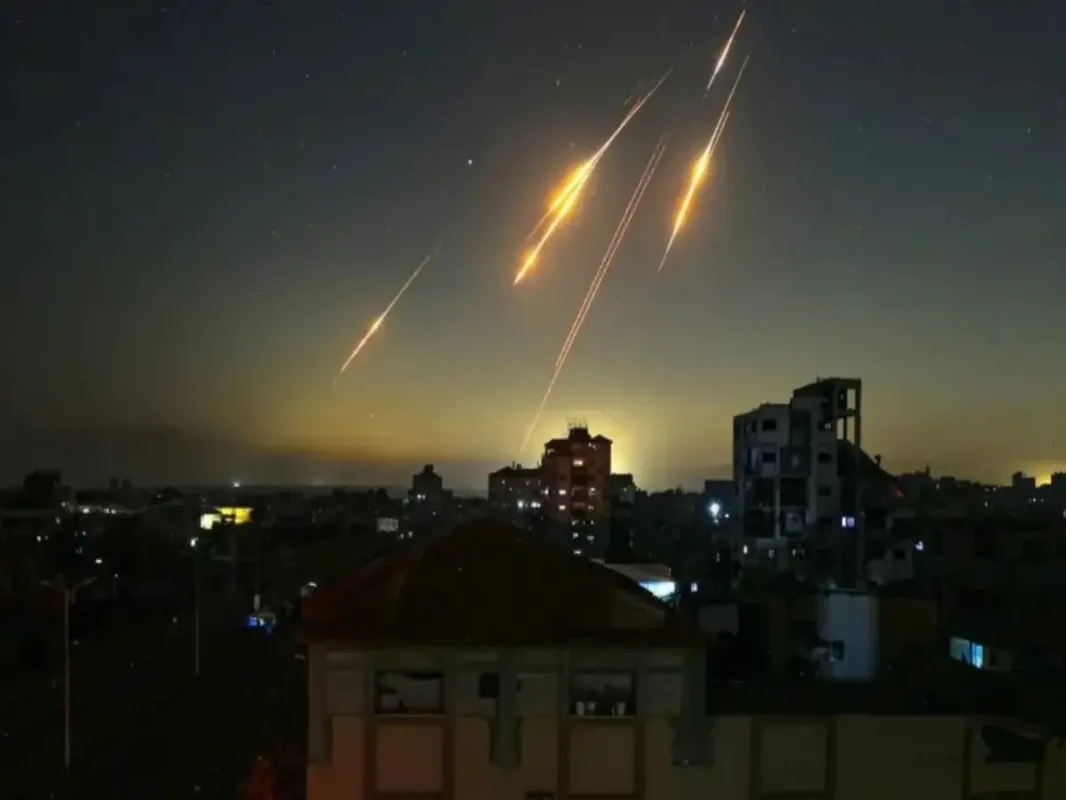

The real surprise in this crisis is not the American action. If anything, it's the European surprise. For weeks, Washington had been building, almost on display, the material and political conditions to use force against Iran: the deployment of a double naval air device, the influx of assets into the Middle Eastern theater, the increasingly unambiguous language of the White House and the Pentagon. As early as mid-February, Reuters reported the dispatch of a second US aircraft carrier to the region, to accompany the USS Abraham Lincoln already present since January 26 in the CENTCOM area of responsibility. It was not a tactical detail: it was a strategic message. Spending millions to move two carrier strike groups and then not using them would have been possible only in the presence of a credible de-escalation, which never materialized.

Even in the Italian debate, the point had been grasped. Federico Rampini, in the Corriere della Sera, insisted precisely on the political and military value of that deployment: two aircraft carriers are not mere theater, they are preventive coercion and operational preparation. In other words, the kinetic option was incorporated into the deployment itself. Those who read those signals as mere verbal deterrence probably underestimated the elementary fact that, in the American strategic posture, deterrence works precisely because there is a concrete willingness to employ it behind it.
For this reason, the political point is not to ask whether the US attack was “predictable.” It was. The point is to ask why part of Europe found itself in a reactive mode, almost incredulous, in front of a scenario that the Americans were preparing in a progressive and visible way. If three clues make a proof, here the clues were well more than three: first, the approach of the double aircraft carrier group; second, the US rhetoric on the “tremendous power” arriving in the Middle East; third, the subsequent operational pace of Operation Epic Fury, which according to the Pentagon and Reuters quickly surpassed hundreds and then thousands of targets hit. It is not the chronicle of a sudden outburst of anger; it is the trace of a campaign thought out in advance.

Europe Chases Events
The indirect confirmation comes from the sequence of European reactions. The United Kingdom found itself with the RAF base in Akrotiri, Cyprus, hit by an Iranian-made drone probably launched from Lebanon, according to Reuters. The attack occurred shortly after Keir Starmer's green light for the “defensive and limited” use of British bases by the United States. Two additional drones were then intercepted. If London had to scramble with the destroyer HMS Dragon and counter-drone means, it means that the geographical extension of the Iranian retaliation had not been sufficiently anticipated in terms of the immediate protection of the most exposed installations.
Even more significant was the Greek reaction. After the raid on Akrotiri, Athens announced the dispatch of frigates and F-16 fighters to Cyprus to strengthen the island's defense. Reuters speaks of two frigates and four F-16s; other sources indicate among the naval units involved the Kimon and a second frigate equipped with anti-drone systems. The political point, however, does not change: Greece did not move in a logic of preventive deterrence, but in a logic of reinforcement following the blow suffered in the Cypriot area.

France offers an even more eloquent image of the “European surprise.” On March 3, Emmanuel Macron announced the dispatch of the aircraft carrier Charles de Gaulle to the Mediterranean. Reuters and AP reported that the ship was diverted from the Baltic to the south; ANSA, citing BFM TV, spoke of an interruption of the planned deployment in the Baltic and a route towards the eastern Mediterranean. Whatever formulation one prefers, the substantial fact is one: Paris had to quickly reposition its main naval presence tool, a sign that Europe had not pre-arranged a setup consistent with the probability of conflict expansion to the eastern Mediterranean.
The Italian Case and the Strategic Lesson
Italy, then, is the most delicate case. The base of Ali al Salem, in Kuwait, where the Air Force contingent operates, had already been hit in the first wave of Iranian retaliation on February 28. Antonio Tajani spoke of significant damage to the runway; in the following days, reports of further strikes in the area multiplied. On March 5, Guido Crosetto announced that 239 of the 321 military personnel present in Kuwait would be transferred to Saudi Arabia, while 82 would remain at Ali al Salem to ensure operational continuity. It is an understandable decision in terms of personnel protection, but it is also the implicit admission that the threat to that base was concrete, persistent, and not episodic.
To this is added the new element that emerged today. Rivista Italiana Difesa, in an analysis by Tommaso Massa on March 6, reports that during the night Iran again hit Ali al Salem, where a large fire was detected even by satellite, probably corresponding to fuel tanks. The same author, already on February 28 and March 4, had documented strikes on the base and damage to areas connected to communications and military infrastructure. Not all of this information currently has independent confirmation of equal level from international agencies; but together they reinforce the picture of a base that has steadily entered the cycle of targets of Iranian retaliation.

Here lies the heart of the problem. If the United States acted according to a visible logic — accumulation of forces, political messages, theater preparation, then employment — Europe showed an opposite logic: not prevention, but chasing events. London reinforced Cyprus after the blow. Athens intervened after Akrotiri. Paris redirected the Charles de Gaulle after the escalation. Rome arranged the transfer of most of the contingent after Ali al Salem had already repeatedly come under attack. It is not so much a denial of European military capabilities, as a signal of insufficient political-strategic reading of the crisis trajectory.
Saying that “European intelligence slept” is a harsh formula, but it captures at least part of the point. Perhaps the technical intelligence did not sleep; more likely, the political-strategic synthesis and the ability to translate indicators into timely operational postures slept. Because all the indicators were there: the double US aircraft carrier group, the progressive militarization of the theater, the anticipated vulnerability of Western bases in the Gulf and eastern Mediterranean, the predictable Iranian choice to strike deep into allied infrastructures. In war, often, surprise does not arise from the absence of signals, but from the inability to fully believe in them. And it is precisely this, today, the European surprise.
For Italy, the lesson is immediate. When a major ally concentrates an offensive device of that magnitude in a theater where we have men, aircraft, and support bases, we cannot just hope that deterrence holds. We must think as if employment were probable, not as if it were a remote hypothesis. Ali al Salem demonstrates that the cost of a forecasting error is not theoretical: it concerns the safety of personnel, operational continuity, and the very credibility of our posture in the region.



Comments
No comments yet. Be the first!