


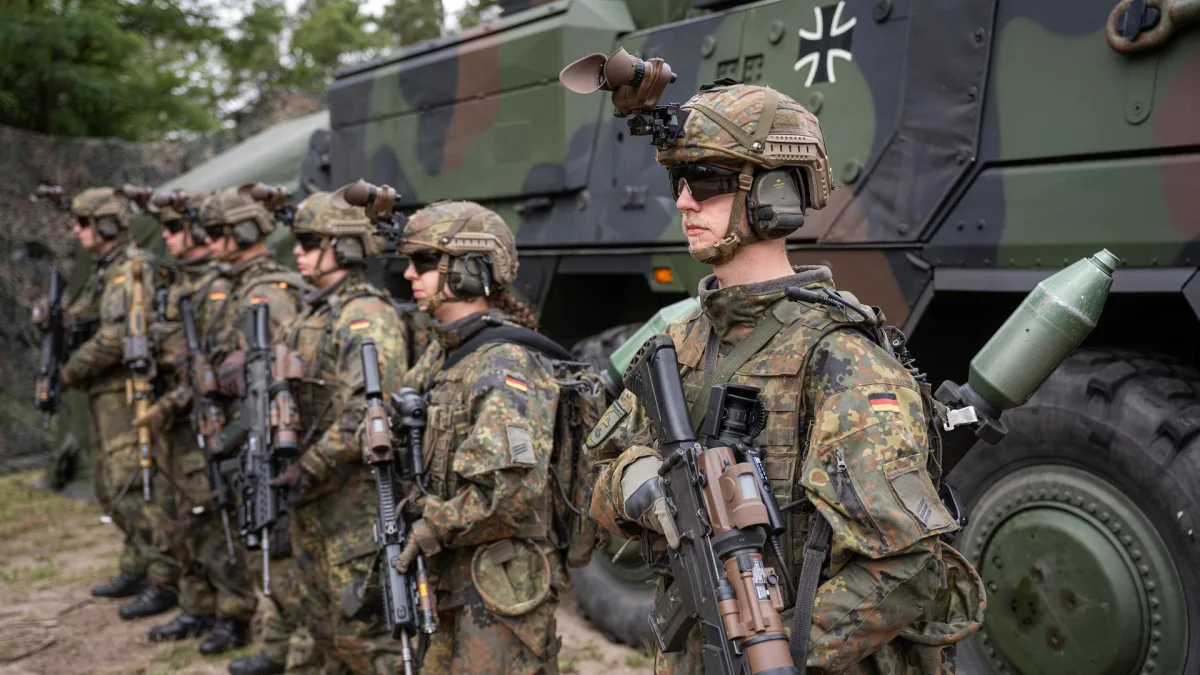

The idea is simple, yet ambitious: transform the West's “phase of uncertainty” into a European acceleration on security, industry, and deterrence capabilities. This is the main thread of the reasoning of Thomas Bagger, the German ambassador to Italy, who in a conversation with HuffPost invites to “set aside pessimism” and build a convincing vision for the future of the European Union, shaken by the fluctuations of American politics and Russian strategic pressure.
The Thesis: Rome and Berlin as a “Motor” in Times of Threat
Bagger links the need for a European quality leap to a political premise: the war in Ukraine is not, in his account, a confined conflict, but a broader confrontation between Moscow and the West. Hence the conclusion: if Europe cannot rely “only” on the United States to face the threat, it must invest more in its own capabilities, also to make deterrence towards Russia credible.
The point is not (only) to buy more armaments: it is to build European critical mass, industrial coordination, and a political stance less dependent on Washington's moods.

The Political Context: The “New Level” of Cooperation and the Merz–Meloni Harmony
The ambassador's words fit into a phase of operational rapprochement between Italy and Germany, favored by the convergence between Prime Minister Giorgia Meloni and Chancellor Friedrich Merz, which emerged strongly at the bilateral summit in Rome on January 23, 2026.
On that occasion, Rome and Berlin presented an action plan and a package of agreements focusing on three axes: industrial competitiveness, EU simplification/rules, and cooperation in defense and security (also with an explicit reference to strengthening the European pillar of NATO).
“Revival” and “Rearmament”: The Two Pillars of the Same Strategy
In the reading that emerges from this diplomatic season, economic revival and rearmament are not separate chapters.
1) Industrial Revival and Competitiveness
Reuters describes the Italian-German initiative as a pro-industry alliance: push for regulatory simplification, more favorable manufacturing policies, focus on energy, supply chains, and critical raw materials. It is also a response to the perceived double stress: Chinese competition and intra-EU frictions on economic regulation (with growing differences compared to France on some choices).
2) Rearmament and Deterrence Capabilities
In the political lexicon of the summit, defense returns to being the infrastructure of European sovereignty: coordinating responses to Euro-Atlantic threats and strengthening the European pillar of NATO in terms of deterrence and defense.
It is on this point that Bagger introduces the most direct argument: investing “more” in European strength to reduce strategic vulnerability and “discourage Moscow's appetite.”

The Balance with the United States: Less Dependence, Not a Break
An interesting element is that the proposed trajectory does not coincide with a principled anti-Americanism. On the contrary: the document and summit declarations reaffirm “the fundamental importance” of the transatlantic bond.
The line, rather, is: remain allies, but become more autonomous. In other words, avoid that every change of wind in Washington — and the uncertainties linked to Donald Trump's politics also mentioned in the HuffPost interview — translates into European paralysis.
Why Italy and Germany
In the account of this phase, Rome and Berlin claim a particular role: they are two large manufacturing economies, deeply intertwined in European industrial chains, with a common interest in keeping together transition, competitiveness, and security. It is also for this reason that, at the summit, the emphasis is on industry, energy, and defense as a single package.
There is also a symbolic factor: 2026 is presented as a “special” year of Italian-German friendship (75th anniversary of the resumption of diplomatic relations), which makes cooperation more politically viable even on the domestic front.

The Real Knot: Turning Agreement into Capability (and Money)
The political promise is clear, but the test is operational:
- spending and tools: rearmament means multi-year allocations, common programs, faster procurement;
- defense industry: without integration (standards, orders, supply chain), the increase in spending risks fragmenting;
- European governance: “regulatory self-control” and simplification are shared banners, but require stable coalitions in the EU.
And it is here that Bagger's bet becomes political: if Italy and Germany could keep deterrence and competitiveness together, they could indeed offer Europe a pragmatic guide at a time when the Union is called to choose whether to “endure” or “act.”




Comments
No comments yet. Be the first!