


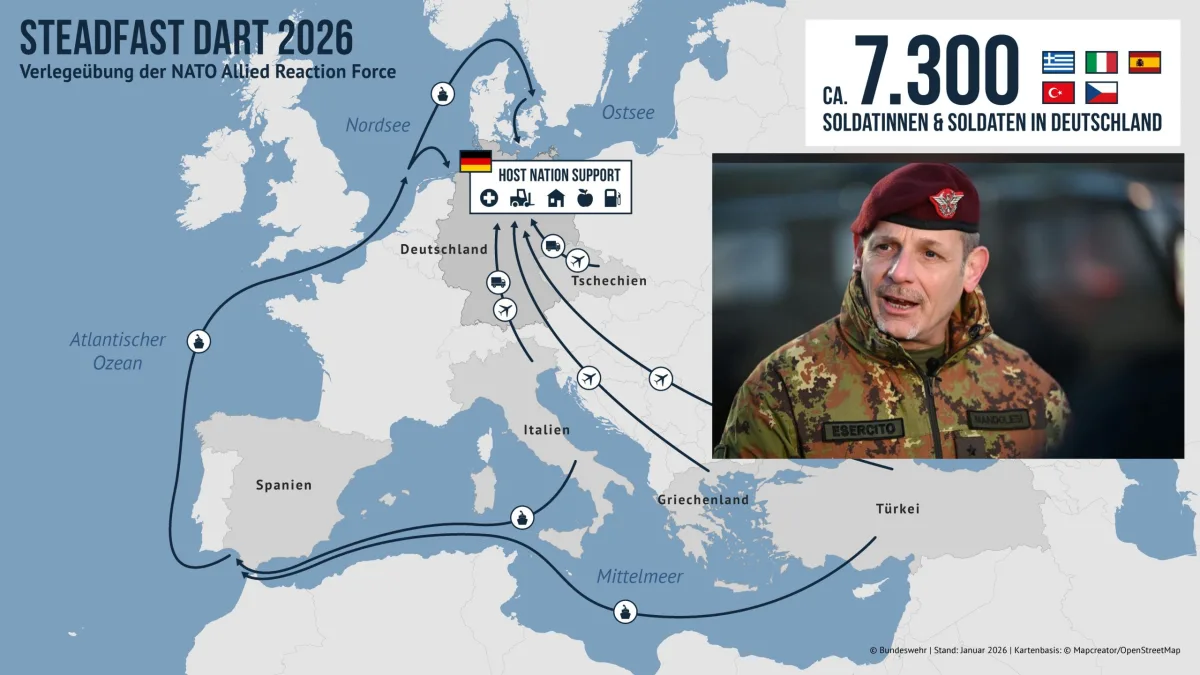

This morning the first Italian troops of the NATO Rapid Deployable Corps – Italy (NRDC-ITA) landed at the port of Emden, in Germany, as part of the Exercise STEADFAST DART 26. The arrival marks the “visible” start of activities on German territory, with vehicles and materials beginning to move along the logistical axes towards the training areas.
According to the NATO operational command of Joint Force Command Brunssum (JFCBS), this is the first large-scale peacetime deployment of the Allied Reaction Force (ARF) within its Area of Responsibility: a concrete message, made of wheels turning and logistical chains working, more than slogans.
Emden, gateway of “readiness”
In the Lower Saxony port, convoys of military trucks, tactical vehicles, and support equipment were unloaded from a cargo ship, initiating the redeployment phase. German media report that the operation involves thousands of soldiers and a significant mass of equipment, with Germany acting as the host nation and logistical hub.
The exercise setup is deliberately realistic: in addition to sea transport, convoy land movements and air transports are planned, to test times, procedures, and multinational coordination along the entire chain “from port to theater.”
“Like a firefighter”: what is the ARF
Welcoming the Italian military in Emden was General Nicola Mandolesi, DCOS Support of JFC Brunssum, who summarized the essence of the force as follows:
“The ARF is NATO's emergency response capability — like a firefighter, a toolbox ready to respond immediately, wherever a crisis emerges.”
The Allied Reaction Force is a high-readiness capability, designed to be multinational and multi-domain. Within NATO, the ARF has replaced the previous NATO Response Force (NRF) under the new force model, with the aim of ensuring rapid response and operational integration between land, air, and maritime components.
On the Italian side, NRDC-ITA — in the role of ARF command — has simultaneously conducted updating and verification activities of Command & Control procedures in preparation for STEADFAST DART 26, with exercises aimed at “validating” processes and synchronization between component commands.

Numbers and countries involved: a European deployment “in sight”
The scale is one of the key elements of the exercise: German sources speak of about 10,000 soldiers and over 1,500 vehicles, with the use of aircraft and naval units. Eleven NATO countries are participating (including Italy, Germany, the United Kingdom, France, Spain, Greece, and other European allies), while the United States is not among the participants in this specific activity.
The main training phases are planned in Germany, with activities reported in the area of Truppenübungsplatz Bergen (Lower Saxony) and in Schleswig-Holstein (including the area of Putlos and the Kiel area), confirming Germany's centrality as a transit platform and as an operational space for training.
Readiness made visible
STEADFAST DART 26 aims to demonstrate — and not just declare — that Europe can deploy, sustain, and integrate high-readiness forces “at speed and scale” appropriate to a real scenario: thousands of vehicles on the road, port rotations, rail and air flows, interoperability between languages, standards, and procedures.
Because, when deterrence is credible, it is often also because it is visible.



Comments
No comments yet. Be the first!