


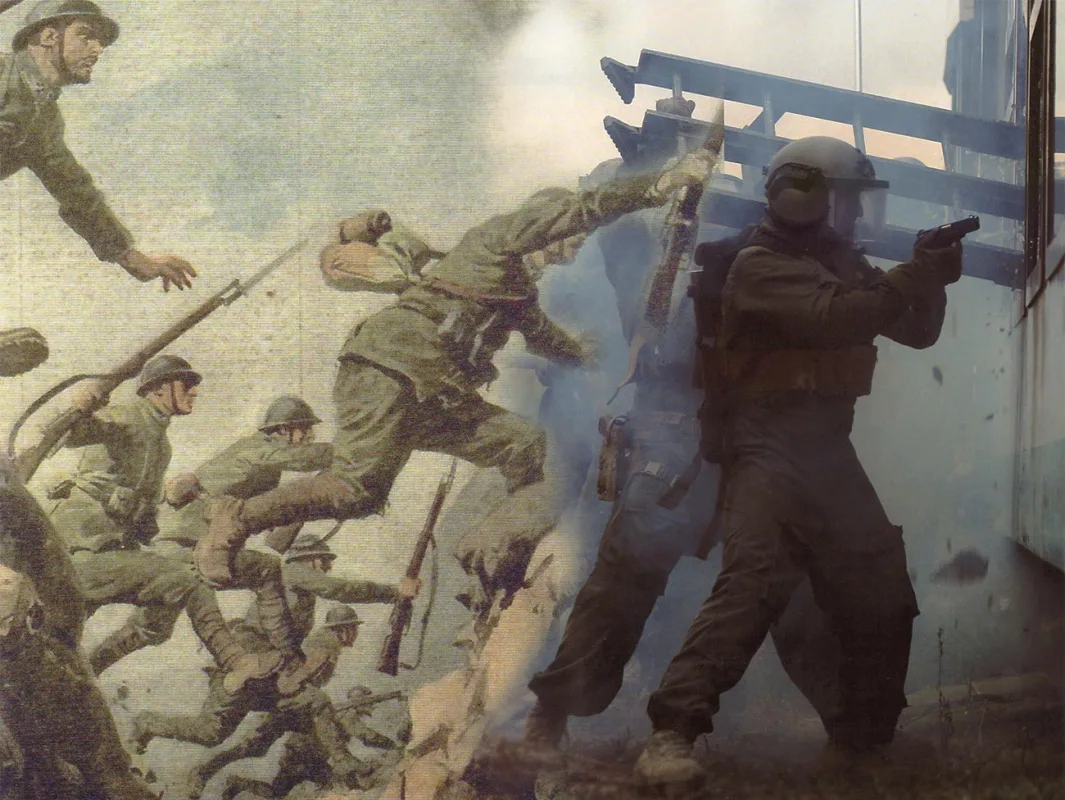

Italy was the first country in the world to experiment with elite military units, pioneers of innovative tactics and assault means never seen before: on land with the Arditi and at sea with the daring MAS flotillas of the Regia Marina. From their origins, these units embodied courage and the ability to anticipate new operational methods, creating a tradition destined to inspire modern Special Forces worldwide.
Even the Roman army employed special units, such as the Exploratores and the Speculatores, dedicated to exploration and reconnaissance missions. These were soldiers trained for advanced operations, somewhat akin to modern reconnaissance units.
However, to encounter true formations conceived with a strategy based on boldness, surprise, and breaking conventional patterns, one must reach the early 20th century with the birth of the Arditi.
A truly Italian story, marking a path destined to forever transform the way conflicts are faced, introducing a modus operandi aimed at opening asymmetric scenarios and experimenting with unconventional combat techniques.
The first Raiders in history: the Arditi
At the beginning of the 20th century, the military world urgently felt the need to innovate assault tactics to face an increasingly modern and complex war. The turning point came in 1917, in the midst of the First World War, when the first Italian special forces were officially born: the assault units of the Regio Esercito.
These units, conceived for breaking enemy lines, represented an absolute novelty on the strategic level. They were not simple infantrymen, but chosen soldiers, characterized by specific training and light equipment that made them extremely mobile and particularly effective in hand-to-hand combat.
They were the legendary Arditi, a specialty of the infantry arm of the Regio Esercito, organized into autonomous units with innovative operational functions. Their “asymmetric” nature allowed them to influence battles with quick and targeted interventions, often conducted in the shadows, replacing brute force with discretion, surprise, and superior training.

The Arditi were trained to penetrate enemy lines and carry out acts of sabotage with speed and coordination, using the element of surprise as the main weapon of their raids. Equipped with daggers, firecrackers, and light submachine guns, they were considered the elite of the Regio Esercito and were employed in high-risk missions, often characterized by very high casualties.
Unlike traditional infantry units, their goal was not simply to conquer positions, but to inflict significant damage and destabilize enemy forces, thus paving the way for the advance of Italian lines.
The first training center was established at Sdricca di Manzano, near Udine. Here the Arditi were prepared in hand-to-hand combat techniques, rapid assault, and a training path that tempered them not only physically but also psychologically, so they were ready for missions requiring absolute courage and determination.
In parallel, the Regia Marina also developed its own raider units, the so-called maritime assault groups, composed of specialists in underwater attacks and sabotage actions. These men used light boats, such as the MAS (Motoscafi Armati Siluranti), and the famous “pigs”, modified torpedoes piloted by trained operators, with which they directly hit enemy naval units. Their missions, often conducted in total isolation, were characterized by extraordinary boldness and a very high level of risk.
Among the maritime raiders, there were famous episodes involving brave men and technologically innovative means. These actions marked the debut of the first true underwater assault missions in Italian history and laid the foundation for the creation of future naval special forces units of the Marina Militare.
Experiments before 1917
Even before the official formation of the Arditi, the Regio Esercito had already initiated some attempts to develop special units. In 1914, the Explorers Groups were created, soldiers trained to operate behind enemy lines and sabotage their defenses. Dressed entirely in black to aid camouflage, they were mainly employed in exploratory missions and cutting enemy barbed wire.
Another precursor to the Arditi were the so-called Death Companies, composed of special infantry and engineering patrols. These men were equipped with armor and protective helmets, often of the “Farina” model, and trained for high-risk operations, such as demolishing obstacles and opening breaches in barbed wire under enemy fire.
In 1916, the Supreme Command decided that the qualification of “bold soldier” should be attributed to soldiers distinguished by courage and determination. However, there was an explicit prohibition on forming permanent special units. As recognition, a badge was awarded: the royal monogram “VE” (Vittorio Emanuele), to be worn on the left arm, conceived as a mark of honor and a symbol of example for all other soldiers. This emblem, more than just an ornament, marked the birth of the term “Ardito” in the collective imagination, paving the way for the creation of future assault units.
The birth of the Arditi was not an isolated event but the result of a progressive evolution of tactics and operational needs that developed during the Great War.

The first deployment in the Battle of Gorizia
The first deployment of the so-called “special platoons” dates back to August 1916, during the Battle of Gorizia, in the clashes between the Brigata Lambro and the Austro-Hungarian army at quota 188 and the Dosso del Bosniaco. However, due to the inaccuracy of official reports and the difficulty of the terrain – scattered with barbed wire and subjected to intense Austrian artillery fire – it is difficult to determine with certainty the actual effectiveness of these units on the outcome of the battle.
It is nonetheless likely that they were used as breakthrough units in the indicated positions and as reconnaissance units once the Gorizia line was breached.
Further significant actions occurred on February 11, 1917, when two platoons recaptured the trench of the Casa dei Pini salient, lost two days earlier by the 206th Battalion of the Brigata Lambro. On February 26, another platoon stormed a trench near Belpoggio, successfully capturing it.
The innovations of Major Giuseppe Bassi
In 1917, based on the proposals of some generals aware of the need to overcome the traditional strategy of frontal assault supported by artillery, and thanks to the initiative of young officers dissatisfied with the stalemate and slaughter of trench warfare, a special unit was experimented with at the 48th Division of the VIII Army Corps. This formation was entrusted to the command of Major Giuseppe Bassi, assisted by Sergeant Giuseppe Longoni.
Bassi drafted an innovative note on the use of Fiat Mod. 15/OVP submachine guns (Officine Villar Perosa), proposing significant technical modifications: the removal of the protective shield, the introduction of a light bipod, and a guide to facilitate magazine replacement even in the dark and during combat. His proposal was not limited to technical aspects but included a new employment doctrine, optimizing machine gun sections and defining the ideal equipment for the units: daggers and grenades alongside muskets and revolvers, to increase the aggressiveness and effectiveness of soldiers in action.
The report, forwarded to General Gaetano Giardino in November 1916, received his approval and was then sent to General Grazioli for further examination. Commander of the Brigata Lambro, Grazioli likely adapted those notes to his own reflections on special platoons and on March 7, 1917, issued a directive to regiment commanders, ordering the creation of attack units specialized in surprise raids, hand-to-hand attacks, sudden counterattacks, and operations not foreseen by conventional infantry.
On March 14, 1917, the Italian Supreme Command was informed of the formation of special units also in the Austro-Hungarian army, while the German army had already introduced the concept of elite troops, the Stoßtruppen, generally better trained than ordinary units. However, the Italian Arditi were not a simple imitation of the Germans and Austrians: unlike their counterparts, they were established as autonomous units, with their own identity and mission, not limited to performing support functions for the infantry. The experiments of the Regio Esercito in this direction, initiated even before knowing the foreign experiences in detail, were decisive in accelerating the project to officially establish the Italian special units.
After witnessing an exercise conducted by Major Bassi, General Luigi Cadorna understood the potential of the new tactics and gave the green light to the creation of the Arditi, issuing a circular with precise guidelines for the establishment of special units. On July 29, 1917, King Vittorio Emanuele III officially sanctioned the birth of the Assault Units, marking Italy's entry into the modern era of special forces.
Thanks to this innovative approach, the Arditi were successfully employed in the battles on the Italian front, distinguishing themselves for their courage and ability to infiltrate deep into enemy lines, striking with speed and effectiveness.
The baptism of fire and Monte San Gabriele
The new Assault Units had their baptism of fire during the Eleventh Battle of the Isonzo, in August 1917, when they were employed to break through the Austro-Hungarian positions on the Bainsizza plateau. The Arditi distinguished themselves for their bold actions and ability to infiltrate enemy lines, managing to break enemy defenses and capture strategic positions like Monte San Gabriele.
Monte San Gabriele, fortified and considered almost impregnable, was the scene of one of their most famous operations. At dawn on September 4, 1917, the Arditi launched an assault on the summit, surprising an unprepared enemy at their arrival. With hand grenades and flamethrowers, they overwhelmed the Austro-Hungarian defenses and paved the way for the advance of the Italian troops.
This success brought them fame and recognition, firmly establishing the role of the Arditi as the elite force of the Regio Esercito.

The conquest of Col Moschin
At the end of the spring of 1918, with summer just around the corner, the Austro-Hungarian forces attempted a new, desperate assault to break the Italian defenses on the Grappa massif. The goal was to penetrate the Brenta and Piave valleys, bypassing the Italian deployment along the river course. The plan involved a strategic offensive aimed at bypassing Cima Grappa, the core of the defensive setup, with a simultaneous breakthrough on the western and eastern sides of the mountain complex. The operation was entrusted to the XI Army of General Scheuschenstuel, reinforced by new troops and supported by intense artillery fire.
At 3 AM on June 15, a violent bombardment opened the offensive. The Italian artillery responded promptly, partially containing the pressure on the eastern sector, but by 8 AM the Austrian infantry launched the attack. The greatest successes were recorded on the western side, where the peaks defending the Brenta flank quickly fell: Col del Miglio, Col Fenilon, Col Fagheron, and Col Moschin itself fell. In a few hours, the Italian defenses on Grappa were on the verge of collapse, opening a potential direct access to the Venetian plain for the Austrians.
The Austro-Hungarians, close to a decisive victory, should have immediately renewed the offensive to consolidate their gains, but their reserves were almost exhausted. Meanwhile, the Italian reaction was swift: intense artillery fire hit the newly conquered positions, hindering the influx of reinforcements. In the early afternoon, the IX Assault Unit, consisting of just over 600 men and already alerted in anticipation of the attack, launched a counterattack. In a few hours, they recaptured Col Fagheron and, by 10 PM, also retook Col Fenilon, with the support of two battalions of the 91st Infantry Regiment.
However, the most important position remained to be retaken: Col Moschin.
At dawn on June 16, 1918, the IX Assault Unit launched a lightning attack and, in just ten minutes, recaptured Col Moschin, wresting it from the Austro-Hungarians. The action led to the capture of about 300 prisoners, including 17 officers, and the seizure of 25 machine guns. In just twenty-four hours, the enemy offensive had been completely neutralized. In recognition of that heroic feat, the city of Rome erected a commemorative monument on Col Moschin, using an ancient Roman column.
The success of the IX Assault Unit on Col Moschin was complete and with relatively contained losses, thanks to a maneuver conducted under favorable conditions: the enemy, now exhausted and weakened by the Italian artillery fire, was decisively overwhelmed by a motivated and highly trained unit.
A few days later, however, on June 24, 1918, the IX Unit was again called into action to recapture an Austrian stronghold on Asolone. On this occasion, the preparatory artillery fire proved less effective, and the recapture of the height cost the Arditi a very high blood toll. The position was taken, but only temporarily: an immediate enemy counterattack managed to overpower the Italian forces, now exhausted. The losses were severe, almost 50% of the personnel: 19 officers and 305 Arditi fell, demonstrating how the Italian high commands had not yet fully understood how to best employ the extraordinary combat capabilities of these units.
Subsequently, between October 24 and November 4, 1918, the Arditi were once again protagonists, contributing decisively to the breakthrough of the Piave line, which led to the final victory over the Austro-Hungarian armies and the victorious conclusion of the conflict for Italy.

Organization of Assault Units (First World War)
The total strength was 735 soldiers, divided into three companies of about 200 men each, with a structure reminiscent of the organization of modern special forces detachments.
Operational structure
First Attack Platoon
- First Assault Squad: a dagger and twenty hand grenades each
- Second Attack Squad: a dagger, twenty hand grenades each + a Villar Perosa cal. 9 Glisenti submachine gun (“Pernacchia”) with 10,000 cartridges
- Third Attack Squad: same as the Second
- Fourth Attack Squad: a dagger and twenty hand grenades each
- Ammunition Pair: two soldiers with four bags containing 150 hand grenades each
Second Attack Platoon
- Similar structure to the First Platoon, with four attack squads (three equipped with Villar Perosa) and an ammunition pair.
Third Attack Platoon
- Identical organizational scheme as the previous ones.
Fourth Attack Platoon
- Same structure with four squads and an ammunition pair.
Fifth Specialist Platoon
- First Machine Gun Squad: two heavy machine guns with 20,000 cartridges
- Second Demolition Squad
- Third Signal Squad
Sixth Flamethrower Platoon
Complement Company
- About 135 soldiers, each armed with a dagger, four hand grenades, and a carbine with 71 cartridges.
Specialist Platoon
- First Machine Gun Squad: two heavy machine guns with 20,000 cartridges
- Second Gunner Squad: two 65/17 cannons
Internal organization of the squads
Each attack or assault squad was divided into 5-6 pairs, with a strength of about 12 men, a configuration surprisingly similar to that of modern special forces detachments.
The first military Paratrooper in history: Lieutenant Alessandro Tandura
A crucial moment for the Italian special forces, and more generally for world military history, was represented by Lieutenant Alessandro Tandura, the first paratrooper in the world to perform a jump in wartime action. The mission took place on the night between August 8 and 9, 1918, when Tandura jumped from a Savoia-Pomilio SP.4 aircraft beyond enemy lines in Veneto, thanks to the support of British pilots William George Barker and William Wedgwood Benn of the Royal Air Force. The feat was a pioneering event in the use of paratroopers in military operations and laid the foundations for the development of future Italian airborne units.
For this act, Lieutenant Tandura was awarded the Gold Medal for Military Valor with the following citation:
Driven by the most ardent love of country, he volunteered to undertake an extremely risky mission: from a flying airplane, he had himself launched with a parachute beyond the enemy lines in invaded Veneto, where, with keen intelligence and indomitable disregard for all danger, he gathered groups of our dispersed officers and soldiers, and, inspiring them with his own courage and faith, he established with them an intelligence service that proved invaluable to the operations. Twice arrested and twice escaped, after three months of legendary audacity, he completed his prudent and fruitful work by boldly leading his bands of rebels and with them rising in the movement that outlined the enemy retreat, thus facilitating the victorious advance of our troops. A shining example of self-sacrifice, conscious courage, and generous complete dedication of himself to the Fatherland.
(Piave – Vittorio Veneto, August – October 1918)

A few days later, the second launch was also carried out by Pier Arrigo Barnaba, Lieutenant of the Fiamme Verdi, the Arditi of the Alpini. He was the first Alpini Paratrooper in history.
In the future, parachuting and special forces will be inseparable concepts, united by the same vocation for rapid and decisive action. In the post-war period, many nations established paratrooper units, and even today the paratrooper license is a fundamental requirement for special forces operators.
The MAS Flotillas
The MAS Flotillas represented the precursors of the Italian Navy's special forces. Framed within the Regia Marina, they have an operational history that has its roots in World War I and extends to World War II.
These units were made up of Armed Motor Torpedo Boats (MAS), designed to conduct rapid and lightning attacks against the enemy navy. The MAS began to distinguish themselves already during the Great War, inflicting heavy losses on the Austro-Hungarian fleet.
In the Second World War, their operations further expanded thanks to the support of raider units and, with the birth of the Italian Social Republic, also of marine infantry units.

The origins
The first MAS were developed during the initial phase of World War I, starting from the project developed by the Venetian shipyard SVAN (Società Veneziana Automobili Navali), which built the prototypes MAS 1 and MAS 2 in June 1915.
The Regia Marina had already shown interest in armed motorboats since 1906, but only with the outbreak of the war did they move from projects to mass production. These vessels, designed for rapid attacks and to exploit the element of surprise, were used to launch torpedoes against enemy ships.
World War I and the successes of the MAS
With the start of World War I, the MAS were employed in surveillance and attack operations, demonstrating their effectiveness in missions against Austro-Hungarian forces. These motorboats, small, maneuverable, and with high speed, represented a strategic shift for the Regia Marina, which focused more on quantity and agility than on the power of large battleships.
The assaults conducted by the MAS were crowned with spectacular successes, such as the missions of Luigi Rizzo and Andrea Ferrarini, who in 1917 with MAS 9 (Rizzo) and Mas 13 (Ferrarini) sank the battleship Wien off Trieste, and in 1918 destroyed the Santo Stefano, also of the Austro-Hungarian navy.

The sinking of the Szent István and the Viribus Unitis
On June 10, 1918, the historic Premuda enterprise took place, in which Lieutenant Luigi Rizzo and Midshipman Giuseppe Aonzo, aboard MAS 15 and MAS 21, dealt a decisive blow to the Austrian fleet.
In the midst of the First World War, the two MAS, under the command of section chief Luigi Rizzo and respectively commanded by Armando Gori and Giuseppe Aonzo, departed from the port of Ancona and, with audacity and precision, managed to infiltrate among the enemy units heading to the Otranto Channel.
At dawn, the MAS managed to torpedo and sink the Austrian battleship SMS Szent István (Santo Stefano), marking a decisive success for the Royal Italian Navy. This heroic act is still celebrated today every June 10 with the Navy Day.

On November 1, 1918, during the Pola operation, Major Raffaele Rossetti and Medical Lieutenant Raffaele Paolucci, aboard a “mignatta”, managed to sink the battleship SMS Viribus Unitis, the pride of the Austro-Hungarian Navy.
On the evening of October 31, two MAS escorted by as many torpedo boats set sail from Venice, without any official act ratifying the operation by the Italian side. Upon reaching the Istrian waters, the torpedo boats withdrew, allowing one of the MAS to tow the mignatta, a self-propelled torpedo, to within a few hundred meters of the breakwater of the port of Pola.
At 10:18 PM, Rossetti and Paolucci headed towards the port with their mignatta, while the MAS moved away to return to the recovery point. The approach proved to be extremely risky: the two officers dragged the mignatta with the engine off, overcame an external barrier and three orders of nets, managing to evade the Austrian vigilance. They passed unnoticed next to sentries, patrol boats, and even a submarine at anchor.
At 3:00 AM they found themselves near the anchored ships and only at 4:45, after more than six hours in the water, did they reach the Viribus Unitis. Rossetti detached from the mignatta and attached a 200 kg explosive charge to the hull, set to explode at 6:30. Discovered by a spotlight, they were captured: Paolucci still managed to activate a second charge, while Rossetti sank the mignatta near the steamer Wien.
Brought aboard as prisoners, the two Italians learned that during the night the Pola fleet had been handed over to the Yugoslavs and that the ship no longer flew the Austrian flag. At 6:00, they warned Captain Vuković of the imminent danger, who ordered the evacuation. However, seeing no explosions, the crew returned aboard. At 6:44, the charge detonated: the Viribus Unitis listed and sank rapidly, causing numerous casualties and the death of Vuković himself, struck by a mast of the same ship while trying to save himself by swimming.
The Viribus Unitis, built in 1912 in Trieste, was the first battleship of the Tegetthoff class and symbolized the power and pride of the Austro-Hungarian Navy. Its sinking represented not only a devastating blow to the enemy fleet but also one of the most legendary feats of the Italian raiders.
It was silenced forever by the heroism of two men: Raffaele Rossetti and Raffaele Paolucci.

D’Annunzio and the support to the Incursori
Among the greatest supporters of the MAS was Gabriele D’Annunzio, who was on board the MAS during the famous Beffa di Buccari on the night between February 10 and 11, 1918 and who helped spread the motto “Memento Audere Semper” (Remember to always dare). Thanks also to D’Annunzio's support, the use of the MAS became a symbol of the courage and audacity of the Italian forces, earning the nation's esteem.
At the end of the conflict, the Regia Marina had 419 MAS units, a sign of the success of this combat strategy based on surprise and agility.

TO BE CONTINUED …
DON'T MISS THE NEXT ARTICLES ON THE HISTORY OF ITALIAN SPECIAL FORCES:
Part II: Between the two wars and World War II (March 4)
Part III: From the post-war period in the Cold War to today (March 11)


Comments (2)