


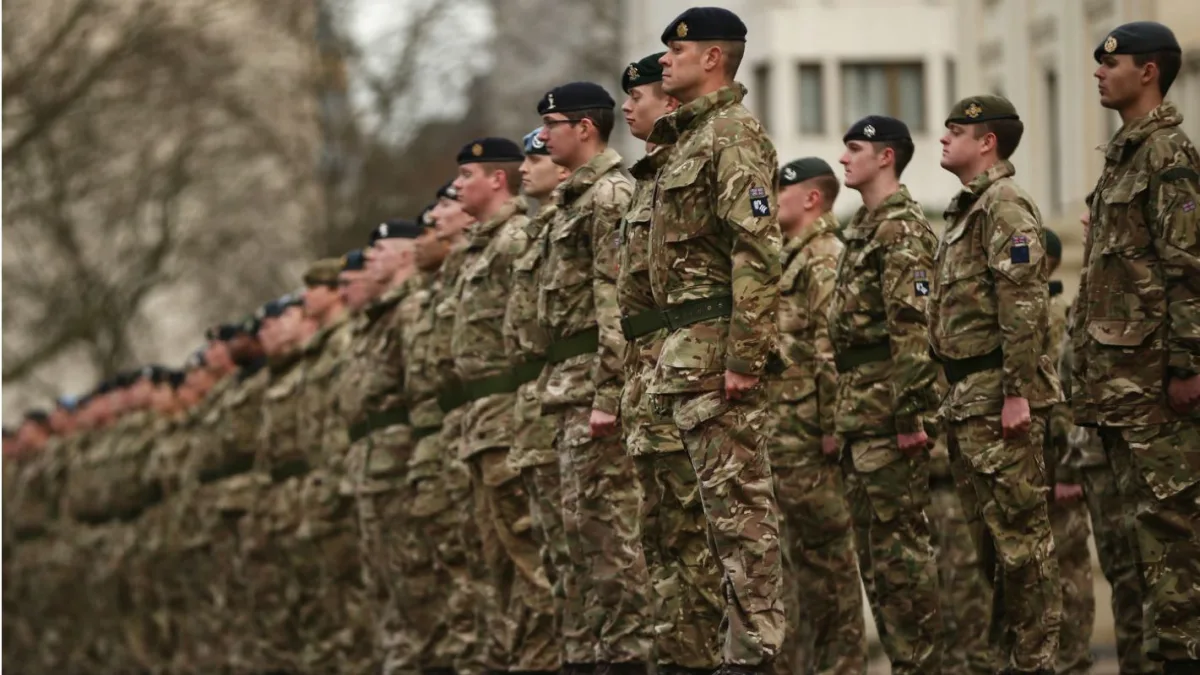

There is a phrase that, more than others, has crossed the Channel without losing strength: losing our children. In France as in the United Kingdom, the words spoken by their respective Chiefs of Staff have opened a deep crack in the European public discourse. Not because they announce an imminent war, but because they bring back to the center of the collective imagination something that for decades had remained on the margins: the idea that national defense might once again demand a direct human price from families.
French General Fabien Mandon and British Sir Richard Knighton speak from different contexts, but within the same strategic framework: the return of Russia as a power perceived not only as hostile but potentially existential for Europe. Both evoke the need to prepare, both use a language that goes beyond the technical boundaries of military doctrine and bursts into the emotional and civil sphere. And it is precisely here that the comparison becomes revealing.
France: the fracture between military command and civil society
In France, Mandon's intervention had the effect of a shock. The reference to the possibility of “losing one's children” was not presented as a direct call to arms, but as an invitation to awareness of what a high-intensity war would entail. The general spoke to mayors, that is, the level closest to citizens, breaking a tradition: that which wants communication on the war risk filtered almost exclusively by political power.

The reaction was immediate and cross-cutting. Radical left, communists, and far-right contested the very legitimacy of a military leader in raising the issue of human sacrifice. The government quickly intervened to reassure, clarifying that there was no talk of general mobilization nor of sending young French to die in Ukraine. But the symbolic damage was done: for the first time in years, war entered the lexicon of everyday life, not as a distant event, but as a possibility that touches the children.
France thus appears divided between two impulses. On one side, a state apparatus that invests more and more in defense and deterrence; on the other, a society that rejects the very idea of psychologically preparing for human losses, as if naming them were already a step towards the inevitable.
United Kingdom: the explicit mobilization of the whole society
In the British case, Sir Richard Knighton's words were even more direct. Not only did he state that families must be ready to send their children to war against Russia, but he explicitly called into question schools, parents, and industry. Here the message is not only psychological: it is organizational, cultural, almost pedagogical.
Knighton speaks of a conflict not probable but possible, and precisely for this reason he considers it necessary to prepare society as a whole. The key concept is that of national resilience: more soldiers, more reservists, more cadets, more workers in the war industry. Sacrifice is not evoked as a tragedy to be feared, but as a value to be rediscovered, part of an implicit pact between citizens and the State.
This stance is consistent with the British strategic tradition, historically more inclined to integrate civilians and military into the narrative of national security. Not surprisingly, Knighton's statements fit seamlessly into the political framework outlined by the Starmer government and the rhetoric of NATO, which explicitly calls for a “wartime mentality.”

Two styles, the same European unease
When compared, the two events show differences in style more than in substance. In France, the problem is who speaks and how; in the United Kingdom, what is asked of society. But in both cases, the same difficulty emerges: preparing public opinions for extreme scenarios without losing democratic consensus.
The reference to children is the point of maximum tension. It is a powerful lever because it touches the most intimate dimension of citizenship. Using it means admitting that war is no longer just a matter of budget, technology, or nuclear deterrence, but of bodies, interrupted biographies, involved families. And it is precisely this admission that many European societies do not seem ready to accept.
The unresolved knot: telling the truth without normalizing war
France and the United Kingdom face the same dilemma: how to tell the truth about strategic risks without slipping into a normalization of war? Remaining silent could deceive and psychologically disarm; speaking too openly risks frightening, dividing, or fueling accusations of militarism.
The words of Mandon and Knighton indicate that part of the European military apparatus believes the time of ambiguity is over. But they also show how fragile the pact between defense and society is. At stake is not only the preparation for a possible conflict but the ability of European democracies to face the idea of sacrifice without losing themselves.
In this sense, the real battleground is not (yet) military. It is cultural, political, and moral. And it is there that it is decided whether Europe will be able to defend itself without renouncing the promise, made to the generations raised after 1945, that war was now a closed chapter of history.

Italy as a mirror of the European fracture
This perception, however, does not translate into a propensity to fight. where the gap between risk perception and willingness to sacrifice appears almost abysmal. According to recent surveys, Italians estimate at 31 out of 100 the probability that the country will be involved in a conflict within the next five years: a value far from negligible, indicating a growing awareness of strategic vulnerability.
This perception, however, does not translate into a propensity to fight. Among citizens of potentially mobilizable age (18–45 years), only 16% declare themselves willing to take up arms. A much larger share is at the opposite end of the discourse of the French and British military leaders: 39% define themselves as pacifists and ready to protest, 19% would desert, while over a quarter would prefer to delegate defense to professional soldiers or even foreign mercenaries. It is a picture that tells of a country little inclined to the idea of direct sacrifice, despite the significant increase in defense spending over the last ten years.
The Italian data illuminates a crucial node of the European confrontation: the majority of citizens do not perceive themselves as a “people of warriors” and believe that without the help of allies the country would be overwhelmed. At the same time, distrust towards the historical American ally is growing and a paradox takes shape: the more the sense of insecurity increases, the less the consensus for traditional rearmament grows. Only a minority sees armed deterrence as the key to peace, and just one in ten Italians considers the hypothesis of acquiring a nuclear weapon acceptable.
On the level of alliances, Italy oscillates. NATO remains a reference for about half of the population, but the idea of an integrated European defense, supported by a relative majority, emerges strongly. And yet, above every strategic option, a transversal preference imposes itself: neutrality. Whether it is Ukraine, the Middle East, or even hypothetical conflicts involving the United States, the prevailing choice of Italians is to stay out, avoid clear alignments, minimize the human and political cost of war.
Placed alongside the words of Mandon and Knighton, the Italian case makes evident the depth of the European fracture. While some military leaders speak openly of children, sacrifice, and national mobilization, large portions of civil societies – especially in Southern Europe – react by taking refuge in the idea of delegation, alliance, or neutrality. It is this gap, more than external threats, that today represents the true vulnerability of the continent.



Comments
No comments yet. Be the first!