


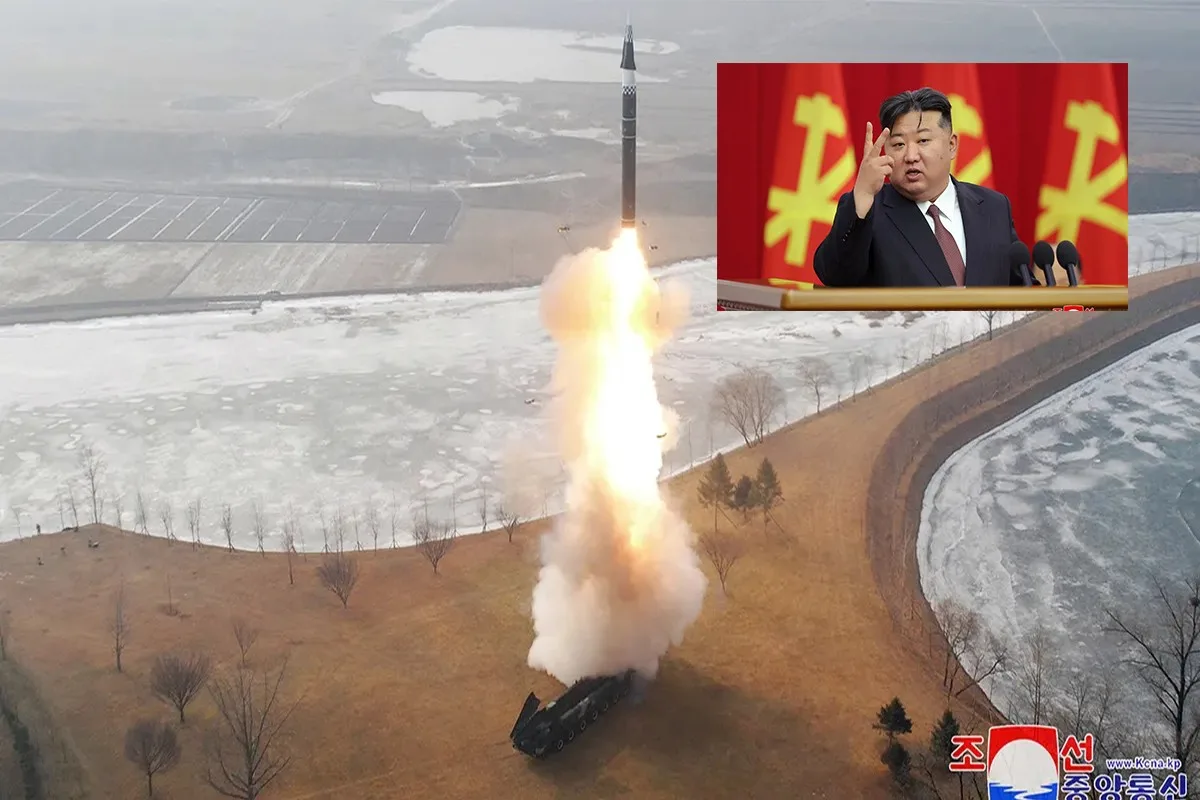

Kim Jong Un has included anti-satellite capabilities among the regime's strategic priorities for the first time. Behind this choice are more advanced military ambitions, the fear of new U.S. defensive shields, and the desire to preserve its nuclear deterrence.
An almost unnoticed but potentially decisive move. On the occasion of the ninth Congress of the Workers' Party of Korea, Kim Jong Un announced a new phase in strengthening national defense, setting goals that go well beyond traditional missile development.
“The Party's Central Military Commission has set key objectives to equip our army with new secret and special strategic weapons, carefully examined new defense plans, and approved long-term programs,” declared the North Korean leader.
The list of capabilities to be developed includes intercontinental ballistic missiles launchable from land and submarine, unmanned attack systems based on artificial intelligence, electronic warfare tools, but above all, two novelties that deserve particular attention: special weapons to strike enemy satellites in case of conflict and advanced reconnaissance satellites.
The message is clear. For the first time, at least on an official level, space weapons are elevated to a strategic priority. These are no longer vague formulas or propagandistic allusions, but a political directive suggesting a qualitative leap in Pyongyang's military ambitions.

Kim Focuses on Space
Among the points of the new five-year Defense plan, North Korea has included what it defines as “special resources to attack enemy satellites in times of emergency.”
The formula remains deliberately ambiguous. However, behind this expression could lie the project to develop a direct ascent anti-satellite (Asat) capability, meaning ground-launched missiles capable of reaching low orbit and striking or disrupting adversary satellites.
It would not be an entirely unrealistic prospect. China, India, and Russia have already developed such capabilities, while North Korea's ballistic missile program could offer a technical basis useful for attempting a similar path. The real limitation, if anything, is another: precision. Pyongyang has demonstrated the ability to put payloads into low Earth orbit, but hitting a satellite requires much more sophisticated guidance systems than those so far attributed to the regime.
In any case, the political signal counts almost as much as the immediate technical feasibility. Including anti-satellite among the priority objectives means recognizing that space dominance is now an integral part of military competition.

The Risk of Anti-Satellite Tests
A potential Asat test would not be comparable to the usual North Korean missile launches. The destruction of a satellite in low orbit would indeed generate persistent space debris, with potentially serious consequences for many other civilian and military infrastructures.
But there is also an even more alarming hypothesis. The reference to “special resources” could allude not only to kinetic missiles but also to a possible nuclear-type anti-space capability: for example, the detonation of a high-altitude warhead capable of producing electromagnetic pulse and radiation sufficient to disable numerous satellites over a wide area.
It is not science fiction. For a state already equipped with nuclear weapons and ballistic missiles, it would indeed be one of the theoretically simplest options to pursue. And Pyongyang, from its point of view, would also have little to lose: its presence in Space remains extremely limited, with modest satellite capabilities compared to those of the great powers.
A Response to the American Golden Dome?
The North Korean choice should also be read in relation to new U.S. missile defense projects, starting with the so-called Golden Dome: a multi-layered architecture aimed at integrating space sensors, alert networks, and future interceptors to detect and neutralize ballistic missiles in the early or intermediate phases of flight.
For Pyongyang, such a system represents a direct threat. If Washington were to significantly strengthen its interception capability, North Korea would see the credibility of its nuclear deterrent weakened, founded precisely on the ability to strike U.S. territory.
That's why striking or neutralizing the satellites of the American shield may appear, in the regime's logic, a rational response: not so much to achieve superiority in Space, but to prevent the United States from rendering its retaliatory capability ineffective.

The New Frontier of North Korean Deterrence
Kim Jong Un's move thus indicates an important evolution. North Korea no longer limits itself to strengthening its terrestrial and nuclear arsenal but looks to Space as a new field of strategic competition.
The ultimate goal remains the same: to ensure the regime's survival through credible deterrence. Only today, to do so, Pyongyang seems convinced it must threaten not only enemy cities and military bases but also the orbital infrastructures on which communications, surveillance, and missile defense depend.
In this sense, the leap announced at the Party Congress is not only technological. It is above all political and doctrinal. And it suggests that, in the coming years, competition with North Korea could increasingly extend beyond Earth's atmosphere.





Comments
No comments yet. Be the first!