


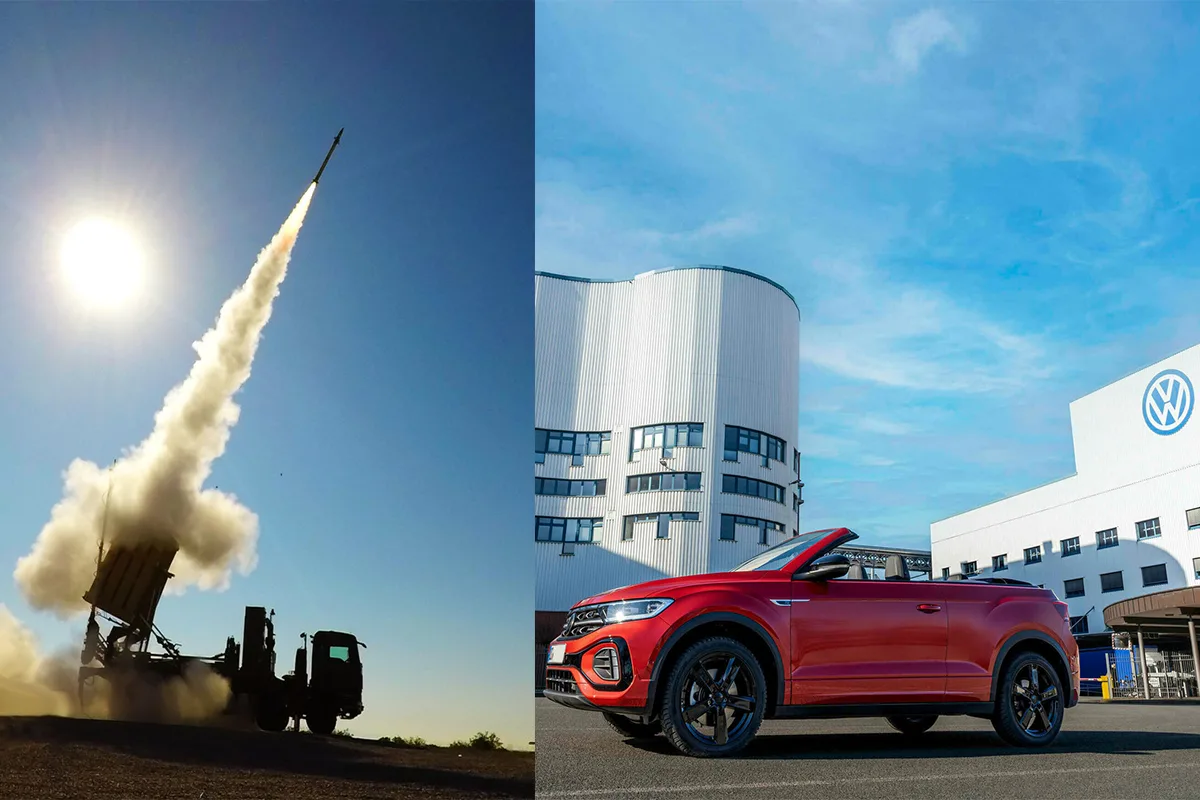

The news is concrete, even though the agreement is not yet finalized: Volkswagen is in talks with the Israeli company Rafael Advanced Defense Systems to convert the Osnabrück site in Lower Saxony from car production to the manufacturing of components for the Iron Dome missile defense system. According to information reported by Reuters, citing the Financial Times, Volkswagen has clarified that it excludes direct production of weapons, but is exploring industrial alternatives for the site, where about 2,300 people work and where production of the T-Roc Cabriolet is set to end in 2027.
To understand the significance of the matter, it is important to remember that Iron Dome is one of the most well-known defense systems in the world: Rafael describes it as a multi-mission platform for protection against short-range threats, already operationally deployed for years. For this reason, Volkswagen's potential entry into its supply chain would not be a simple tactical operation but a sign of a broader European industrial transformation.
The central issue is the future of Osnabrück. After the labor agreement at the end of 2024, Volkswagen committed to finding a reuse for the site instead of letting it shut down without alternatives. In this sense, the Rafael path appears as a possible industrial outlet capable of safeguarding jobs and manufacturing skills at a time of significant pressure on the group.

Not an Isolated Case: German Auto Seeks Defense Outlets
The possible agreement with Rafael does not arise in a vacuum. In recent months, Volkswagen has explored multiple avenues in the defense sector. In March 2025, the CEO of Rheinmetall described the Osnabrück site as “very suitable” for military production, and in March 2026, Volkswagen also showcased prototypes of vehicles developed at the plant at an industry fair to test market interest. However, talks with Rheinmetall did not lead to an operational solution.
In parallel, Rheinmetall is now a key player in European rearmament and is linked to the Italian Leonardo in a joint venture, Leonardo Rheinmetall Military Vehicles, created to develop and produce new land military vehicles. This confirms that a more integrated defense industrial supply chain is consolidating in Europe, within which even historical pieces of the automotive industry can find new functions.
Thus, the real news is not just that a car factory might produce for Iron Dome. The news is that Germany is seriously considering converting part of its industrial power towards productions considered strategic. We are no longer facing a theoretical hypothesis: we are in a phase where the German manufacturing industry is seeking new markets, and defense is now one of the most evident.

The Real Causes: Auto Crisis, Chinese Competition, and European Rearmament
The push towards these conversions primarily stems from the crisis in part of the European and German automotive industry. Volkswagen has initiated a tough restructuring in Germany, with over 35,000 future job cuts announced at the end of 2024 and the decision to cease production in Osnabrück in 2027 if a new industrial project does not emerge.
Also weighing in is the Chinese competition, which cannot be dismissed as merely a political slogan: the European Union imposed compensatory tariffs on Chinese electric cars from October 2024 after concluding that their supply chain benefited from distorting public subsidies. Meanwhile, the presence of Chinese manufacturers in Europe continues to grow, while German manufacturers are losing ground in China, which had been one of their crucial markets.
However, an important correction must be added: it is not entirely accurate to speak today of a generalized collapse of electric cars in Europe. ACEA data shows that in 2025, battery electric cars reached 17.4% of the EU market, up from 13.6% in 2024, and in the first two months of 2026, they rose to 18.8%. The problem, therefore, is not just weak demand: it is mainly the difficulty of European groups to defend margins, market shares, and competitiveness within a much tougher transition than expected.
Finally, there is the geopolitical dimension. With the Bundestag vote on March 18, 2025, Germany approved a historic shift in public spending, easing the debt brake for defense and opening up to a massive increase in strategic investments. It reflects two converging fears: on one hand, the threat made evident by the Russian invasion of Ukraine, and on the other, the idea that Europe can no longer take American protection for granted. In this context, the operational successes of missile defense systems in the Middle East make investing in air defense more urgent; but, based on available sources, the Volkswagen-Rafael negotiation appears primarily as the product of an ongoing German industrial conversion, rather than a direct effect of the war with Iran.



Comments
No comments yet. Be the first!