


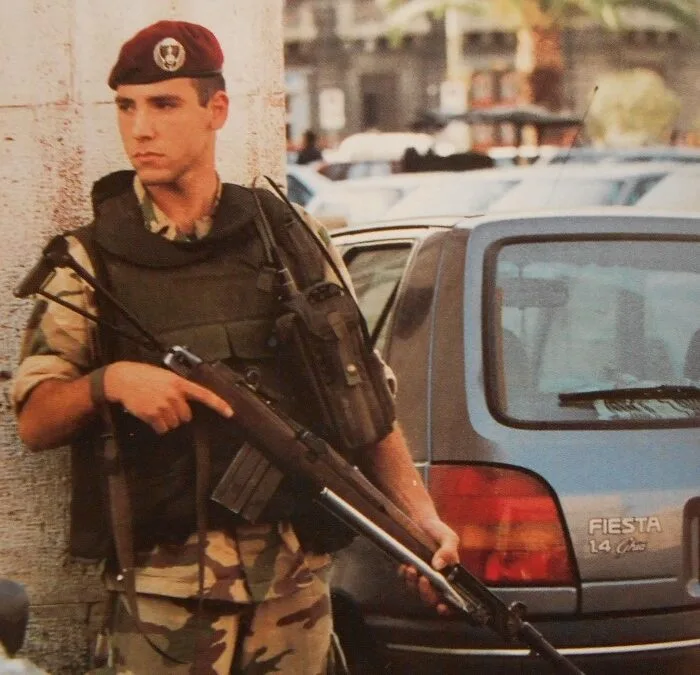
In 1992, three glorious units of the Folgore Parachute Brigade, the 185th Artillery, 186th and 187th, were reconstituted.
Thus, 1992 was an important year, a year during which the operation “Vespri Siciliani” began, marking the arrival in Sicily of the Italian Paratroopers with the aim of contributing to the safeguarding of the State, after the attacks on judges Falcone and Borsellino.
The context
The presence of the army in Sicily was made necessary to support the regular police forces after the tragic series of events that bloodied the island in 1992, such as the mafia attack that caused the death of Judge Giovanni Falcone, killed along with his escort in the attack on May 23 known as the Capaci massacre. About two months later, it was followed by another bomb attack, which caused the death of Judge Paolo Borsellino and his escort on July 19, known as the via d'Amelio massacre.

A partial attempt to employ military personnel for public order tasks was implemented a few days earlier, for a short period in Sardinia with the operation called "Forza Paris" (July 1992), on the occasion of the kidnapping of Farouk Kassam, but it was more of a training in patrols and sweeps in rugged environments, possible hideouts for outlaws.
The Vespri Siciliani operation was the first large-scale intervention, for public order reasons, carried out by the Italian Armed Forces in the post-war period, and it was also the most numerically significant.
It was the first large-scale intervention, for public order reasons, carried out by the Italian Armed Forces in the post-war period, and it was also the most numerically significant.
The deployment of the Italian Army was decided on July 24, 1992, by the Council of Ministers chaired by Giuliano Amato, with the Decree-Law "Urgent Measures to Combat Organized Crime in Sicily" No. 349 of July 25, 1992, which authorized the use of military personnel for security and territorial control operations and the prevention of organized crime offenses, and conferred on military personnel some functions typical of public security officers and agents.
The government, after heated parliamentary debates, received the green light from Parliament, and the Chief of Staff of the Army, General Goffredo Canino, agreed with the Chief of Police, Prefect Vincenzo Parisi, on the operational methods of intervention, including the control of fixed positions.
The coordination was entrusted to the individual Provincial Committees for Order and Security, led by the prefects, with the participation of an Army officer.
The military operation

Sunday, July 26, 1992, late morning.
While all of Italy goes to the beach, four military planes of the 46th Air Brigade, two C-130s and two G-222s, await on the scorching runways of Pisa airport the Paratroopers of the Folgore.
From Siena and Livorno, they arrive in military vehicles, mingling with the cars and campers of vacationers heading to Castiglioncello and Tirrenia, the maroon berets.
The airport is bustling with journalists. From the Paratroopers, as tradition dictates, sealed lips.
Departure around three in the afternoon. Landing at Punta Raisi an hour later.
They head to Palermo, but it's not a trip or a prize journey; it's a military operation, with military Paratroopers equipped and armed for war, on Italian soil.
For the Folgore, an extraordinary opportunity to demonstrate its greatness even on national territory.
From July 26, 1992, cordons, night ambushes, mobile checkpoints, surveillance of prominent personalities, constant cooperation with law enforcement are guaranteed by the sacrifice of Officers, Non-Commissioned Officers, and Paratroopers who, subjecting themselves to heavy and continuous shifts, demonstrate an uncommon sense of duty.
In summary, the fight against organized crime aimed to:
- limit the freedom of action of illicit activities
- ensure a safe and visible presence of State forces on the territory
- sweep extra-urban areas
- cordon urban areas to allow special interventions by the Police Forces
- carry out roadblocks/checkpoints
- ensure the safety of people and structures of the state apparatus, potential targets of criminal threats
- allow the Police Forces to fulfill more specialized prevention and repression tasks

On August 14, over 8,000 military personnel were operating in Sicily, deployed in various cities.
In Palermo, the most difficult task, and in the capital of Sicily, the General Staff employs the most reliable soldiers: 1,000 Paratroopers of the Folgore Brigade and 500 lancers of the 6th Aosta Lancers Squadron Group in Palermo.
The operation severely impacted the operational capacity of Cosa Nostra and contributed to the arrest of numerous bosses.
The Vespri Siciliani Operation is an absolute success, the military carried out or participated in:
- 1,647 sweeps
- 21,512 patrol activities
- 39,014 roadblocks
- 62,847 building checks
- 665,407 vehicle checks
- 813,439 people identified
- 786 target cordoning activities
- 1,225 people handed over to the Public Security Authorities
- 168 weapons and 3,113 kg of explosives seized
By December 1992, the Paratrooper regiments were still in Sicily, but the Horn of Africa calls: they are relieved to allow their deployment to Somalia, a land ravaged by civil war and famine. What will be the historic IBIS operation is on the horizon.
Comments
No comments yet. Be the first!