



The decision of the US Navy Secretary John Phelan to cancel four of the six Constellation-class frigates is not just an American issue: it directly affects Fincantieri, the Italian naval industry, and the “family” of FREMM from which the project originates. The Constellation indeed arises as an evolution of the Italian-French FREMM, particularly the Italian variant Bergamini class, chosen as the “parent design” in the FFG(X) program. The idea was to leverage a frigate already tested by the Italian Navy, adapting it to US standards to reduce time, risks, and costs. In reality, Washington's continuous modification requests – more systems, more growth margins, larger volumes – have turned what was supposed to be an adaptation into an almost new project: larger, heavier, more complex. The result was an escalation of costs and delays, leading to Phelan's “strategic shift”: confirming only the first two units and scrapping the subsequent four, while reaffirming the intention to redirect cooperation with Fincantieri to other types of ships.

Fincantieri between Italy, Wisconsin and the FREMM model
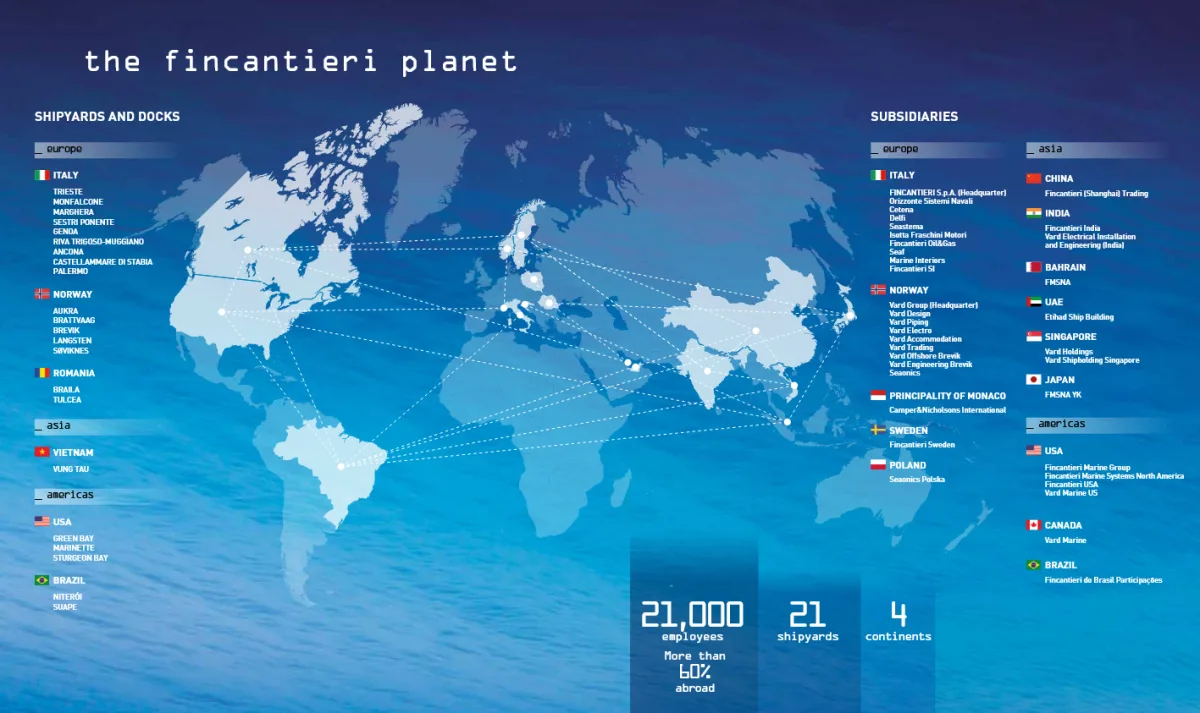
For Fincantieri, which through Marinette Marine has invested heavily in the Wisconsin shipyards and built its offer precisely on the success of FREMM, the downsizing of the program is a political and industrial blow, but not a farewell. Investments in the United States remain strategic, and the US Navy continues to consider the Italian group a pillar of its industrial base, especially for amphibious units, icebreakers, and special platforms. In parallel, the Italian FREMMs – thanks to their multi-mission flexibility and a successful balance between sensors, armament, and management costs – continue to be a case study: they are operational in the Mediterranean, integrated into NATO, and sold for export to countries like Egypt and Indonesia. The comparison between the FREMM program, managed in Italy with a relatively compact supply chain and controlled timelines, and the complex “Americanization” of the Constellation highlights a lesson for Washington: starting from a good design is not enough if the political-bureaucratic machine distorts the project to the point of making it unmanageable.

Innovation, Navier, and strategic choices for Italy
At the heart of this story is the great challenge of maritime supremacy in a world where China churns out ships at industrial rates and where the technological quality of hulls is increasingly important. Phelan's “strategic shift,” with fewer traditional frigates and more focus on truly combat-ready capabilities, intertwines with the growth of innovative players like the startup Navier, which works on hybrid-electric hydrofoils and dual-use platforms for patrol, surveillance, and advanced logistics. Here Italy has a direct interest: to systematize Fincantieri's experience, the FREMM and PPA legacy, and an ecosystem of emerging naval technologies, to position itself as an essential partner in future allied programs. The lesson from the Constellation case is clear: no foreign program is guaranteed forever, and the true strength of a maritime nation lies in its ability to design, build, and update reference platforms at home, while simultaneously making itself indispensable in international supply chains and allies' choices.






Comments
No comments yet. Be the first!