


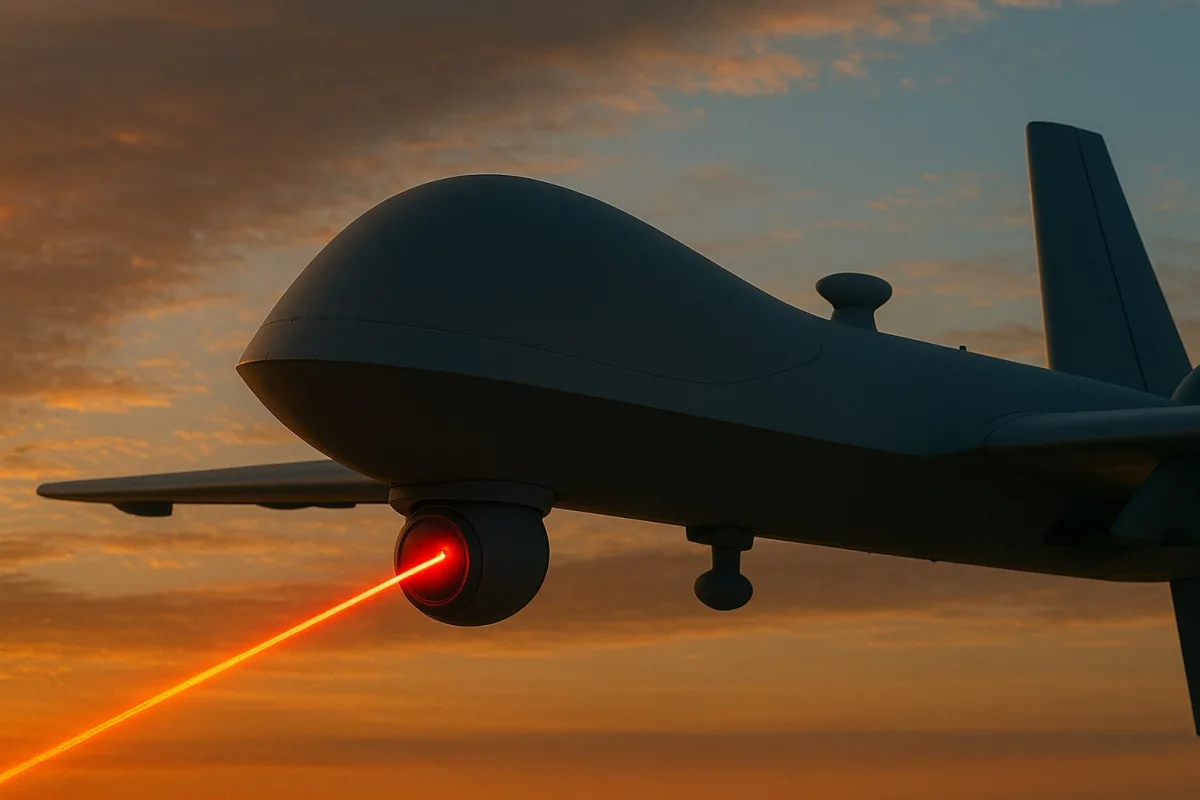

December 10, 2025 – The United States Department of Defense is working to introduce a new generation of large and versatile drones equipped with directed energy weapons, particularly high-energy lasers capable of effectively countering hostile drone swarms and other aerial threats, into its fleet of unmanned aircraft.
Why lasers on drones are a breakthrough
In recent years, modern conflicts — from Ukraine to the Middle East — have shown how low-cost drones can pose a serious strategic threat when deployed in large numbers. High-energy lasers offer significant advantages in these areas:
- Drastically reduced engagement cost: unlike traditional missiles, a laser “burns” a target using energy; the cost of a single shot is a fraction of that of a missile.
- “Infinite ammunition” storage: as long as the system has energy available, it can continue to engage targets without the need for physical resupply of bullets or rockets.
- Precision and versatility: a laser beam can disable sensors, optics, or critical components without destroying the entire drone structure, rendering the threat useless.
The USA program: Class 4 and 5 drones with lasers
According to Breaking Defense, the US military wants to arm the next class 4 and 5 drones — those aircraft weighing over 600 kg — with interchangeable payloads including high-power laser systems. These will not be on all drones but selected for specific missions, such as critical area defense or anti-swarm operations.
Among the candidates for the program is General Atomics, already a producer of platforms like the Gray Eagle, which is exploring versions with integrated laser systems, in addition to models like Mojave STOL with space for new technologies.

Other laser technologies and related systems in the USA
The United States is not new to defense with directed energy. Some recent examples include:
- HELIOS (High Energy Laser with Integrated Optical-dazzler and Surveillance): a 60 kW laser system installed on US Navy ships, designed to intercept drones, small boats, and other aerial targets.
- DE M-SHORAD: a Stryker-based vehicle with a laser of about 50 kW for short-range air defense, also tested in real operational areas like Iraq.
- Boeing CLWS (Compact Laser Weapon System): a modular anti-drone laser developed to protect bases, vehicles, and fixed areas.
- BlueHalo LOCUST and other lasers mounted on mobile platforms, capable of taking down groups of small UAVs with directed energy.
The global context of the laser war
Interest in directed energy weapons is not confined to the United States. Other countries and armed forces are developing or testing similar systems:
- United Kingdom is introducing laser systems like DragonFire on ships for anti-drone and anti-missile defense.
- Israel and Russia have already employed laser technologies in combat according to international press sources.
- Alternative systems, such as high-power microwave weapons (e.g., Leonidas), are being tested to neutralize swarms with a single electromagnetic pulse.

Technological limits and future prospects
Despite the progress, laser weapons still face technical challenges:
- High energy consumption: high-power lasers require large amounts of energy, often difficult to generate on small platforms.
- Atmospheric conditions: fog, rain, and dust can scatter and weaken the laser beam.
- Multiple targets: a classic laser can engage one target at a time; for very dense swarms, advanced or combined systems are needed.
However, the integration of AI and advanced sensor technology — as tested by US Navy teams — aims to make these systems increasingly autonomous and effective in rapid assessments and engagements.
The introduction of high-energy lasers on US drones represents a paradigm shift in defense against aerial threats, especially swarms of low-cost UAVs that are difficult to counter with conventional methods. With the evolution of energy, sensor, and AI technologies, these weapons could become a standard component of future defenses, taking down enemies “at almost zero cost” in terms of ammunition and reaction time.





Comments
No comments yet. Be the first!